This article is for educational and informational purposes only. Consult a medical professional before making health decisions.
Sleep Hygiene: Evidence‑Based Habits for Better Rest
Most people approach sleep like a broken appliance. Something must be wrong. Something must need fixing. But sleep is not a machine. It’s a biological rhythm that quietly responds to signals we send all day long. And modern life is very good at sending the wrong signals.
Sleep hygiene is the collection of habits and environmental conditions that support healthy, restorative rest. (NIH Sleep Research)
Poor sleep hygiene is linked to higher risks of cardiovascular disease, depression, and cognitive decline. (Johns Hopkins Medicine)
Light exposure, temperature, routine, and evening stimulation are the four pillars of effective sleep hygiene. (Sleep Foundation)
Consistent sleep hygiene improves sleep quality more than any supplement or gadget.
Even small changes in sleep hygiene — like dimming lights 90 minutes before bed — produce measurable benefits within two weeks. (University of Pennsylvania Sleep Medicine)
What Is Sleep Hygiene?
Sleep hygiene refers to the collection of habits and environmental conditions that support healthy sleep cycles. These include light exposure, temperature, consistent routines, and evening stimulation levels. Research institutions like the National Institutes of Health sleep research division and sleep medicine programs at major universities consistently emphasize these behavioral signals when addressing sleep quality.
Sleep hygiene is not about fixing a broken machine. It’s about sending the right signals.
What is sleep hygiene in simple terms?
Sleep hygiene is the set of daily habits and bedroom conditions that tell your brain it’s time to rest. It includes things like keeping a consistent bedtime, dimming lights before sleep, and keeping your bedroom cool and dark.
The term “sleep hygiene” was first introduced in the 1970s by sleep medicine pioneer Dr. Peter Hauri. Decades of research from institutions like Johns Hopkins Medicine and the Sleep Foundation have confirmed that good sleep hygiene is one of the most effective non‑pharmaceutical interventions for poor sleep.
Why Sleep Hygiene Matters for Your Health
The consequences of poor sleep hygiene extend far beyond morning grogginess. Chronic insufficient sleep is associated with increased risk of hypertension, diabetes, obesity, depression, heart attack, and stroke. The Centers for Disease Control and Prevention has declared insufficient sleep a public health epidemic, with more than one‑third of American adults reporting fewer than seven hours of sleep per night.
Good sleep hygiene can reduce these risks. A study from University of Pennsylvania Sleep Medicine found that participants who improved their sleep hygiene saw measurable reductions in daytime fatigue and improvements in cognitive performance within two weeks.
Core Principles of Sleep Hygiene

Effective sleep hygiene rests on four pillars. First, light management. Your brain’s sleep‑wake cycle relies on light cues. Exposure to bright light — especially blue light from screens — suppresses melatonin production. The National Library of Medicine has documented that evening screen use delays circadian rhythms by an average of 30 minutes.
Second, temperature control. Your body temperature naturally drops as you prepare for sleep. A bedroom temperature between 60 and 67 degrees Fahrenheit supports this process. American Academy of Sleep Medicine guidelines specifically recommend cooler temperatures for optimal sleep quality.
Third, consistent timing. Going to bed and waking up at the same time — even on weekends — is perhaps the most powerful sleep hygiene habit. The National Heart, Lung, and Blood Institute notes that irregular sleep schedules are strongly associated with poor sleep quality.
Fourth, evening stimulation reduction. High‑intensity exercise, heavy meals, caffeine, and alcohol close to bedtime all disrupt sleep architecture. Harvard T.H. Chan School of Public Health recommends finishing meals at least three hours before bed and avoiding caffeine after 2 p.m.
Light, Screens, and Sleep Hygiene
Modern life floods our evenings with light — specifically blue‑wavelength light from phones, tablets, computers, and LED bulbs. This light tricks your brain into believing it’s still daytime. The result: delayed melatonin release, later bedtimes, and shallower sleep. Good sleep hygiene means dimming lights and using blue‑blocking modes on devices at least 90 minutes before bed. UCLA Health Sleep Center emphasizes that this single change often produces the most immediate improvement in sleep quality.
Routine: The Backbone of Sleep Hygiene
A consistent bedtime routine is the most powerful sleep hygiene tool you have.
Why is routine so important for sleep hygiene?
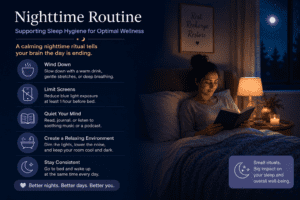
Your brain learns patterns. When you repeat the same wind‑down activities — brushing teeth, dimming lights, reading a book — your brain begins associating those actions with sleep. Over time, the routine alone triggers sleep readiness.
Your brain is a pattern‑recognition machine. When you perform the same sequence of behaviors before bed each night — brushing your teeth, dimming the lights, reading a physical book — your brain learns to associate those cues with sleep. This is classical conditioning applied to sleep hygiene. The Harvard Medical School Division of Sleep Medicine recommends a wind‑down period of 30 to 60 minutes that excludes screens, work, and emotionally charged conversations.
Final Thoughts on Sleep Hygiene
Sleep is not a problem to be solved. It is a biological rhythm to be supported. Sleep hygiene is not about rules or perfection. It is about signals. The right signals at the right times. A dark room. A cool temperature. A consistent bedtime. An evening without blue light and caffeine. These are not complicated. They are not expensive. But they require something harder than money: they require consistency.
The body does not negotiate. It responds to what you show it. If you show it chaos, it will sleep chaotically. If you show it predictable, gentle cues — the same routine, the same environment, the same timing — it will eventually trust that safety and reward you with rest. Sleep hygiene is not a luxury. It is the quiet architecture of a functioning human being. And in a world that never stops, that may be the most radical habit of all.
Frequently Asked Questions About Sleep Hygiene
Sleep hygiene is the set of daily habits and bedroom conditions that promote healthy, restorative sleep. It matters because poor sleep hygiene is directly linked to insomnia, daytime fatigue, weakened immune function, and increased risk of chronic diseases like hypertension and depression. The CDC identifies sleep hygiene as a key modifiable factor in improving public sleep health.
Common signs of poor sleep hygiene include taking more than 30 minutes to fall asleep, waking up multiple times during the night, feeling unrefreshed in the morning, relying on caffeine to function, and experiencing irregular sleep schedules (especially sleeping much later on weekends). The Sleep Foundation offers a self‑assessment checklist for sleep hygiene habits.
Research from Johns Hopkins Medicine identifies five most effective sleep hygiene habits: (1) consistent wake‑up time even on weekends, (2) avoiding caffeine after 2 p.m., (3) dimming lights 90 minutes before bed, (4) keeping your bedroom cool (60–67°F) and dark, and (5) using your bed only for sleep and intimacy — never for work or scrolling.
Most people notice improvements in sleep quality within one to two weeks of consistent sleep hygiene practice. However, if you have chronic insomnia, it may take four to six weeks to see significant changes. The University of Pennsylvania Sleep Medicine program notes that consistency is more important than intensity — small daily habits matter more than dramatic one‑night changes.
Yes. Multiple studies from NIH‑funded research confirm that evening screen use delays melatonin production by an average of 30 minutes and reduces REM sleep. Blue light is the primary culprit. Good sleep hygiene means putting away phones, tablets, and computers at least 60 minutes before bed — or using night mode settings after sunset.
Not necessarily. Short naps (20–30 minutes) in the early afternoon are generally fine and may even improve alertness. However, long naps or late‑afternoon naps can interfere with your ability to fall asleep at night. The American Academy of Sleep Medicine advises that if you struggle with nighttime sleep, you should avoid napping altogether to preserve your natural sleep drive.
Research from NHLBI and Harvard Sleep Medicine recommends a bedroom temperature between 60 and 67 degrees Fahrenheit (15–19°C). Your body temperature naturally drops as you prepare for sleep, and a cooler room accelerates this process. Good sleep hygiene includes using breathable bedding and keeping your thermostat lower at night.
For mild sleep difficulties, consistent sleep hygiene is often sufficient. However, chronic insomnia — lasting more than three months — may require cognitive behavioral therapy for insomnia (CBT‑I) or medical evaluation. The NIH notes that while sleep hygiene is a foundational component of insomnia treatment, it is rarely sufficient alone for clinical insomnia. Always consult a medical professional for persistent sleep problems.