This article is for educational and informational purposes only. Not a substitute for professional medical advice. Consult qualified healthcare providers for personal health evaluations.
Wellness Assessments: What They Actually Measure, What They Miss, and Why They Matter
Why “not currently dying” is not a strategy, and how structured health evaluations surface the blind spots your ego has been carefully protecting.
Wellness assessments are structured health evaluations measuring physical fitness, nutrition, mental health, and lifestyle patterns, not just whether you’re still breathing.
Fitness evaluations within wellness assessments measure what your body can actually do right now, not what it could do in college or what your gym membership implies.
Nutritional assessments reveal deficiencies your calorie-tracking app can’t see, including the ones you’ve normalized as “just being an adult.”
Mental health screenings are the most underfunded component of wellness assessments, yet early detection of burnout and anxiety saves careers and lives.
Organizations with systematic wellness assessments see 20-30% decreases in absenteeism, but only when they act on the data, not just collect it.
Self-reported data has limitations. Pair it with biometrics, interpret with humility, and never treat a single score from wellness assessments as gospel.
What Wellness Assessments Actually Are
Let’s get something straight: “not currently dying” is not a wellness strategy. It’s barely a status update. Yet that’s the bar most of us set for our health, somewhere between “functioning” and “hasn’t collapsed in a public place recently.”
And look, I include myself in that “us.” I’ve been in the wellness field for three decades and I still catch myself treating “not in pain right now” as a win. Which is… not great. Probably says something about the industry I work in, honestly.
Wellness assessments are structured evaluation tools that measure everything from your cardiovascular fitness and nutritional status to your mental resilience and whether you have meaningful human connections or just a group chat that sends memes. Think of them as a full-body audit conducted by someone who isn’t your mother but shares her gift for identifying exactly what you’re doing wrong.
The simplest definition.
What do wellness assessments actually measure?
Wellness assessments measure the gap between where you are and where you could be, across physical fitness, nutrition, mental health, social connection, and lifestyle patterns. They create a baseline, track your trajectory, and replace vague guilt with actual data.
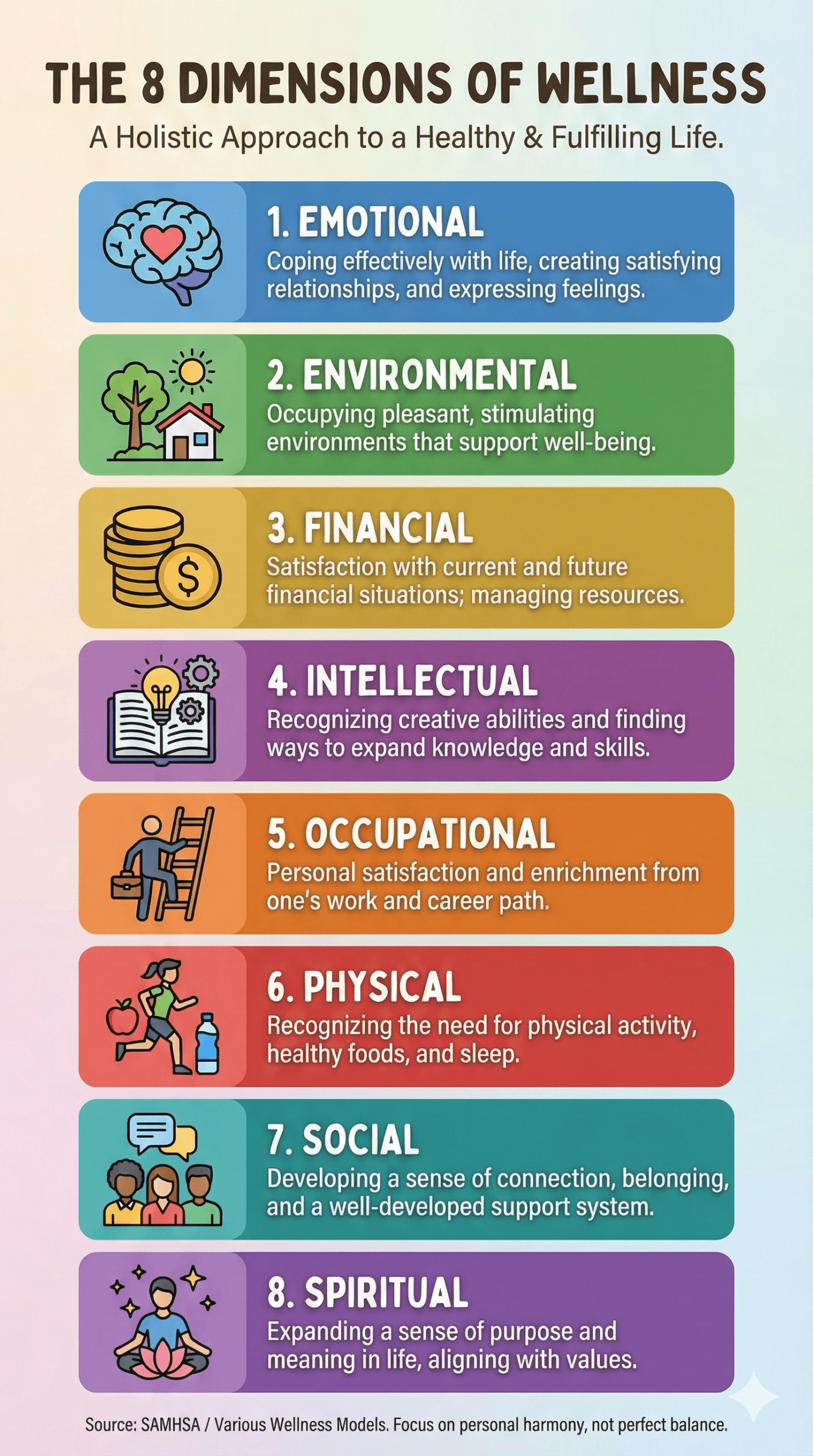
The framework that actually makes sense here is the 8 Dimensions of Wellness: physical, emotional, intellectual, social, spiritual, environmental, occupational, and financial. It’s a legitimate, research-backed framework used by the Substance Abuse and Mental Health Services Administration (SAMHSA) and university health systems across the country. The premise is almost offensively obvious: you are not just a body that needs fuel and repairs.
On a personal level, these health evaluations drag your blind spots into fluorescent lighting. That stress level you’ve decided is “just how adulting feels”? The sleep debt you’ve been accumulating like it’s a loyalty program? A good assessment will find it, quantify it, and present it to you in a format that makes denial significantly harder.
I should be honest here though. I’ve taken my own wellness assessments and been… surprised. Not pleasantly. There’s a specific kind of humility that comes from spending your career telling people to prioritize sleep and then discovering your own sleep quality scores like a C-minus. So when I say these things surface what you’ve been ignoring, I’m speaking from the uncomfortable side of that experience.
For organizations, the value proposition shifts but the fundamental logic holds. Companies running systematic wellness assessments tend to see higher program participation because, and this will shock absolutely no one who’s ever received a corporate wellness email, people engage more when you address their specific needs instead of mass-distributing a PDF titled “10 Tips for Hydration” as though dehydration is the workforce’s defining crisis.
The CDC’s research on workplace health promotion is genuinely encouraging, though it comes with a caveat: program design matters enormously. A poorly built wellness program doesn’t reduce healthcare costs. It just gives everyone a pedometer and a newsletter they immediately delete. I’ve seen that happen. More times than I’d like to admit.
Fitness Evaluations in Wellness Assessments
Fitness evaluations are the cornerstone of physical wellness assessments, and they work by systematically measuring what your body can actually do right now. Not what it could do in college. Not what you told your doctor at your last checkup. And definitely not what your optimistic gym membership implies.
These assessments examine cardiovascular fitness through VO2 max measurements or step tests (the National Heart, Lung, and Blood Institute (NHLBI) has solid resources on heart-healthy living), muscular strength via exercises like push-ups and grip strength tests, and flexibility using the sit-and-reach test that has been humbling desk workers since the invention of the desk.
Each component tells a different story about your physical wellness. Together, they assemble a narrative that’s usually less “inspiring comeback story” and more “well, at least now we know.”
I’m going to be vulnerable for a second here. My own grip strength test a few years ago was… look, I’d rather not give you the number. Let’s just say that for someone who writes about fitness for a living, it was a reality check. The kind where you quietly put down the article you were writing about “maintaining functional strength” and go buy some hand grippers. Do as I say, not as my test results suggest, I guess.
Personalization is the real value.
Why do generic workout routines fail where wellness assessments succeed?
Generic routines are the wellness equivalent of a hospital gown. Technically they cover the essentials, but the fit is terrible, the dignity is questionable, and nobody chose this. Fitness evaluations within wellness assessments let trainers design programs that target your specific weaknesses while building on existing strengths.
Modern fitness assessments have gotten impressively sophisticated. Wearable devices, bioimpedance scales, and digital movement analysis systems provide precise measurements and real-time tracking. Harvard’s T.H. Chan School has excellent research on staying active that grounds this in evidence rather than marketing hype. The HHS Physical Activity Guidelines recommend at least 150 minutes a week of moderate aerobic activity, but that’s a starting point, not a prescription.
Though I should mention, and this is something the tech companies selling these tools won’t tell you, wearable accuracy varies wildly. I’ve worn three trackers simultaneously and gotten three different step counts. So. Take the precision promises with a grain of salt.
Nutritional Assessments: The Truth Your Calorie App Won’t Tell You
Nutritional assessments do something your calorie-tracking app fundamentally cannot: they tell the truth. These evaluations integrate multiple data sources, including eating patterns, nutrient intake, and metabolic indicators, to reveal what’s actually happening inside your body. This includes the deficiencies you didn’t know you had because you assumed feeling exhausted all the time was just “being an adult in the modern economy.”
And I’m… listen, I’m going to share something here that undermines my credibility a little but I think matters more for being honest. I recommended nutritional assessments for years before actually getting a thorough one myself. When I finally did? My vitamin D levels were in the basement. Me. The wellness guy. Walking around telling people to get their blood work done while my own body was basically operating in a nutritional deficit. The shoemaker’s children, and all that.

The methodology layers several proven tools, each with good backing from places like the USDA Food and Nutrition Information Center. Dietary recalls capture detailed food consumption over 24-72 hours, which is where most people discover that their diet is significantly more chaotic than they’d prefer to admit out loud. Then come the biometric indicators: blood lipid profiles, vitamin D levels, inflammatory markers. These provide objective data that your food diary absolutely cannot argue with, no matter how creatively you categorized that 11 PM cheese plate as a “protein snack.”
What’s exciting about nutritional science right now, and I say this knowing that nutritional science has also gotten a lot of things wrong over the years, is the growing research on food and brain health. Harvard Health’s work on foods linked to better brainpower and the MIND diet research from Rush University are genuinely compelling. Not magic. Not cure-alls. But compelling enough to pay attention to.
Mental Health Screenings Within Wellness Assessments
Mental health screenings are arguably the most important component of comprehensive wellness assessments, which is why they’re also the component most likely to be crammed into the corner of the budget like a houseplant everyone forgot to water.
These screenings use validated assessment tools, including the PHQ-9 for depression, the GAD-7 for anxiety, and various stress inventories (the National Institute of Mental Health (NIMH) has a solid overview of mental health resources), to evaluate psychological well-being and catch problems while they’re still problems and not full-blown crises.
I want to talk about this more carefully than I usually do. The truth is, mental health is the area where the gap between what the wellness industry says and what it actually does is widest. We’ll put “mental health matters” on a poster and then under-resource the actual screening and follow-up programs that make that statement mean something.
Early detection is everything here. When organizations include mental health components in their wellness assessments, they create opportunities to identify burnout, anxiety, and depressive symptoms during the stages when interventions actually work. This is before someone’s sending increasingly unhinged emails at 2 AM and their coworkers are having whispered conversations in the break room. This means timely referrals to employee assistance programs and workplace resources, counseling services, or appropriate providers.
The Harvard Study of Adult Development has decades of data showing that social connection and emotional well-being aren’t soft extras. They’re primary predictors of health outcomes and longevity. Research from the American Psychological Association (APA) on healthy workplaces confirms what most of us already know intuitively: psychological stress is a physical health problem.
And I’ve gotten this wrong before. Early in my career, I treated mental health as a footnote in wellness assessments, an “oh, and also” tacked onto the end of physical wellness programs. I regret that. The mental dimension isn’t supplementary. It’s fundamental.
The Business Case for Workplace Wellness Assessments
The business case for comprehensive wellness assessments is strong enough to survive scrutiny. Organizations implementing systematic assessment programs typically report a 20-30% decrease in unscheduled absences, as employees shift from reactive health management (“I’ll deal with it when I can’t physically stand up”) to something resembling proactive behavior.
What makes these tools work as engagement drivers is almost embarrassingly simple: they make the invisible visible. Participants frequently report increased health consciousness following their assessment experience. Not because someone cornered them in a conference room with a PowerPoint about fiber intake, but because they saw their own data staring back at them. The CDC’s worksite wellness research suggests employees who participate in wellness assessments are roughly 40% more likely to adopt healthy lifestyle modifications within six months.
Healthcare cost reduction is the number that makes executives sit up straight: organizations report average savings of $3.27 for every dollar invested in wellness programs. But, and I cannot emphasize this enough, those returns depend on program design and consistent participation. This isn’t a vending machine where you insert money and health falls out.
Honesty moment.
Is that $3.27 ROI figure from wellness assessments reliable?
That figure gets cited a lot, including by me, and the studies behind it have limitations. The ROI calculations vary depending on methodology and time horizon. The directional truth holds: good wellness assessments and follow-up programs save money. The specific number depends on your specific program.
The strategic advantages extend beyond immediate health metrics into productivity, retention, and organizational culture. Gallup’s workplace research has the data on this, for anyone who needs more than anecdotes.
How to Implement Wellness Assessments
Successful implementation of wellness assessments starts where every organization instinctively wants to skip: a comprehensive needs assessment that identifies your specific health priorities and workforce demographics. This is the eat-your-vegetables step. It’s not exciting. It doesn’t photograph well for the company newsletter. But it determines which assessment types will deliver actual insights for your actual people.
I have watched organizations skip this step. I have watched it go badly every single time. And, this is embarrassing, I once helped design a program that sort of glossed over this part. The client was eager, we were eager, and the needs assessment felt like bureaucratic friction. The program underperformed. Because of course it did. We built for assumptions instead of reality. I think about that one more than I should.
Defining Objectives and Tool Selection for Wellness Assessments
Establish clear, measurable objectives that connect to your broader wellness strategy. “Make employees healthier” is not an objective. It’s a wish. Are you targeting healthcare cost reduction? Productivity improvement? Specific health risks that keep showing up in your claims data? Pick your primary focus and be honest about it, because trying to solve everything simultaneously solves nothing.
Once objectives are defined, select assessment tools that match your goals, budget constraints, and employee demographics. Basic online questionnaires run $5-15 per employee annually. Comprehensive biometric screening platforms can hit $50-100 per participant. Neither price point is inherently wrong. What matters is whether the tool matches your objectives, not whether it impresses people during the budget presentation.
Tool validation should be non-negotiable. Look for wellness assessments backed by peer-reviewed research and validated across diverse populations. If a vendor can’t point you to the evidence base behind their product, that’s not an assessment tool. That’s a horoscope with better branding. Mayo Clinic’s brain health resources are worth reviewing if cognitive assessments are part of your toolset.
Data Collection and Privacy Protocols
When conducting biometric screenings as part of wellness assessments, implement privacy safeguards that are robust, transparent, and not an afterthought someone added after the legal department sent a panicked email. Encrypted data storage. Limited access protocols. Clear consent procedures written in language that actual humans can parse without a law degree.
HIPAA compliance isn’t optional here, and neither is taking data security seriously. Trust is the currency of wellness data collection, and once you’ve spent it, the refund policy is nonexistent. I’ve seen an organization lose nearly half its wellness program participation overnight after a minor data incident. It took two years to rebuild trust. Don’t learn this lesson the hard way.
Common Misconceptions About Wellness Assessments
Despite growing adoption of workplace wellness assessments, several stubborn myths continue to keep organizations from implementing comprehensive evaluations. And some of these myths, I’ll be honest, the wellness industry has earned through its own mistakes.
“Wellness assessments require handing over my complete medical history. They’ll know everything about me.”
Effective wellness assessments focus on aggregated, anonymized data patterns, general wellness indicators like stress levels, sleep quality, and work-life balance, without requiring specific diagnoses.
But, and I think this matters, the fear isn’t irrational. There have been cases where health data was mishandled. The myth persists partly because trust hasn’t always been earned. We need to acknowledge that instead of just dismissing the concern.
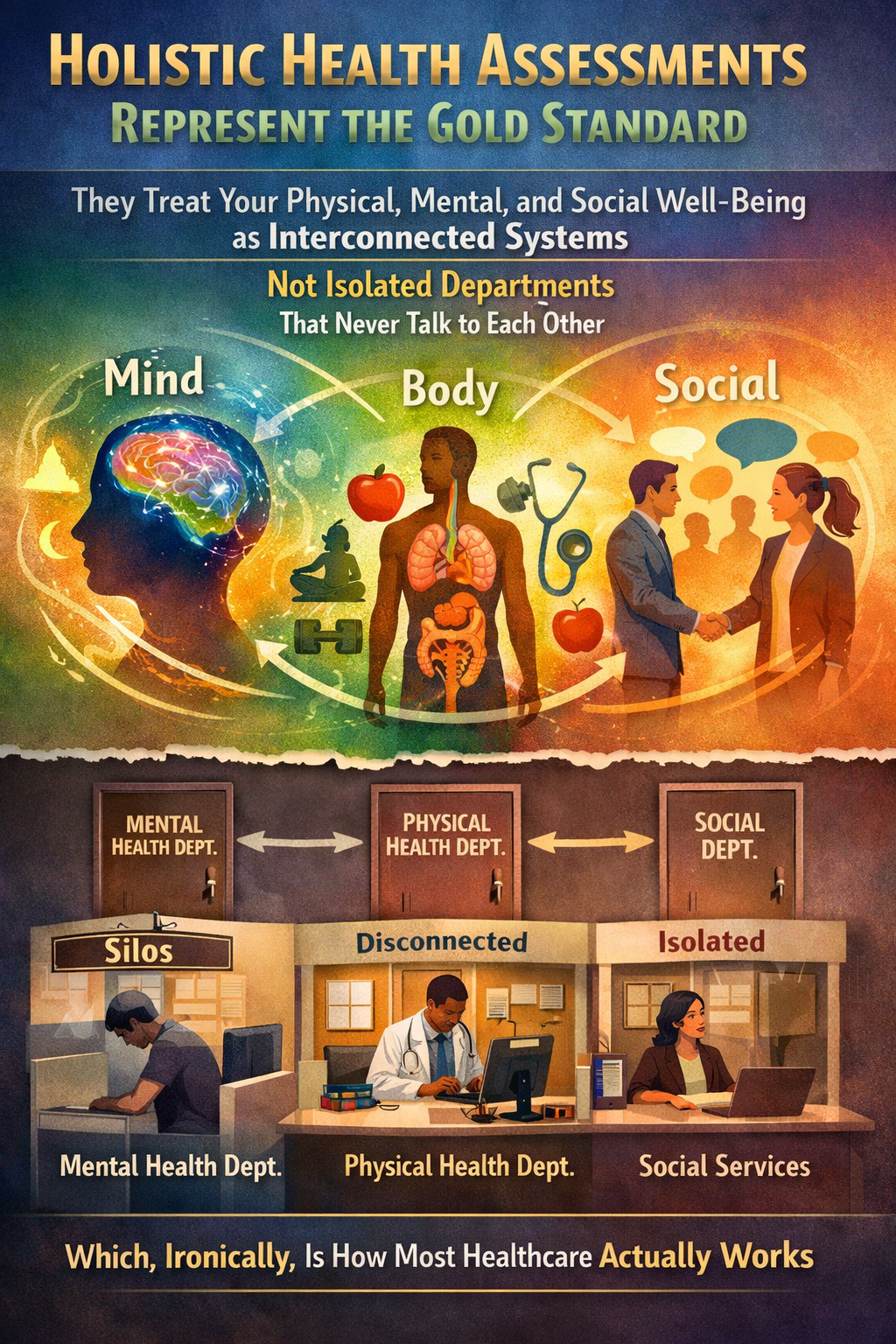
The Physical Health Only Misconception assumes wellness assessments exclusively measure fitness metrics or medical conditions. Modern evaluations recognize that comprehensive well-being encompasses mental health, social connections, financial stress, and career satisfaction alongside physical indicators.
The Size Barrier Fallacy suggests only Fortune 500 companies can benefit. In practice, small and medium-sized organizations often see proportionally greater returns because they can implement changes faster based on assessment findings. Bureaucracy is the enemy of agility, and smaller organizations have less of it.
What Wellness Assessments Get Wrong
Here’s where I break from the typical wellness article playbook. Most pieces treat limitations as a brief, obligatory paragraph at the end, a throat-clearing “to be sure” before moving on. I think that’s intellectually dishonest. The limitations of wellness assessments are real and they affect how much you should trust any given result.
Self-reported data, which forms the backbone of most wellness assessments, suffers from social desirability bias. People give answers they think are “correct” rather than truthful responses about their actual behaviors. Your employee who reports exercising “3-4 times per week” might be averaging once, optimistically. I know this because I’ve done it. You probably have too. We’re all unreliable narrators of our own health. This doesn’t invalidate the data, but it means you need to pair self-reports with objective measures wherever possible.
Cultural sensitivity is another critical consideration that gets lip service more often than actual attention. Standard assessment tools may not account for diverse cultural perspectives on health, wellness practices, or comfort levels with sharing personal information. Most of the widely-used wellness assessments were designed primarily by and for a fairly narrow demographic. The field is improving. It’s not there yet.
And there’s one more limitation I rarely see discussed: wellness assessments can create a false sense of precision. You get a number, a score, a color-coded risk level, and it feels definitive. It’s not. These are snapshots. Useful snapshots, but snapshots nonetheless. One assessment on one day of your life. The goal isn’t perfect measurement. It’s useful measurement that improves decisions over time.
None of these limitations are reasons to abandon wellness assessments. They’re reasons to implement them thoughtfully, interpret them carefully, and resist the temptation to treat any single data point as gospel.
Final Thoughts on Wellness Assessments
Look, I’ve just spent several thousand words telling you what wellness assessments are, what they measure, what they get wrong, and where even I’ve stumbled with them. If you’ve made it this far, you’re either genuinely interested in understanding your own wellness or you have very unusual reading habits. Either way, the simplest step is the one most people skip. Just take one.
Not a perfect one. Not the most comprehensive one. Just a starting point that tells you something you didn’t know yesterday. Because that’s the thing about wellness assessments that even I, after 30 years in this field, am still learning: the value isn’t in the score. It’s in the honest conversation the score starts. With yourself. About yourself. Including the parts you’d rather not look at.
I’m still having that conversation. It’s not comfortable. But it’s better than the alternative, which is just not knowing and hoping for the best. The SAMHSA wellness framework and the CDC’s workplace health research both point toward the same conclusion: wellness assessments work when you act on what they reveal. Not before. Not without follow-through. But when you pair honest data with consistent action, the trajectory changes.
Start anywhere. Just start.
Frequently Asked Questions About Wellness Assessments
There isn’t one. The 8 Dimensions framework used in comprehensive wellness assessments exists precisely because health is interconnected. Physical, emotional, social, and financial wellness all influence each other. That said, mental health often underpins everything else. When it’s neglected, physical health, relationships, and work performance all suffer. The SAMHSA wellness framework treats all eight dimensions as equally essential.
Annually for a comprehensive baseline, with quarterly check-ins on specific metrics you’re actively working to improve. More frequent than monthly and you’re likely obsessing over noise rather than signal. The CDC’s workplace health model recommends regular reassessment cycles to track progress and refine interventions. Wellness assessments are most useful when they show trajectory, not just a single snapshot.
They can surface blind spots and start conversations, but treat them as directional, not diagnostic. Validated wellness assessments used in clinical or workplace settings undergo peer review and population testing that most free quizzes skip. If a tool can’t point you to its evidence base, it’s not an assessment. It’s a personality quiz with health-themed questions. The NIMH and university health systems use validated instruments for a reason.
Collecting data and then doing nothing with it. Employees notice. Participation drops, trust erodes, and the program becomes “that thing we tried in 2024.” Wellness assessments without structured follow-up actions are the equivalent of getting a diagnosis and walking out of the doctor’s office without filling the prescription. According to CDC research, the organizations that see real ROI are the ones that pair assessment data with targeted interventions.
For basic lifestyle wellness assessments, no. You can interpret sleep quality scores, stress inventories, and activity levels on your own. For biometric data such as blood work, VO2 max, or body composition, yes. Context matters enormously. A number without interpretation is just decorative math. The NHLBI and other clinical resources emphasize that biomarker results require professional context to be actionable rather than anxiety-producing.
Welcome to the club. Seriously, most people are surprised by their wellness assessments, and not pleasantly. I’ve been in this field for 30 years and my own results have humbled me more than once. The point isn’t to feel good. It’s to know where you actually stand so you can move forward with accurate information instead of comfortable denial. Research from the APA shows that honest self-assessment, even when uncomfortable, is a predictor of eventual behavior change.