
This article is for educational and informational purposes only and is not medical advice. Consult a healthcare professional before making changes to your diet or health routine.
Mediterranean Diet Longevity: What the Evidence Actually Says
No powders. No subscription funnel. Just the dietary pattern with the most durable evidence base in nutrition science, and an honest look at what it can and cannot do.
Does the Mediterranean Diet Actually Improve Longevity?
Can following a Mediterranean diet help you live longer?
Mediterranean diet longevity is supported by substantial research. A 2024 study following more than 25,000 women for nearly 25 years found that those who most closely followed a Mediterranean-style eating pattern had a meaningfully lower risk of premature death. A 2024 systematic review in older adults found high adherence was associated with a 23% lower risk of all-cause mortality.
The diet works by reducing reliance on ultra-processed foods, improving fat quality, increasing fiber, and supporting cardiovascular health. No single ingredient is the mechanism. The pattern is.
Key Takeaways
Mediterranean diet longevity research is among the most consistent in nutrition science, spanning multiple large studies and meta-analyses across different populations.
The evidence is strong enough to take seriously but honest enough to acknowledge: it reduces risk, it does not guarantee anything.
The PREDIMED trial found significantly fewer major cardiovascular events in Mediterranean diet groups compared to a reduced-fat control diet.
The diet works through pattern, not magic ingredients. Adding olive oil to a bad diet is not the same as adopting the full eating pattern.
It is flexible, enjoyable, and sustainable enough that real humans can actually follow it, which matters more than theoretical nutritional perfection.
Moderate wine intake is part of the traditional pattern, but no one should start drinking for longevity reasons. The wine is not the point. The plate is.
Why Mediterranean Diet Longevity Research Keeps Surviving
Most nutrition claims collapse on contact with a skeptical second look. The Mediterranean diet has been stared at by researchers for three decades, subjected to large randomized trials, multiple systematic reviews, and the kind of sustained academic attention that tends to dismantle things that do not deserve it.
It has mostly survived. That alone is worth a few minutes of your attention.
Mediterranean diet longevity is not a phrase invented by a supplement brand. It describes a consistent finding across serious epidemiological and clinical research: people who eat in a way that broadly resembles the traditional dietary pattern of Mediterranean populations tend to live longer, with lower rates of the diseases that kill most people in industrialized countries.
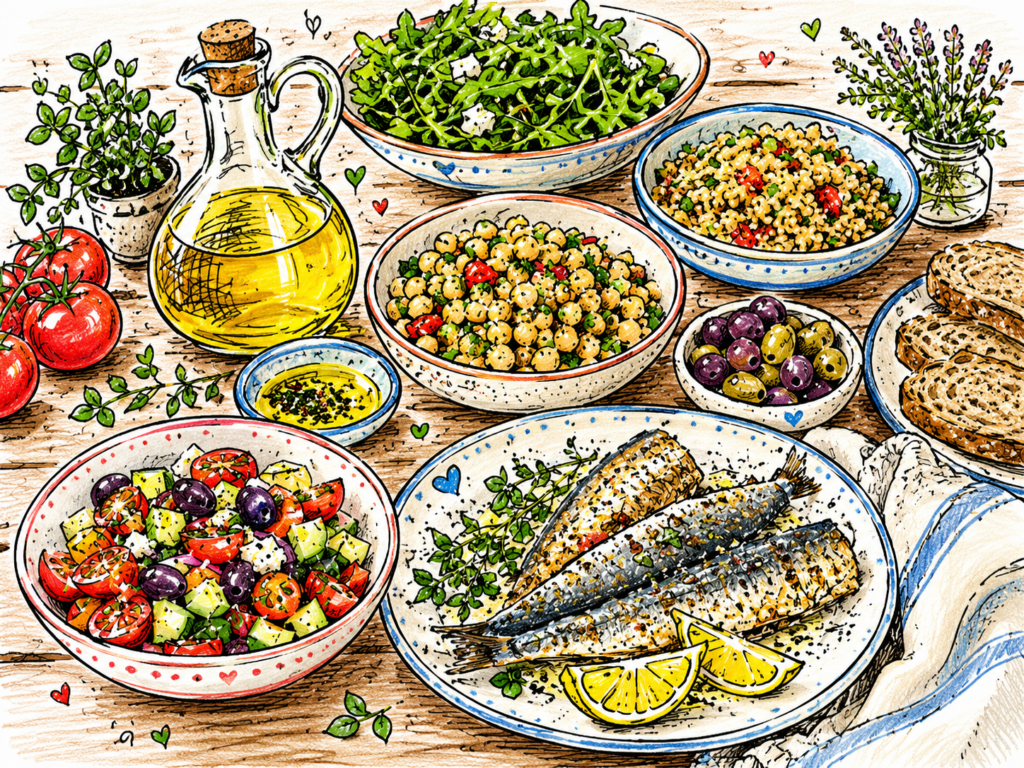
The diet itself is not dramatic. Harvard’s Nutrition Source describes it as a primarily plant-based eating plan where olive oil, legumes, nuts, herbs, spices, fish, and seafood play major roles. Vegetables, fruits, whole grains, beans, and modest amounts of dairy, poultry, and eggs round out the pattern. Red meat and processed meat appear occasionally, not as centerpieces.
In other words, it is food. Actual food. The kind your great-grandmother might recognize before we collectively decided breakfast should come in a wrapper with a cartoon tiger on it.
What the Mediterranean diet is not: a magic ingredient list, a 30-day challenge, or a license to pour olive oil over whatever you were already eating and declare victory. Pattern is the operative word here.
The whole thing, assembled together, over time. That distinction matters enormously, and the research is clear about it.
What the Mediterranean Diet Actually Is
The American Heart Association describes a Mediterranean-style diet as including plenty of fruits, vegetables, grains, potatoes, beans, nuts, and seeds, with olive oil as the primary fat source. Dairy, eggs, fish, and poultry appear in low to moderate amounts. Fish and poultry appear more often than red meat. Wine, when consumed, is in moderation.
That is the architecture. But understanding what it displaces matters as much as what it includes. More beans means less processed meat.
More fish means fewer drive-thru mystery slabs. More fruit means fewer desserts that look engineered by a committee of dentists and bankruptcy attorneys. The substitution effect is not an accident. It is the mechanism.
The traditional Mediterranean lifestyle, as Harvard notes, also emphasized daily physical activity and the social dimension of eating. That context gets stripped out whenever Americans translate anything into macros and apps.
The Mediterranean pattern was not just “consume monounsaturated fats.” It was cook, sit, eat with people, walk, repeat. The nutrition is inseparable from the lifestyle that surrounds it, which makes it both more effective and slightly annoying to sell in capsule form.
What the Longevity Research Actually Shows
A 2024 study connected to the Women’s Health Initiative followed more than 25,000 middle-aged women for nearly 25 years. Researchers tracked diet, health history, blood markers, and medical outcomes.
Women who more closely followed a Mediterranean-style diet had a lower associated risk of premature death compared with those who followed the pattern least. The researchers identified body weight, metabolic health, inflammation, and blood sugar control as factors that appeared to help explain part of the association.
That mechanistic pathway matters. Longevity is rarely about one heroic food. It is usually about the boring machinery: blood vessels, blood sugar, inflammation, weight, cholesterol, blood pressure, and whether your daily meals keep punching your body in the face over decades.
The Mediterranean diet appears to protect on several of those fronts simultaneously, which is why the signal is durable across different study designs and populations.
A 2024 systematic review and meta-analysis focusing specifically on older adults found that high adherence to a Mediterranean diet was associated with a 23% lower risk of all-cause mortality and a 27% lower risk of cardiovascular mortality.
The authors noted important limitations, including that most included studies were observational and that there was high heterogeneity across studies. That caveat is not a footnote. It is a central part of reading the evidence honestly. But a 23% reduction in all-cause mortality, repeated across multiple study populations, is a number worth taking seriously.
The PREDIMED Trial: The Cardiovascular Evidence
The PREDIMED trial is the most cited randomized clinical trial in Mediterranean diet research. Researchers assigned people at high cardiovascular risk to one of three groups: a Mediterranean diet supplemented with extra-virgin olive oil, a Mediterranean diet supplemented with mixed nuts, or a reduced-fat control diet.
The Mediterranean diet groups had significantly fewer major cardiovascular events.
There is a complication worth knowing about. The original 2013 paper was retracted and republished in 2018 because of randomization problems at several study sites. The reanalysis did not substantially change the main results.
Harvard notes that the broader conclusion remained largely unchanged after correction. Science should show its receipts, and PREDIMED showed its receipts, crumpled and slightly oily as they were.
The point is not that PREDIMED is perfect. The point is that it is the kind of evidence that is extremely difficult to generate for dietary interventions, and the signal held up even when scrutinized. Most nutrition research never gets that test.
For a broader look at how nutrition intersects with long-term health outcomes, the Sustainable Nutrition article on this site covers the evidence for eating patterns that hold up over time rather than cycling through trends.
Why Mediterranean Diet Longevity Evidence Is Consistent


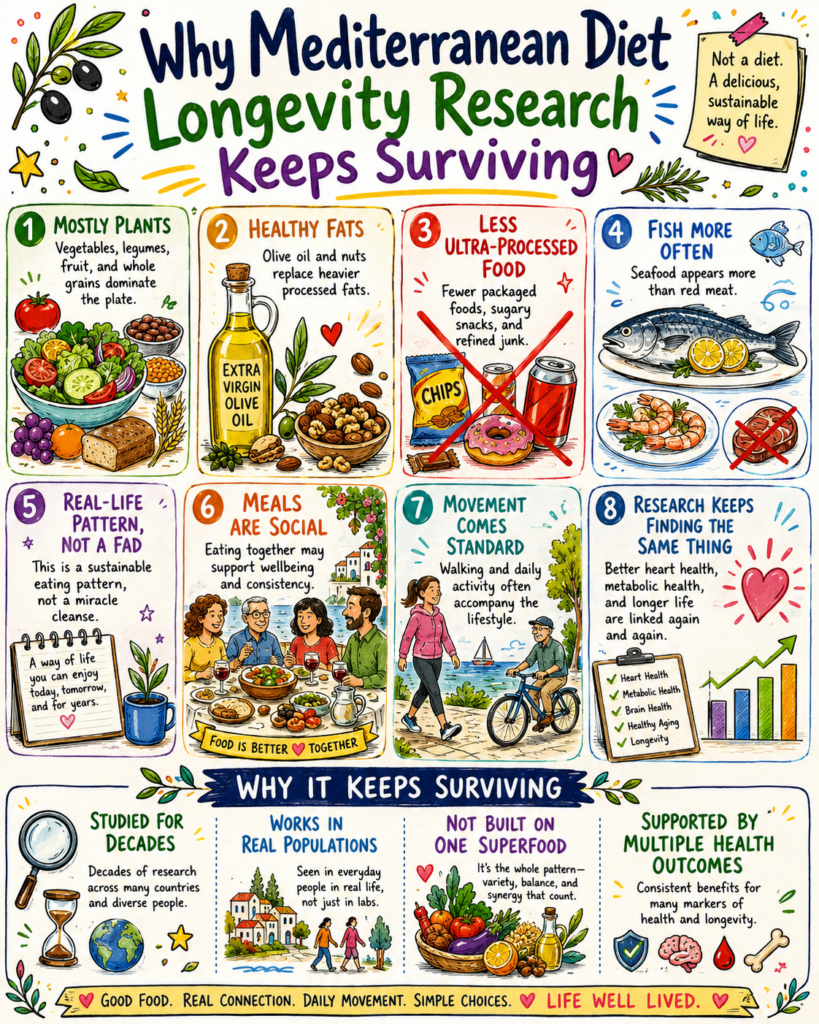
The Mediterranean diet appears to support several systems that affect long-term health simultaneously. Cardiovascular function is the most documented.
The combination of olive oil, fish, nuts, and legumes improves the quality and profile of dietary fat, reduces LDL cholesterol oxidation, and has anti-inflammatory effects that matter for arterial health over decades.
Metabolic health is the second front. The high fiber content from legumes, whole grains, vegetables, and fruit supports blood sugar regulation, gut microbiome diversity, and satiety. These are not exotic mechanisms. They are basic biological plumbing, and the Mediterranean diet handles them without requiring you to weigh almonds like a jewel thief.
Inflammation is the third. Chronic low-grade inflammation is a driver of cardiovascular disease, type 2 diabetes, cognitive decline, and several cancers.
The Mediterranean diet’s emphasis on plants, olive oil, and fish over processed meats and refined carbohydrates consistently produces lower inflammatory markers in clinical and observational studies.
Understanding how these systems interact is also relevant to brain health. The same dietary patterns associated with cardiovascular protection appear repeatedly in research on cognitive aging and dementia risk, for the same mechanistic reasons.
The Observational Research Problem (and Why It Still Matters)
Nutrition research has a fundamental problem: randomizing people to years of different diets in controlled conditions is nearly impossible. Most Mediterranean diet longevity research is observational. Researchers follow large populations, collect dietary data, and look at health outcomes.
The limitation is that people who eat Mediterranean-style diets may also exercise more, smoke less, have better access to healthcare, and cook more often than people who do not. Researchers adjust for many of these factors, but adjustment is not magic. It is statistical housekeeping.
This is why no honest assessment of the Mediterranean diet ends with a guarantee. Reducing risk is not the same as eliminating it. A bowl of chickpeas has not solved mortality. The honest framing is: this dietary pattern, followed consistently over time, appears to stack the odds in a favorable direction across multiple biological systems.
That is a meaningful claim. It is just not a mystical one.
The consistency of the pattern is the most compelling part of the evidence. When the same general dietary architecture keeps showing up near lower rates of cardiovascular disease, lower mortality, better metabolic health, and healthier aging, across studies conducted in different countries, using different methods, in different decades, eventually you stop calling it coincidence and start asking what dinner looks like.
This skeptical approach to wellness evidence is a running thread on this site. The 8 Dimensions of Wellness framework is another useful lens for understanding why no single dietary intervention can account for the full picture of health and longevity.
How to Actually Eat the Mediterranean Way for Longevity
The single most practical reframe: think of this as shifting the center of gravity of your meals, not performing a nutritional identity crisis.
The foods are not unusual. The proportions are different from what most people in the United States currently eat.
1. Vegetables and Legumes First
At least half of most meals should come from vegetables, beans, lentils, or chickpeas. These are the base, not the garnish.
Legumes in particular deliver fiber, protein, and micronutrients at a cost that makes premium protein powders look like a very expensive joke. Aim for legumes several times a week if they are not already present.
2. Olive Oil as the Primary Fat
Replace butter, seed oils, and margarine with extra-virgin olive oil where cooking temperatures allow. Use it generously on salads, roasted vegetables, and cooked grains.
The polyphenol content of extra-virgin olive oil is part of the mechanism, not just the fat profile, so quality matters more here than with other cooking fats.
3. Fish and Seafood Twice a Week
Oily fish, specifically sardines, mackerel, salmon, and anchovies, are the most aligned with the traditional Mediterranean pattern.
The omega-3 profile and the displacement of processed meat are both relevant. Canned sardines with olive oil and lemon over whole grain bread is not exotic. It is also not a drive-thru mystery slab, which is the point.
4. Limit Processed Meat and Ultra-Processed Food
This is where the Mediterranean diet does most of its work quietly. The pattern does not require you to fear food. It requires you to stop letting processed meats, refined carbohydrates, and ultra-processed snacks occupy the center of your plate. Occasional is fine. Daily is the problem.
The most meaningful lever most people can pull is not adding olive oil to their current diet. It is removing something the current diet should not contain in bulk.
The Biggest Mistake People Make With This Eating Pattern
They treat the Mediterranean diet as a shopping list instead of a pattern. They buy olive oil. They add olives to their charcuterie board.
They drizzle something on pasta. Then nothing changes in how they actually eat, because everything else on the plate is still processed meats, refined grains, and oversized portions of “technically Mediterranean” pasta.
Harvard makes this point without ambiguity: the benefits appear to come from the combination of foods, not from single foods or nutrients pulled out of context. Simply adding olive oil or nuts to an otherwise unchanged diet is not the same as adopting the full pattern.
That sentence should be printed on the front of every wellness product that has ever tried to extract a single Mediterranean ingredient and sell it at a 3,000% markup.
You cannot garnish your way out of a bad diet.
The good news is that the pattern is not a deprivation protocol. It does not require you to weigh things, fear dinner, or pretend that a bowl of lentils is the same as a spiritual experience.
It asks you to shift what anchors your meals, cook more often than not, and eat fewer things that emerged from a crinkly bag with neon dust on them. For a look at how dietary patterns interact with stress physiology and cortisol, the connection between what you eat and how you feel is more mechanistic than most people realize.
Final Thoughts
The wellness industry is extremely good at making you feel like you are one supplement away from solving your biology.
The Mediterranean diet is a problem for that business model because it is composed of foods that have been available since before anyone had a podcast. You cannot patent lentils. You cannot charge $89 a month for olive oil and call it a protocol.
The honest version of Mediterranean diet longevity is this: the evidence is consistent, the mechanism is plausible, the pattern is sustainable, and the downside of eating more vegetables, legumes, fish, and olive oil while eating fewer processed meats and ultra-processed foods is essentially zero.
That is a better risk-reward profile than almost anything else in nutrition.
It will not guarantee that you live to 100. Nothing does. Life has an exit requirement, and no dietary pattern has successfully negotiated with it. But if the question is whether a Mediterranean-style diet may help stack the biological odds in your favor across the systems that most influence how long and how well you live, the answer is yes.
The evidence is strong enough to take seriously, modest enough to avoid worship, and practical enough to start tonight.
Pick one meal this week. Make it vegetables, legumes, olive oil, and something from the sea. Do not announce it on social media. Do not buy a supplement to accompany it. Just eat.
No powder. No cleanse. No spiritual rebirth through imported vinegar. Just dinner, behaving itself. 🫒
Frequently Asked Questions About Mediterranean Diet Longevity
The research consistently associates Mediterranean diet longevity with lower mortality risk, but “associated with” is not the same as “guarantees.” A 2024 study of more than 25,000 women over nearly 25 years found lower premature death risk among those who most closely followed the Mediterranean pattern.
A 2024 meta-analysis in older adults found a 23% lower all-cause mortality risk with high adherence. Most of this research is observational, which has real limitations. The honest answer is: the pattern appears to reduce risk across multiple biological systems, and the consistency of that finding across independent studies conducted over decades is meaningful.
The American Heart Association describes the core of a Mediterranean-style diet as vegetables, fruits, whole grains, beans, nuts, seeds, and olive oil as the primary fat. Fish and poultry appear in moderate amounts, more frequently than red meat.
Dairy is present but modest. What it limits: processed and red meats, refined carbohydrates, added sugars, and ultra-processed foods. The key is the overall proportion and pattern, not any single ingredient.
PREDIMED was a large randomized clinical trial that assigned people at high cardiovascular risk to a Mediterranean diet supplemented with extra-virgin olive oil, a Mediterranean diet supplemented with nuts, or a reduced-fat control diet.
The Mediterranean groups had significantly fewer major cardiovascular events. The original 2013 publication was retracted and republished in 2018 due to randomization issues at some sites, but reanalysis did not substantially change the conclusions.
PREDIMED is significant because randomized dietary trials of this scale are rare, and the Mediterranean diet held up even under scrutiny.
No. Harvard’s Nutrition Source is explicit on this point: the benefits appear to come from the combination of foods, not from individual ingredients pulled out of context. Adding olive oil to a diet otherwise built around processed meats, refined grains, and ultra-processed foods is not the same as adopting the Mediterranean pattern.
The mechanism involves the overall dietary architecture, specifically what legumes, fish, vegetables, and whole grains displace from your daily eating, not just what they add.
Moderate wine consumption is historically associated with the traditional Mediterranean pattern. However, the American Heart Association advises against starting drinking for health benefits, noting that those benefits are unproven, and the National Institute on Alcohol Abuse and Alcoholism notes health risks even at low consumption levels.
If you already consume wine occasionally with meals, that is a conversation for you and your clinician. If you do not drink, do not begin because a magazine photographed a Sardinian grandfather next to a stone wall. The wine is not the mechanism. The rest of the plate is.
Most Mediterranean diet longevity research is observational, meaning researchers follow populations and record outcomes without being able to control what people eat over years.
This creates the possibility that people who eat this way are also healthier in other ways: they may exercise more, smoke less, experience less financial stress, or have better healthcare access.
Researchers adjust for these variables statistically, but adjustment has limits. Additionally, measuring diet accurately over time is genuinely difficult. The result is a body of evidence that is consistent and plausible, but cannot definitively prove causation the way a controlled drug trial can.
Start with one substitution per week rather than an overhaul. Replace processed meat at one meal with canned fish or legumes. Swap refined grains for whole grains at one meal per day.
Add a vegetable serving where a processed snack currently lives. Use olive oil where butter currently lives. The Mediterranean pattern is flexible and does not require nutritional theater. Harvard notes that the social and physical activity dimensions of the traditional Mediterranean lifestyle matter too. Cooking at home more often, eating with other people, and walking regularly are all part of why the pattern works in the populations where it was observed.