This article is for educational and informational purposes only and is not financial or investment advice. Consult a qualified financial professional before making retirement income decisions.
The 4 Percent Rule in Retirement: What It Gets Right and Wrong
Why the most famous retirement withdrawal rule is a useful starting point, not a prophecy, and how sequence of returns risk can quietly rewrite your entire plan.
What Is the 4 Percent Rule, and Why Does It Matter for Retirement?
What is the 4 percent rule for retirement withdrawals?
The 4 percent rule is a retirement withdrawal guideline suggesting you withdraw 4% of your portfolio in year one, then adjust that dollar amount for inflation each year. It originated from William Bengen’s 1994 research and was later tested in the Trinity Study, which examined whether portfolios survived 30-year retirement periods. It remains a useful starting framework, but it does not account for sequence of returns risk, healthcare shocks, or individual spending volatility.
Key Takeaways
The 4 percent rule is a starting framework, not a guaranteed retirement income plan.
Sequence of returns risk means the order of market returns matters as much as the average.
Poor market returns in the first 5 to 10 years of retirement can permanently damage a portfolio.
Morningstar’s recent research suggests a 3.9% starting withdrawal rate for a 90% success probability over 30 years.
Cash reserves, flexible withdrawals, and separating essential from discretionary spending all reduce sequence risk.
A rigid plan can be riskier than a modest one. The goal is a retirement income plan that bends without snapping.
Why the 4 Percent Rule in Retirement Deserves a Closer Look
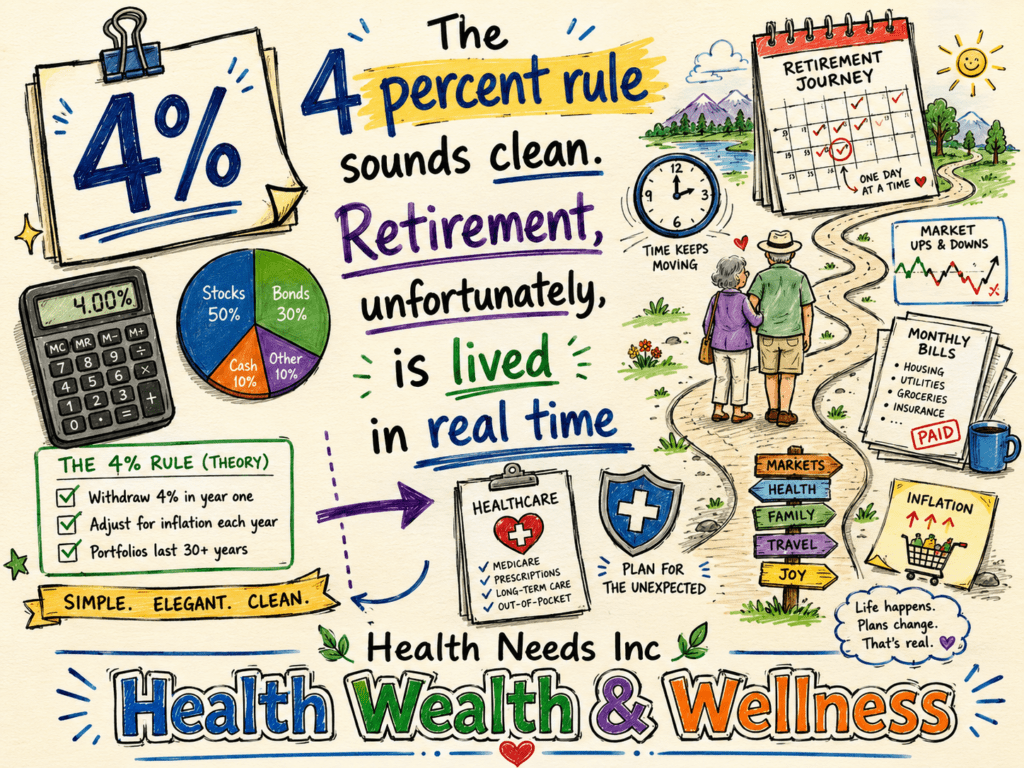
The 4 percent rule in retirement is one of those financial ideas that became famous because it sounds clean enough to fit on a refrigerator magnet. Withdraw 4% of your portfolio in year one. Adjust for inflation each year. In theory, your money should last 30 years. Wonderful. Elegant. Suspiciously tidy.
And that is where retirement reality walks in wearing muddy boots.
The rule is not useless. It is one of the better starting points in retirement income planning. But it was never meant to be a prophecy, a permission slip, or a magical incantation muttered over a 401(k) while the market behaves like a well-trained spaniel. It is a rule of thumb built from historical data, assumptions, and averages. Retirement, unfortunately, is lived in real time. And real time has teeth.
The companion hazard, sequence of returns risk, makes the picture even more complicated. Two retirees with identical savings, identical average returns, and identical withdrawal rates can end up in completely different financial situations. The difference is timing. If you have ever wondered why retirement planning myths persist so stubbornly, this is a good place to start looking.
So what does the 4 percent rule actually tell us, where does it break down, and what can you do about the parts it ignores? That is what this article is for.
What the 4 Percent Rule Actually Says
The basic idea is simple. If you retire with $1 million, you withdraw $40,000 in the first year. The next year, you increase that dollar amount for inflation. If inflation runs 3%, you withdraw $41,200. You keep doing this each year until the money outlasts you or you outlast the money.
This concept was originally associated with financial planner William Bengen’s 1994 research and later popularized by the Trinity Study, which tested various withdrawal rates against historical market returns. The Trinity framework examined stock and bond portfolios over 30-year retirement periods and judged whether the money survived.
That last sentence matters. The test was not whether you would sleep well, whether your roof and hip and adult child and dog and property tax bill would all stay politely within budget, or whether you would feel prosperous in year 22. The test was binary: did the portfolio hit zero before 30 years?
- Based on historical U.S. stock and bond returns
- Assumes a 30-year retirement horizon
- Does not adjust for individual health or spending patterns
- Does not account for sequence of returns risk directly
- Does not factor in taxes, healthcare costs, or housing volatility
A retirement plan that technically succeeds while leaving you white-knuckled in year 29 is not a triumph. It is a hostage situation with spreadsheets.

Why the 4 Percent Rule Is Not a Universal Law
The biggest mistake people make with this rule is treating it like gravity. Gravity applies to everyone. The 4 percent rule does not.
It depends on retirement age, portfolio mix, market valuation when you retire, inflation, taxes, healthcare costs, Social Security timing, pension income, required minimum distributions, housing costs, whether you can reduce spending during bad markets, and whether your retirement lasts 20 years, 30 years, or 40 years.
The real lesson is not that 4% is dead. The real lesson is that 4% is conditional. And retirement planning is mostly the art of noticing the conditions before they notice you. If your cortisol levels spike every time you check your portfolio balance, the plan might need emotional shock absorbers alongside the financial ones.
- Retirement age affects how long the money must last
- Tax-deferred vs. taxable accounts change the effective withdrawal rate
- Healthcare costs often rise faster than general inflation
- Social Security timing can shift how much pressure falls on the portfolio
- Spending flexibility is itself a risk management tool
Sequence of Returns Risk in Retirement Explained
Here is where things get rude.
Two retirees can have the same amount saved, earn the same average annual return, withdraw the same amount, and still end up in completely different financial situations. Why? Because the order of returns matters. That is sequence of returns risk.
If the market performs badly early in retirement while you are taking withdrawals, you may be forced to sell investments when they are down. That leaves fewer shares to recover when the market rebounds. The portfolio is not merely bruised. It is smaller, weaker, and less able to heal.
Schwab describes sequence risk as the problem of poor returns arriving at the wrong time, especially early in retirement when withdrawals begin. U.S. Bank similarly notes that negative market returns near the start of retirement can significantly affect long-term retirement security.
During your working years, a market crash can be annoying but useful. You are still contributing. You may be buying investments at lower prices. In retirement, the same crash becomes a trapdoor. You are no longer buying. You are selling. Same market decline. Different life stage. Completely different meaning.

Why Average Returns Can Lie to Retirees
Retirement projections often lean heavily on average returns. That sounds reasonable until you remember that averages are tidy little con artists.
Imagine two retirees. Both average 6% annual returns over time. One gets strong returns in the first decade, then weaker returns later. The other gets weak returns first, then strong returns later. Same average. Different outcome.
The retiree with early gains has breathing room. The portfolio grows before the heavier withdrawals do damage. The retiree with early losses may spend the rest of retirement trying to recover from an opening punch.
- A 7% average return tells you nothing about the sequence
- Early gains create a buffer; early losses create a hole
- A good return after a gutted portfolio is too late to matter
- Retirement income planning must account for timing, not just totals
This is why “my portfolio averages 7%” is not a retirement income plan. It is a weather report from another planet. What matters is not just the return. It is when the return arrives.
The First Decade of Retirement Matters Most
The early years of retirement are unusually important because the portfolio is usually at or near its largest, and withdrawals are just beginning. A major downturn during this window can permanently change the math. This does not mean retirement is doomed if the market falls after you stop working. It means your plan needs shock absorbers.
A retirement income plan that assumes smooth returns is not a plan. It is a decorative napkin. The practical question is not “Will bad markets happen?” Of course they will. The better question is “What do I sell when they do?”
That is where planning starts to become real. And where techniques like mindful stress management can complement the financial strategy. The stress of watching a portfolio drop 18% six months after your retirement party is not abstract. It is physiological. It affects decision-making, sleep, and the temptation to panic-sell at precisely the wrong moment.
How to Reduce Sequence of Returns Risk in Retirement
You cannot eliminate sequence risk. Anyone who says otherwise is selling something, probably in a blazer with unnerving confidence. But you can reduce it. Here are practical strategies that help a retirement income plan survive its most vulnerable years.
1. Keep a Cash Reserve
A cash buffer helps retirees avoid selling stocks during a downturn. Some retirement planners suggest holding one to two years of spending needs in cash or stable short-term instruments. Recent retirement planning commentary often points to 18 to 24 months as a reasonable liquidity buffer. Cash is boring. That is the point. In retirement, boring is not a flaw. Sometimes boring is the sandbag in front of the basement door.
2. Use Flexible Withdrawal Strategies
The classic 4 percent rule assumes you keep increasing spending with inflation every year, regardless of market performance. Real humans do not always behave that way. If the market drops sharply, many retirees can reduce discretionary spending temporarily. Fewer big trips. The kitchen remodel waits. The grandkids get normal gifts instead of the royal endowment. Flexible withdrawal strategies reduce pressure on the portfolio during bad markets, and Morningstar’s research has noted that different spending strategies can support higher or lower starting withdrawal rates depending on goals and flexibility.
3. Separate Essential and Discretionary Spending
Essential expenses are the roof, food, utilities, insurance, taxes, prescriptions, and healthcare. Discretionary expenses are travel, hobbies, dining out, gifts, renovations, and the mysterious category known as “Target run,” where $28 becomes $143 through dark retail alchemy. Essential spending should ideally be covered by reliable income sources: Social Security, pensions, or conservative withdrawals. Discretionary spending can be more flexible and portfolio-dependent.
4. Be Careful with Big Early Spending
The first years of retirement are often expensive. People travel, renovate, help family, celebrate freedom. Understandable. Also dangerous. Big early withdrawals amplify sequence risk, especially if markets are weak. The portfolio is trying to survive its most delicate phase while you are taking it zip-lining. That does not mean retirees should live like monks guarding canned soup. It means early retirement spending should be intentional.
5. Consider Delaying Social Security
Social Security timing can affect how much pressure falls on your portfolio. Delaying benefits can increase monthly payments, though the right choice depends on health, longevity expectations, marital status, cash needs, and taxes. According to the Social Security Administration, delayed retirement credits increase benefits by about 8% per year between full retirement age and age 70. This is not a blanket recommendation. It is a lever. And after 50, levers matter more than vibes.
A More Honest Way to Use the 4 Percent Rule in Retirement
The best use of the 4 percent rule is not as an answer. It is as a question.
If you have $800,000 saved, 4% gives you $32,000 in year-one withdrawals before taxes. Add Social Security, pension income, or other sources. Compare that with your expected spending. Then ask the harder questions:
- Can this survive a bad first decade?
- Can I cut spending if markets fall?
- Do I have enough cash reserve?
- What happens if inflation runs high?
- What healthcare costs am I ignoring because they are spiritually inconvenient?
- What if one spouse lives into their 90s?
- What if the house needs a roof?
- What if adult children need help?
That is where the real retirement planning begins. The financial industry loves “your number,” whether it is $1 million, $1.5 million, or 25 times annual expenses. These numbers are useful in the same way a map is useful. But a map is not the road. It does not show the pothole, the detour, the raccoon with poor judgment, or the toll booth demanding exact change.
Retirement planning is not only about accumulation. It is about conversion. You are converting savings into income, portfolio into paycheck, abstract net worth into groceries, prescriptions, heat, taxes, grandchildren, dental crowns, and occasional proof that you are still alive.
Retirement Reality Is Dynamic
The old dream was simple: retire, withdraw, relax, repeat. But retirement is not static. Spending changes. Health changes. Markets change. Inflation changes. Tax laws change. Family obligations change. Your tolerance for nonsense also changes, usually downward.
A good retirement plan is not carved in stone. It is reviewed, adjusted, stress-tested, and revisited. The 4 percent rule is a flashlight, not the trail. Sequence of returns risk is the hole in the trail. Retirement reality is the part where you keep walking anyway, preferably with better shoes, a cash buffer, and someone competent checking the map.
The goal is not to worship the 4 percent rule in retirement. The goal is to build a retirement income plan that can bend without snapping. Because retirement is not a spreadsheet. It is a life stage with bills attached. And the bills, unlike motivational quotes, arrive on schedule.
Useful Tools for Retirement Withdrawal Planning
- FIRECalc, free historical retirement calculator that tests withdrawal rates against actual market data
- SSA Retirement Estimator, official Social Security benefits estimator based on your earnings record
- Schwab Retirement Calculator, interactive tool for modeling income, spending, and portfolio sustainability
- Morningstar Retirement Research Center, regularly updated withdrawal rate research and spending strategy analysis
Wellness without the noise.
Evidence-based insights on financial wellness, retirement planning, and healthy aging. No hype. No spam. Just what works.
No spam ever. Unsubscribe any time.
Final Thoughts
The 4 percent rule is useful. It is also incomplete. It tells you what might have worked historically under certain assumptions. It does not tell you whether your retirement will survive bad timing, healthcare shocks, inflation, taxes, family pressure, or the emotional chaos of watching your portfolio drop while your bills stay exactly the same size.
Sequence of returns risk is the reminder that retirement math is not only about averages. Timing matters. Flexibility matters. Spending behavior matters. Cash reserves matter. Guaranteed income matters. Humility matters.
The irony is that the most resilient retirement plans are often the least exciting ones. They have buffers, backup plans, and the willingness to adjust when the numbers change. They treat the 4 percent rule as a conversation starter, not a contract.
If you take one thing from this article, let it be this: build a retirement income plan that can absorb a bad decade, not just a bad quarter. Start with the 4 percent rule if you need a number. Then build around it with cash reserves, flexible spending, and an honest accounting of what your life actually costs.
Retirement is not a spreadsheet. It is a life stage with bills attached. Plan accordingly.