This article provides general educational information about meaning, purpose, and well-being. It is not mental-health advice, diagnosis, or treatment. A persistent loss of interest, hopelessness, or thoughts of self-harm deserve prompt support from a qualified professional; in the United States, call or text 988 or visit the 988 Suicide & Crisis Lifeline.
Ikigai: The Japanese Operating System for a Life Worth Living
★ TL;DR
Ikigai is not a career formula, a longevity guarantee, or four pastel circles demanding that your passion become profitable. It is a flexible Japanese idea describing what gives life value, meaning, pleasure, or a reason to keep participating in it.
-
The famous diagram is not the original concept. The intersection of what you love, what you do well, what the world needs, and what pays you is a modern Western construction.
-
Ikigai can be wonderfully ordinary. Family, friendship, caring for an animal, tending a garden, making breakfast, mastering a craft, or being useful to someone may count.
-
Purpose and health are associated, not magically fused. Observational studies link ikigai or purpose with better well-being and some favorable health outcomes, but they cannot prove that purpose alone causes longevity.
-
You do not find it once. Ikigai changes with health, work, age, loss, obligation, curiosity, and the shifting cast of people who need us.
-
Start with evidence from your actual days. Notice what absorbs you, restores you, connects you, and makes your presence useful. Meaning is often already occurring before it receives a Japanese label and a hardcover book deal.
The internet turned ikigai into a four-circle career diagram. Japan’s quieter idea is less photogenic, more humane, and considerably less interested in monetizing your tomato garden.

Ikigai is best understood as the people, practices, roles, pleasures, and commitments that make being alive feel worthwhile.
What does ikigai mean?
- Not necessarily a job: income and occupation may contribute, but neither is required.
- Not necessarily grand: a daily ritual or small responsibility may matter as much as a public mission.
- Not permanent: its sources can change across seasons of life.
- Not a cure: meaning can support well-being, but it does not make illness, grief, poverty, or depression evaporate.
Separate ikigai from the diagram. The popular four-way model may be a useful career prompt, but calling it ancient Japanese wisdom gives clip art an unnecessarily distinguished ancestry.
Look for plural sources. One enormous purpose is fragile. A portfolio of relationships, interests, service, creation, and small pleasures can survive change more gracefully.
Meaning needs behavior. Values become life-giving when they appear on the calendar, in relationships, and through repeated action.
Being useful matters. Responsibility can create structure, belonging, and evidence that one’s presence affects the world beyond the self.
Protect purpose during transitions. Retirement, illness, caregiving, bereavement, and relocation can remove roles that quietly carried identity and connection.
What Ikigai Actually Means
Ikigai is usually translated as a reason for living, a reason for being, or that which makes life worth living. Each translation is close enough to be useful and incomplete enough to start an argument, which is what happens whenever one culture attempts to move a large idea through the narrow customs gate of another language.
The word combines iki, relating to life or living, and gai, relating to worth or value. The Government of Japan describes ikigai broadly as whatever brings value and joy to life, including people, work, hobbies, and everyday activities.
That source need not qualify as a destiny. It may be a child, a friend, a craft, a responsibility, a religious commitment, a neighborhood, a recurring pleasure, or work that feels useful.
Japanese psychiatrist Mieko Kamiya helped give the idea modern psychological depth in her 1966 writing on life meaning. A recent peer-reviewed cognitive-motivational model of ikigai likewise treats it as multidimensional rather than a single motivational slogan.
This flexibility is the concept’s strength. A person may experience ikigai through caring for grandchildren and playing the piano badly but enthusiastically. Neither activity needs to become a personal brand.
Western self-help often assumes that purpose must be singular, heroic, and announced. The result is existential pageantry: discover your calling, change the world, launch the podcast, and somehow remember to floss.
Ikigai permits something smaller. It also fits HNI’s Eight Dimensions of Wellness, where meaning lives alongside relationships, work, emotion, physical health, environment, learning, and money rather than floating above them like a motivational weather balloon.
The Four-Circle Ikigai Diagram Is Not Ancient Japanese Wisdom
You have probably seen the diagram. Four overlapping circles ask what you love, what you are good at, what the world needs, and what you can be paid for. The center is labeled ikigai, the sacred location where enthusiasm, competence, social contribution, and direct deposit allegedly achieve enlightenment.
The diagram is not a traditional Japanese model. Its lineage has been traced to a Western purpose framework that was later combined with the term ikigai and circulated through blogs, books, coaching, and social media.
This does not make the questions useless. They can help someone examine career fit, contribution, interests, and economic reality. A tool does not become worthless merely because its passport was forged.
The problem is conceptual shrinkage. Requiring payment turns ikigai into career optimization and excludes retirees, unpaid caregivers, volunteers, people with disabilities, parents, artists without markets, and anyone whose meaningful work is not economically rewarded. The larger Emotional Wellness context matters because meaning is not merely a job-description problem.
Requiring exceptional skill creates another distortion. You may love singing with friends without being good enough to alarm the recording industry. The joy, connection, and ritual can still carry meaning.
Requiring that “the world needs it” invites grandiosity. The world is large and has not appointed most of us to central management. One person, animal, garden, congregation, workshop, or neighborhood may be a sufficient field of usefulness.
The four circles also suggest a fixed answer waiting to be discovered through sufficient introspection. Real lives are less geometrically cooperative. What matters changes after illness, divorce, retirement, grief, parenthood, migration, success, failure, and the arrival of a dog with firm views about sunrise.
What the Science Suggests, and What It Does Not
Research has linked ikigai or broader purpose in life with favorable measures of well-being and health. The findings are intriguing, but the causal story is not settled.
A Japanese cohort study published in Psychosomatic Medicine followed 43,391 adults and reported that participants who said they lacked ikigai had higher mortality risk during follow-up, particularly from cardiovascular causes. The investigators adjusted for multiple health and social factors, but observational adjustment is not a magical solvent that removes every alternative explanation.
A 2022 longitudinal analysis in The Lancet Regional Health – Western Pacific found that having ikigai was associated with several later health and well-being outcomes among older Japanese adults. People with purpose may remain more active, socially connected, hopeful, and attentive to health, all of which could influence outcomes.
The arrow can also point backward. Better health, income, mobility, supportive relationships, and freedom from depression may make purpose easier to feel. People are not randomly assigned a grandchild, a secure pension, arthritis, or a satisfying Tuesday.
Researchers therefore speak more carefully than wellness marketing departments. Ikigai may operate through psychological resilience, social connection, behavioral engagement, stress regulation, identity, and motivation, but no single pathway explains every result.
The honest conclusion is promising and modest. A felt reason to engage with life appears relevant to health and well-being, while HNI’s Physical Wellness guide covers the less poetic but better-established daily foundations. Ikigai is not a vaccine against mortality, and Japan has not discovered a semantic loophole in human biology.
This distinction matters ethically. Telling an ill or lonely person to “find your ikigai” can convert structural problems and clinical suffering into a character assignment. Purpose may help people endure difficulty, but it cannot substitute for medical care, income, housing, safety, or human support.

Why Ordinary Purpose May Be More Durable
A grand mission provides drama. Ordinary purpose provides Tuesdays.
The distinction is useful because most life happens on days without applause, revelation, or suitable lighting. A sustainable reason for living must survive laundry, weather, minor pain, administrative passwords, and the fact that inspiration frequently takes weekends off.
Small sources of ikigai have practical advantages. They are repeatable, close at hand, and less dependent on status. Preparing breakfast for a spouse may sound humble, yet it contains care, competence, ritual, and relationship before 8 a.m.
Meaning also grows through attention. The same garden can be a chore, an aesthetic pleasure, a seasonal education, a connection to family history, or a promise made to next month’s tomatoes.
This does not mean pretending every task is spiritually luminous. Some chores are merely chores, and the dishwasher has resisted centuries of philosophical elevation.
It means noticing which repeated activities create aliveness, coherence, belonging, or usefulness. These signals are more trustworthy than fantasies about the person you think you should become.
Plural purpose is especially resilient. If identity rests entirely on one role, losing that role can collapse the entire structure. HNI’s guide to what wellness assessments actually measure offers another way to examine several life domains without reducing a person to one seductive score.
Not every source needs equal weight. The point is not to turn meaning into asset allocation, although the metaphor is annoyingly accurate. Diversification gives a life somewhere else to stand when one foundation shifts.
Ikigai After Retirement: When the Job Leaves but You Remain
Retirement is often sold as permanent leisure, a long bright weekend involving travel, hobbies, and suspiciously white trousers. What disappears in the advertisement is the psychological infrastructure that work may have supplied.
A job can provide time structure, identity, social contact, competence, status, challenge, and evidence that someone expects you to appear. Even a disliked job may quietly perform several of those functions.
When employment ends, the loss may be liberating and disorienting at once. “What do you do?” changes from a social question into a small metaphysical ambush, particularly when social connection and emotional wellness were quietly bundled into the old role.
The mistake is trying to replace a forty-year career with one perfect hobby. Golf, gardening, or travel may provide pleasure, but pleasure alone does not always replace contribution, development, and belonging.
A stronger transition identifies what the work was doing psychologically. If it supplied mastery, choose something with progressive challenge. If it supplied people, create recurring contact rather than occasional plans. If it supplied usefulness, take responsibility for an outcome that matters to someone beyond you.
Paid work may remain part of ikigai, but it need not return wearing a full-time schedule. Consulting, mentoring, seasonal employment, caregiving, volunteering, making, teaching, or community leadership can preserve selected functions without rebuilding the old machine.
Older adults are often protected from meaningful responsibility in the name of convenience. Families take over errands, decisions, tools, driving, cooking, or caregiving without asking what those activities represent.
Safety matters. So does agency. Before optimizing a task out of someone’s life, ask whether it is secretly a route, a role, a relationship, or proof of competence.
Wellness without compulsory enlightenment.
Get skeptical, humane writing about health, purpose, aging, and the commercial machinery waiting to sell all three back to you.
The Ikigai Field Test
Do not begin with “What is my one true purpose?” The question is too large, too theatrical, and likely to produce an answer borrowed from a person with better branding.
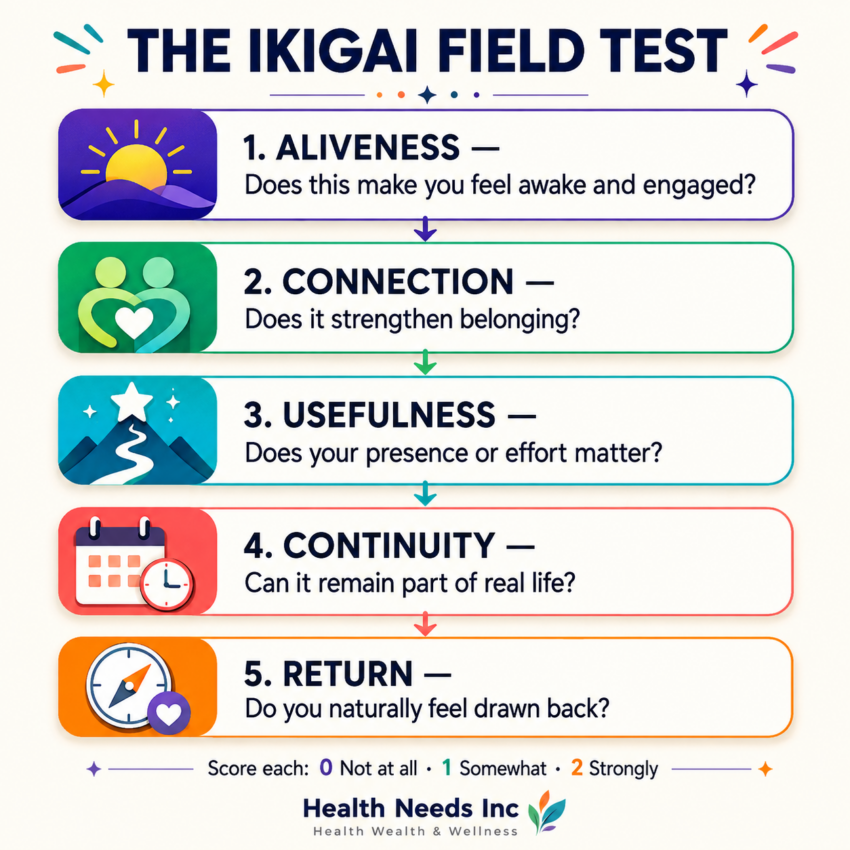
Begin with observation. Review the previous two weeks and list specific moments when you felt absorbed, restored, connected, useful, curious, proud, peaceful, or eager to continue.
Score five possible sources of ikigai
- Aliveness: Did this make you more awake and engaged, rather than merely distracted?
- Connection: Did it strengthen a relationship, community, place, tradition, or sense of belonging?
- Usefulness: Did your presence, care, knowledge, or effort matter to someone or something?
- Continuity: Could this remain part of life under realistic conditions, even in a smaller form?
- Return: After difficulty or interruption, do you naturally feel drawn back toward it?
Score each item from zero to two: not at all, somewhat, or strongly. The score does not diagnose your purpose. It helps separate durable sources of meaning from fantasies, obligations, and pleasant activities that leave no desire to return.
Next, examine the conditions. Who was present? What skill did you use? Was the activity solitary or shared? Did it involve creating, caring, learning, moving, solving, noticing, teaching, preserving, repairing, or contributing?
Patterns matter more than labels. You may discover that teaching appears across work, family, volunteering, and friendship. Your ikigai may not be “become a teacher”; it may involve helping other people understand difficult things.
Then choose one modest experiment. Schedule a conversation, resume a practice, accept a responsibility, join a group, teach one skill, or protect an hour that ordinary busyness has been quietly stealing.
The experiment should generate evidence within a week. Purpose that exists only in a journal remains an attractive hypothesis.
What Blocks Ikigai
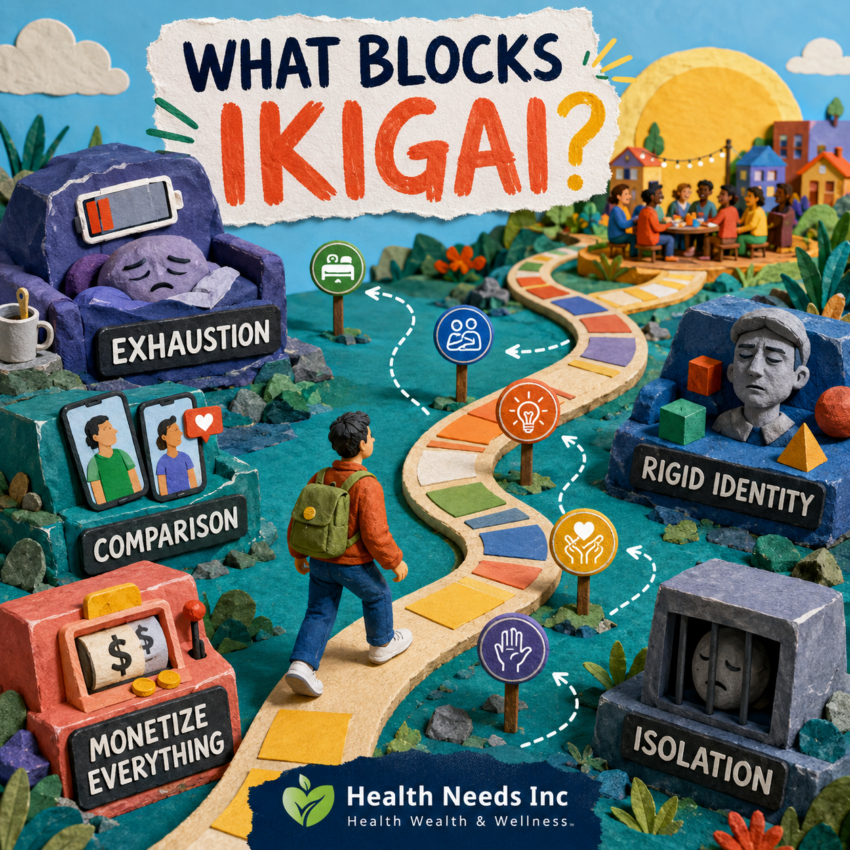
Exhaustion
A depleted nervous system may not deliver clear messages about meaning. Sleep loss, pain, caregiving, depression, unsafe work, and financial strain can reduce curiosity and pleasure; the National Institute of Mental Health’s depression guidance explains when persistent changes deserve professional attention.
Do not interpret exhaustion as evidence that your life has no purpose. Sometimes the philosophical crisis needs rest, treatment, help, or money before it needs another worksheet.
The demand for grandeur
People dismiss genuine sources of meaning because they seem too small. Caring for a cat does not sound like a legacy project, but the cat remains admirably unimpressed by legacy.
Comparison
Other people’s purpose is usually presented after editing. You see the nonprofit launch, not the lonely years, funding anxiety, complicated motives, or alarming email inbox.
Forced monetization
Turning every beloved activity into income can replace play with production. Money is necessary, but not everything valuable improves after acquiring customers.
Rigid identity
A purpose that cannot change becomes a prison decorated with inspirational quotations. Aging asks for adaptation, not betrayal.
Isolation
Meaning is often relational. Chronic isolation removes feedback, responsibility, affection, shared memory, and opportunities to matter in visible ways.
A Practical 30-Day Ikigai Practice
For the first seven days, keep a simple evidence log. Record one moment of aliveness, one moment of connection, and one moment of usefulness each day. Blank entries are data, not moral failure.
During the second week, choose two patterns and increase contact with them. Put the activity on the calendar, involve another person if appropriate, and make the commitment specific enough that reality can either support or contradict your theory.
During the third week, add responsibility. Move from consuming to contributing: help organize the group, teach the beginner, cook for someone, repair the shared space, call the isolated relative, or take ownership of a small recurring task.
Responsibility is powerful because it turns preference into relationship. Someone or something now encounters the consequences of your presence.
During the fourth week, subtract one source of counterfeit importance. Reduce an obligation performed mainly for appearance, guilt, status, or habitual compliance, provided doing so is safe and responsible.
Then review what changed. Did you anticipate the activity? Did time feel different during it? Did it deepen connection, restore energy, develop competence, or make you useful?
Keep what survived contact with life. Modify what almost worked. Release what looked meaningful only from a distance.
The goal is not a final answer. It is a more inhabited week.
Final Thoughts: Meaning Is an Ecosystem
Calling ikigai an operating system is useful if we remember that human beings are not computers. Meaning does not run silently beneath every day with perfect stability, and no update will remove grief, boredom, conflict, or the spinning wheel of doubt.
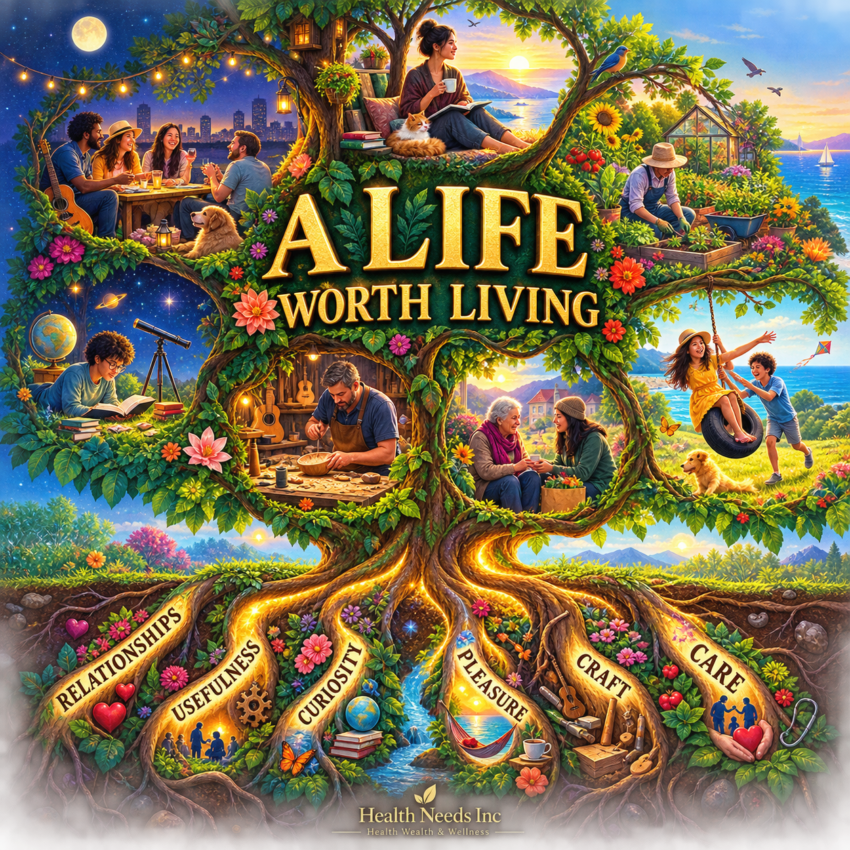
Ikigai is better understood as an ecosystem. Relationships, roles, pleasures, skills, places, memories, obligations, and hopes interact. Some grow, some fail, and some need to be replanted after circumstances change.
The Western diagram asks you to identify the perfect center. The more humane question is whether your current life contains enough reasons to remain engaged with tomorrow.
If the answer is yes, protect those reasons. Give them time, repetition, people, and practical form.
If the answer is uncertain, investigate gently. Exhaustion, depression, loneliness, illness, grief, and financial strain can conceal meaning without proving its absence.
A life worth living may include purpose, but it also includes pleasure without productivity, relationships without strategy, and activities that will never become impressive. Thank goodness. Civilization has endured enough personal brands.
FAQs About Ikigai
Ikigai can be understood as what gives life worth, meaning, pleasure, or a reason to continue engaging with it. It may describe both the source of meaning and the feeling that life is worthwhile.
It can be large or small, public or private, paid or unpaid.
No. The familiar diagram combining what you love, what you are good at, what the world needs, and what pays you is a modern Western construction rather than a traditional Japanese representation.
It may still be useful for career reflection, but it should not be confused with the broader Japanese concept.
No. Work may be one source, but ikigai can arise from relationships, caregiving, community, hobbies, learning, spirituality, nature, creativity, or daily rituals.
Requiring income excludes many meaningful parts of life and makes retirement look like an existential eviction notice.
Observational research has associated ikigai or purpose with some favorable health and longevity outcomes. These studies do not prove that acquiring purpose directly causes a longer life.
Health, relationships, income, activity, mood, and purpose influence one another, so claims should remain modest.
Yes. Multiple sources of meaning are normal and may be more resilient than one defining mission.
Relationships, craft, service, curiosity, pleasure, and responsibility can coexist and change in importance over time.
Identify what work previously provided, such as structure, people, mastery, usefulness, identity, or challenge. Rebuild the functions you still value through part-time work, volunteering, mentoring, groups, caregiving, learning, or personal projects.
Do not demand that one hobby replace an entire occupational ecosystem.
Loss of meaning can accompany grief, isolation, burnout, depression, pain, illness, or severe stress. Treat the absence of feeling as important information, not a personal failure.
Seek qualified support when hopelessness persists or daily functioning suffers. In the United States, call or text 988 if you are in crisis or thinking about self-harm.