This article is for educational and informational purposes only and is not medical advice. Persistent insomnia, severe daytime sleepiness, loud snoring, breathing pauses, unusual nighttime behavior, or sleep problems that affect safety deserve evaluation by a qualified healthcare professional or sleep specialist.
★ TL;DR
Your circadian rhythm is an internal timing system, not a personality test for “morning people” and “night owls.”
-
Light and darkness are the strongest clock-setting signals. Morning light generally shifts sleep earlier, while bright evening light tends to shift it later.
-
A stable wake time, regular meals, daytime activity, and a darker evening give the brain and body fewer contradictory time signals.
-
Do not try to repair months of disruption with one heroic bedtime. Circadian timing moves gradually, because biology has never respected a rebranding campaign.
Your body keeps time through light, darkness, meals, movement, and routine. Here is how to stop giving it five different time zones before breakfast.

Circadian rhythm is the timing system behind sleepiness and alertness.
What is a circadian rhythm?
- A circadian rhythm is a roughly 24-hour pattern in physical, mental, and behavioral functions.
- The brain’s master clock uses light as its strongest environmental cue and helps coordinate sleep, hormone release, appetite, digestion, and body temperature across the day.
Light is the main lever. Outdoor light after waking and reduced bright light before bed help distinguish biological day from biological night.
Wake time is the anchor. A reasonably consistent wake time usually gives the clock a clearer signal than chasing the perfect bedtime.
Timing affects more than sleep. Circadian rhythms influence hormones, digestion, temperature, attention, and mood.
Chronotype is real, but not absolute. Genetics, age, light exposure, work, and behavior all influence when a person naturally feels alert or sleepy.
Shift workers need a different strategy. Generic “get morning sun” advice can be badly timed for someone preparing to sleep after a night shift.
Supplements are not the opening move. Melatonin and bright-light therapy are timing tools, and poor timing can move the clock in the wrong direction.
Your Body Clock Is Not an On-Off Switch
At 10:47 p.m., millions of people perform the same small ritual. They close a laptop, inspect a phone one final time for threats from civilization, turn off the lamp, and expect consciousness to end on command.
The body, having spent the evening under bright light while absorbing news, snacks, work, and interpersonal intrigue, declines the invitation.
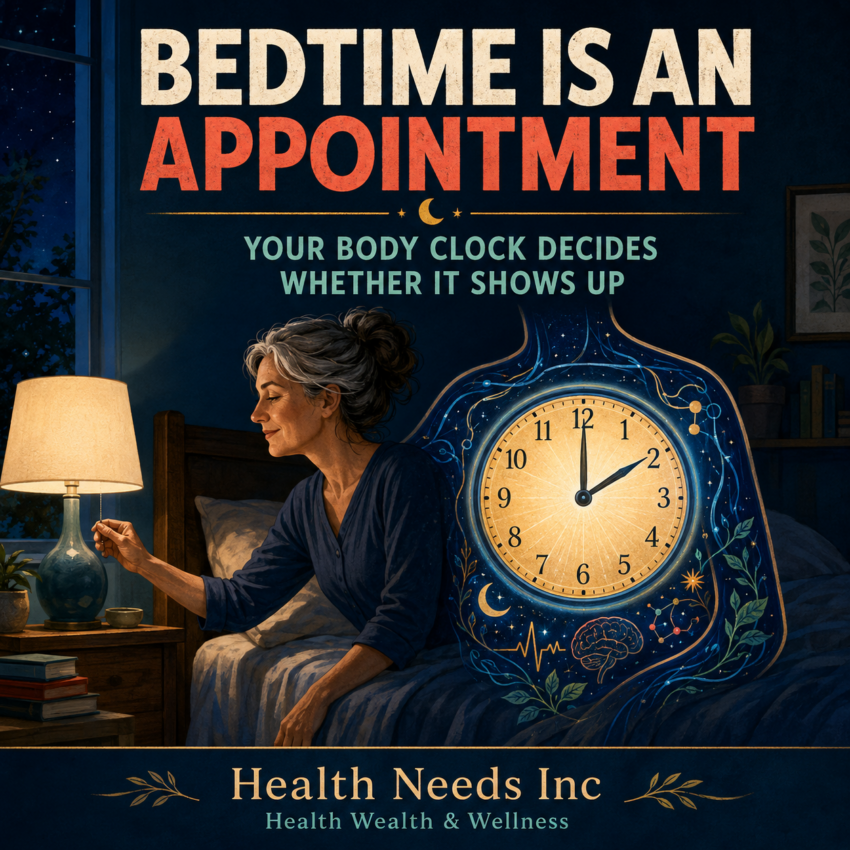
This is often described as a sleep problem. Sometimes it is. But sometimes sleep is merely arriving at the time the internal clock has been trained to expect. Bedtime is an appointment you make. Circadian timing is whether the other party shows up.
The National Institute of General Medical Sciences defines circadian rhythms as physical, mental, and behavioral changes following an approximately 24-hour cycle. Light and darkness have the largest influence, but food, stress, activity, social environment, and temperature also contribute.
That distinction matters. Better sleep hygiene improves the conditions for sleep. Circadian work addresses when the body is prepared to sleep. The two overlap, but they are not identical twins wearing matching pajamas.
How the Master Clock Works
Nearly every tissue and organ has its own circadian rhythm. The master coordinator is a cluster of nerve cells in the brain called the suprachiasmatic nucleus, or SCN. It receives information about light through the eyes and helps synchronize clocks throughout the body.
As evening light fades, the clock helps regulate melatonin production and other changes associated with biological night. Body temperature begins moving downward. Alertness eventually decreases. Sleep pressure, which has accumulated through time awake, meets circadian permission to sleep.
These are two related systems. Sleep pressure is more like an hourglass that fills while you are awake. Circadian rhythm is more like the office schedule deciding when the maintenance crew is allowed inside. A long day creates pressure, but bright evening light or a delayed body clock can still keep the doors locked.
Researchers have estimated the average intrinsic human circadian period at about 24.18 hours under controlled conditions. That small daily drift helps explain why environmental cues matter. The clock must be reset repeatedly, like an elegant antique watch that evolved before streaming television.
The result is not one daily wave. Alertness rises and falls, temperature changes, hormones follow patterns, and appetite and digestion have timing of their own. This is why circadian disruption can feel broader than “I slept badly.” The whole orchestra has misplaced the conductor.

Signs Your Timing May Be Misaligned
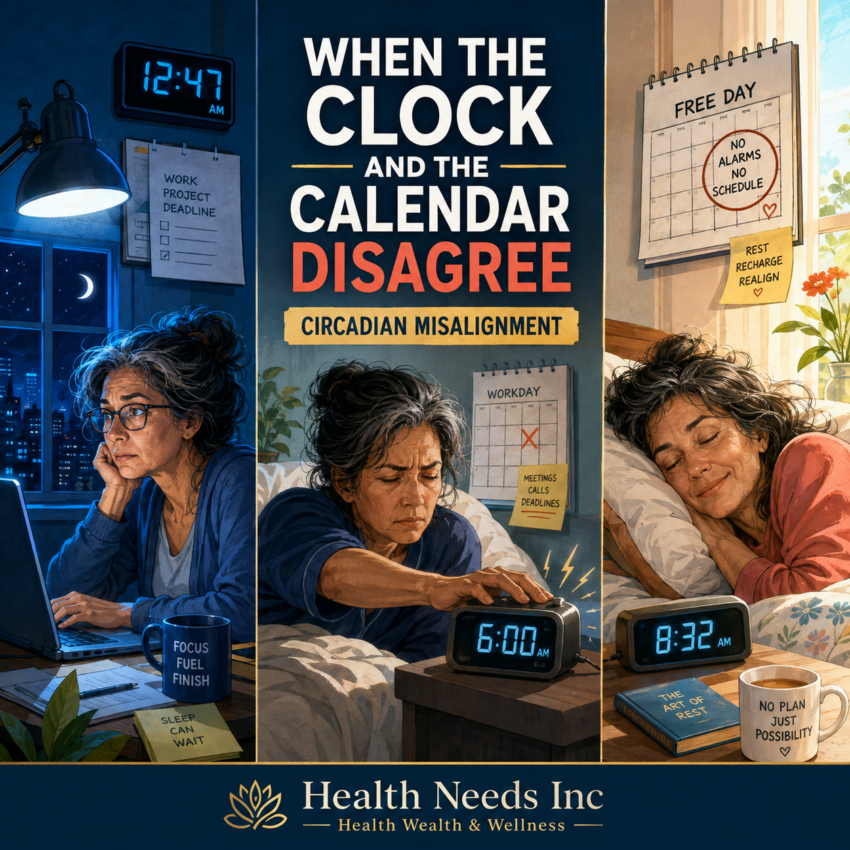
Circadian misalignment means the internal timing system and required schedule are pulling in different directions. Jet lag is the obvious example. Your watch knows you are in London. Your liver remains emotionally committed to Boston.
Common clues include difficulty becoming sleepy at the desired bedtime, extreme difficulty waking for obligations, better sleep when allowed to follow a later or earlier schedule, repeated “Sunday night insomnia,” or feeling as though every workweek begins with miniature jet lag.
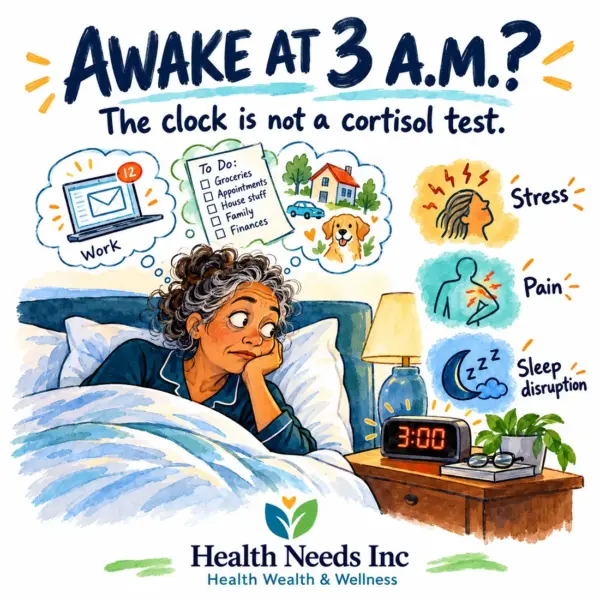
These clues do not prove a circadian disorder. Insomnia, sleep apnea, restless legs, medication effects, pain, mood disorders, caregiving, menopause, alcohol, and plain insufficient sleep can produce overlapping symptoms. The internet enjoys diagnosing every 3 a.m. awakening as cortisol, trauma, or mercury being in litigation. Bodies are less tidy.
The useful question is not “Is my circadian rhythm broken?” It is “Are my signals and obligations consistently asking my body to be awake and asleep at opposing times?”
Light Is the Strongest Time Signal
Light is not merely something that helps you see the furniture. It is biological information. According to NIOSH guidance on light and circadian timing, morning and evening light have opposite effects for people sleeping at conventional nighttime hours.
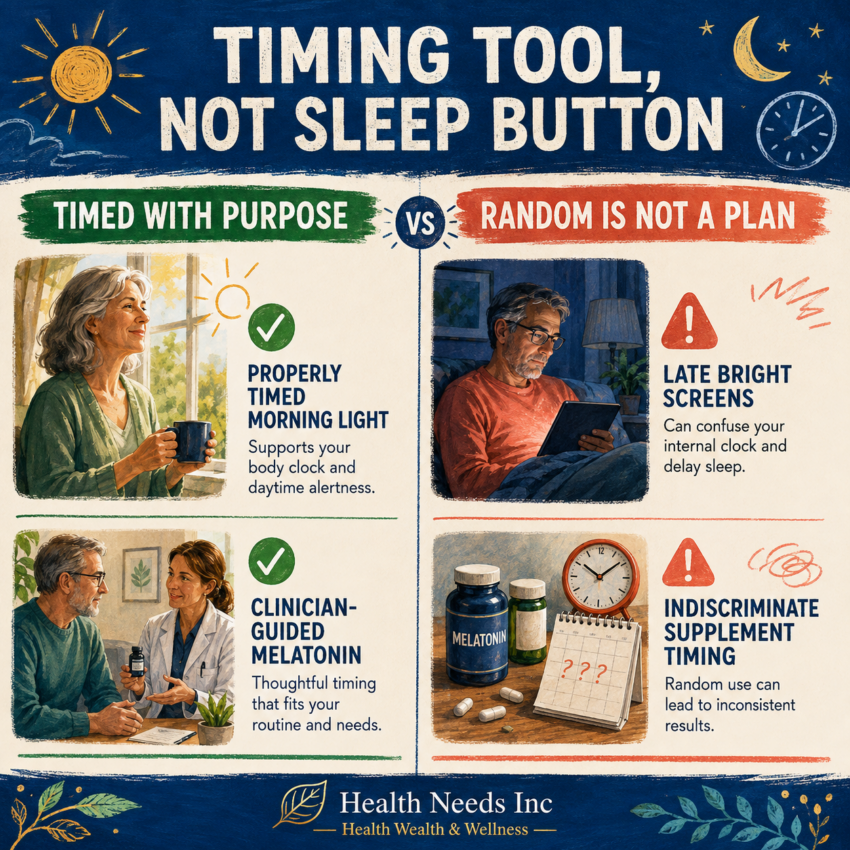
Bright light around the usual waking period generally advances the clock, encouraging earlier sleepiness and earlier waking. Bright evening light generally delays it. Timing matters more than wellness slogans such as “get sunlight,” which are technically correct in the way “use money wisely” is technically financial planning.
Outdoor light is usually much brighter than ordinary indoor lighting, even on many cloudy days. A practical approach is to spend some time outdoors after waking, without staring at the sun or converting breakfast into retinal combat.
At night, reduce the contrast between a dark world and a brightly illuminated home. Dim overhead lights. Use warmer, lower lamps. Put bright screens farther from the face or stop using them before bed. Our forthcoming guide, Blue Light, Melatonin, and You, separates meaningful light management from the marketing opera surrounding orange glasses.
The Seven-Day Rhythm Reset
This is an observation tool, not a medical test. Its purpose is to reduce contradictory signals and reveal patterns. Do not force an early bedtime while lying awake and furious. That turns the bed into a courtroom.
Seven-Day Circadian Reset Worksheet
- Choose one wake-time window. Keep it within about 30 minutes each day, including the weekend if practical.
- Record first outdoor light. Note the time and approximate duration. Do not worry about laboratory precision.
- Record caffeine timing. Include tea, soda, energy drinks, and the “small” coffee that arrived in a bucket.
- Record meal windows. Note the first and last substantial calories of the day.
- Record movement. Write down when you walked, exercised, or spent meaningful time physically active.
- Begin evening dimness. Choose a repeatable time to lower lights and stimulation.
- Track sleepiness, not just bedtime. Note when genuine drowsiness appears, when you got into bed, and when you estimate sleep began.
After seven days, look for inconsistency rather than perfection. If wake time varies by three hours, evening light remains bright, and the last meal moves from 7 p.m. to midnight, the body is not failing. It is receiving a committee report with no final recommendation.
Anchor the Wake Time Before Chasing Bedtime
People often begin by declaring a heroic bedtime. Tonight, they announce, sleep shall begin at 9:30. The body, which became accustomed to 12:45, files an appeal.
A stable wake time is usually the cleaner anchor because it sets the start of the light, activity, meal, and social day. It also allows sleep pressure to accumulate more predictably. Bedtime can then move as sleepiness begins arriving earlier.
This does not mean everyone must wake at 5 a.m. The wellness industry has confused dawn with moral virtue because sunrise photographs sell courses. The correct wake time is one that fits health needs, obligations, sleep duration, and actual life.
If the schedule is far from the desired target, gradual shifts are usually more tolerable than a one-night revolution. Move wake time and morning light earlier in modest increments, then protect the evening from bright light and stimulation. Give the clock several days to respond.
A repeatable 20-minute nighttime ritual can support the transition. Its job is not to sedate you through theater. It is to create a recognizable border between public life and biological night.

Meals, Movement, and Temperature Are Secondary Clocks
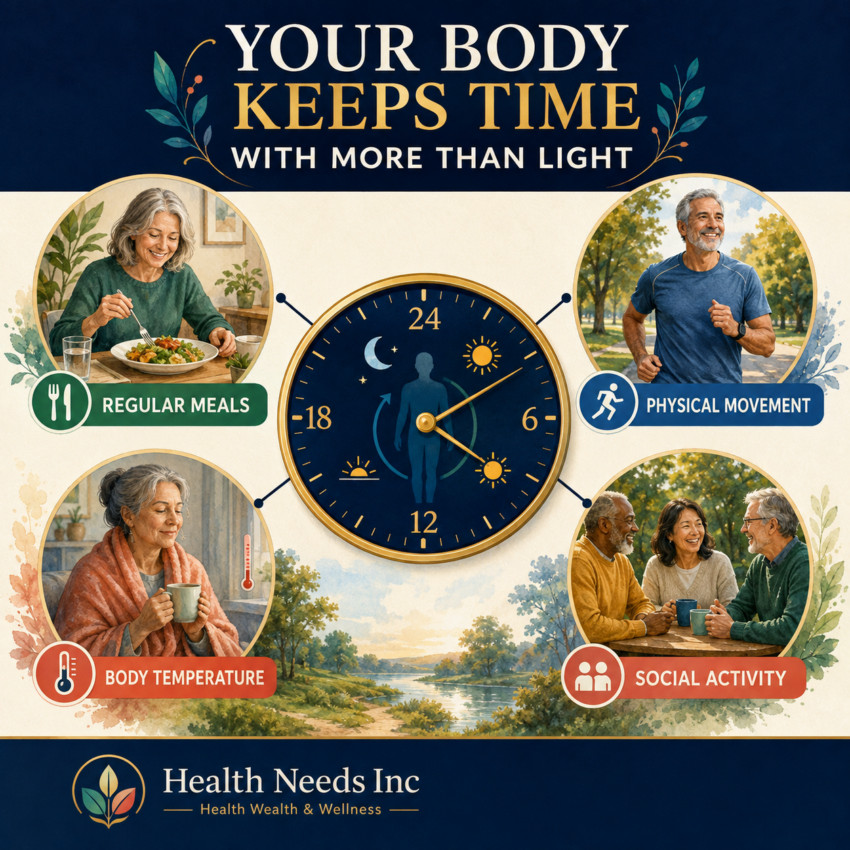
Light is the strongest cue for the brain’s master clock, but it is not the only cue the body receives. Meal timing, physical activity, social interaction, and temperature can influence peripheral clocks in organs and tissues.
A small laboratory study of ten healthy young men found that delaying meals shifted glucose and fat-tissue clock markers without shifting melatonin or cortisol rhythms. It did not demonstrate improved sleep or establish an ideal mealtime for everyone. Translation: the brain may think it is one time while metabolism receives a different memo.
There is no need to turn dinner into a chronobiology exam. Aim for a reasonably stable eating window and avoid making the largest meal a midnight surprise whenever possible. Meal quality and total intake still matter. Time does not sprinkle nutritional absolution over a doughnut.
Movement provides another daytime signal and can improve sleep, mood, and health independently of circadian effects. The ideal exercise time is the time you can repeat safely, but vigorous late-evening exercise affects people differently. Track the response instead of obeying a universal rule carved into a foam roller.
Body temperature also follows a daily rhythm. A cool, dark, quiet bedroom supports the natural nighttime drop in temperature. Our guide to creating the perfect sleep sanctuary covers light, temperature, and sound without pretending the room needs to resemble a Scandinavian sensory-deprivation chamber.
Chronotype Without the Astrology
Chronotype describes a person’s tendency toward earlier or later sleep and activity timing. Morning larks and night owls are not inventions, although social media has naturally converted them into identities, merchandise, and excuses for unanswered email.
Genetics contributes. So do age, light history, work schedule, family life, health, and behavior. Chronotype is a tendency, not a prison sentence. Many people can shift somewhat, but not everyone can comfortably thrive at the same clock time.
This matters because advice designed for an early chronotype can sound absurd to someone whose biology runs later. Telling that person to “just go to bed earlier” resembles telling a short person to become more shelf-compatible.
The practical compromise is to respect the tendency while reducing unnecessary misalignment. Seek bright light after the chosen wake time, keep the schedule steadier, limit late bright light, and avoid swinging several hours between workdays and weekends when possible.
How Aging Changes Circadian Rhythm
Sleep often becomes earlier and more fragmented with age, but “older people need no sleep” is folklore with excellent staying power and poor manners. Many older adults still need roughly seven to nine hours, although individual needs vary.
Age-related changes can weaken or advance circadian signals. The eye may transmit less light, activity and social routines may change, medical conditions may interrupt sleep, and medications may alter alertness. Daytime napping can then reduce sleep pressure, which encourages more nighttime wakefulness, which encourages more napping. The circle is impressively efficient.
Older adults may benefit from stronger daytime cues: outdoor light, regular activity, consistent meals, social contact, and a clear contrast between daytime brightness and nighttime darkness. Safety comes first. Mobility, fall risk, eye disease, and medication effects can change the plan.
Sleep also supports immune function, and chronic sleep disruption deserves more respect than it receives. The forthcoming Sleep and Immunity article examines the relationship without claiming that eight hours creates a force field around the respiratory tract.

Shift Work and Jet Lag Require Different Rules
Night workers live inside a conflict most wellness advice ignores. Their job demands alertness when the body expects sleep, then the morning commute exposes them to light when they are trying to prepare for daytime rest.
NIOSH notes that timed bright light and darkness may help permanent night workers adapt, but the strategy depends on the shift pattern. Rotating schedules are more difficult because the clock is repeatedly asked to relocate. Generic morning-light advice may push the timing in exactly the wrong direction.
Night workers should prioritize safety, protect a dark and quiet sleep period, discuss persistent symptoms with an occupational-health professional or sleep specialist, and avoid driving when dangerously drowsy. No article should pretend a blackout curtain solves a staffing system.
Jet lag is temporary circadian misalignment after crossing time zones. Eastward travel usually requires an earlier clock; westward travel usually requires a later one. Timed light, gradual schedule shifts before travel, and careful planning can help. The correct timing depends on direction, number of zones, baseline schedule, and arrival obligations.
Melatonin and Light Therapy Are Timing Tools
Melatonin is often sold as a generic sleep button. It is better understood as a biological timing signal. Dose, timing, formulation, interactions, product quality, age, and the actual sleep problem all matter.
Taking melatonin at the wrong biological time may be ineffective or move circadian timing in an unwanted direction. It can also cause side effects and interact with medications. People who are pregnant, have chronic conditions, take prescription drugs, or are considering it for children should discuss it with a qualified clinician.
Bright-light devices are also not decorative sunshine. Intensity, timing, distance, duration, eye conditions, migraine susceptibility, bipolar disorder, and medications that increase light sensitivity can matter. Clinical guidance is sensible when using light to shift a significant circadian problem.
The order of operations is less glamorous: clarify the schedule, stabilize wake time, manage natural light and darkness, then decide whether a targeted tool is warranted. The supplement aisle may experience disappointment.
A Practical Daily Circadian Plan
Morning
- Wake within a consistent window.
- Seek outdoor light reasonably soon after waking.
- Move the body and eat at a fairly predictable time.
- Avoid using caffeine as a substitute for chronically insufficient sleep.
Daytime
- Spend time in bright environments, preferably including outdoor light.
- Exercise at a time you can sustain.
- Keep meals reasonably regular.
- Notice the afternoon dip without treating it as evidence of personal collapse.
Evening
- Reduce bright overhead lighting as bedtime approaches.
- Finish large meals and vigorous activity early enough to observe how your sleep responds.
- Use a short, repeatable wind-down ritual.
- Enter bed when sleepy, not merely because a spreadsheet assigned the hour.
Run the plan for two weeks before judging it, unless it worsens symptoms or creates safety concerns. Look for earlier natural sleepiness, easier waking, steadier daytime alertness, and less weekend schedule whiplash.
Wellness without the clock worship.
Get practical health and wellness thinking without miracle claims, panic marketing, or expensive objects that glow beside the bed.
When Circadian Problems Need Professional Help
Seek professional evaluation when sleepiness affects driving or work safety, insomnia persists despite adequate opportunity for sleep, the desired sleep schedule is repeatedly impossible, or symptoms suggest sleep apnea, restless legs, parasomnia, depression, mania, medication effects, or another condition.
Circadian rhythm sleep-wake disorders include delayed sleep-wake phase disorder, advanced sleep-wake phase disorder, irregular sleep-wake rhythm, non-24-hour sleep-wake rhythm, shift-work disorder, and jet-lag disorder. These are clinical conditions, not hashtags for staying up late.
A sleep diary, medication list, work schedule, and two weeks of wake, light, meal, and sleep timing can make an appointment more useful. A clinician may recommend behavioral timing, light, darkness, melatonin, testing, or treatment for another sleep disorder depending on the pattern.

Final Thoughts on Mastering Your Circadian Rhythm
“Mastering” the circadian rhythm does not mean dominating biology with a color-coded morning routine. It means creating enough consistency that the body no longer has to guess whether 11 p.m. is bedtime, lunchtime, or an emergency meeting.
Begin with the strongest signals. Choose a workable wake time. Find daylight after waking. Let daytime be bright and active. Let evening become dimmer and quieter. Keep meals and movement reasonably predictable.
Then observe. The body is not a machine, but it is a pattern detector of astonishing patience. Give it a coherent pattern and it often stops arguing quite so loudly at midnight.
This is one part of Physical Wellness, which is itself only one part of the Eight Dimensions of Wellness. Sleep timing affects mood, work, relationships, thinking, and the fragile diplomacy required to function among other humans before coffee.
Your internal clock does not need perfection. It needs fewer contradictory instructions. In modern life, that qualifies as a radical act.

FAQs About Circadian Rhythm and Better Sleep
The clock usually shifts gradually rather than overnight. The pace depends on the size and direction of the change, light exposure, consistency, chronotype, age, health, and whether shift work or travel continues disrupting the schedule. Modest changes may feel easier within days, while larger changes can take longer.
There is no universally safe instant reset. A consistent wake time, properly timed outdoor light, reduced evening light, and gradual schedule changes are practical starting points. Extreme sleep deprivation can impair judgment and driving and is not a sensible do-it-yourself treatment.
For people who sleep at conventional nighttime hours, bright light around the normal waking period generally shifts the clock earlier and reinforces daytime alertness. Timing matters. Night workers and people with circadian disorders may need a different light plan.
Meal timing can influence peripheral clocks and metabolic rhythms. An occasional late meal is not a biological catastrophe, but highly irregular or consistently late eating may add another conflicting time signal. Meal quality, total intake, health conditions, and medication schedules still matter.
A later chronotype is not a moral or medical failure. Problems often arise when a person’s natural timing conflicts sharply with work, school, caregiving, or social demands. Sleep duration, regularity, light exposure, and overall health behavior matter more than winning an imaginary sunrise contest.
Melatonin can affect circadian timing, but the direction and benefit depend on when it is taken. Product quality, dose, side effects, health conditions, and medication interactions also matter. Discuss targeted use with a qualified clinician or sleep specialist rather than treating it as a generic bedtime vitamin.
You may be repaying sleep debt, following a schedule closer to your chronotype, or escaping workday stress and alarms. Large weekend shifts can also create social jet lag, making Sunday night and Monday morning harder. Track both sleep duration and timing before blaming one factor.