
Physical Wellness: A Practical, Complete Guide
The body is not a lifestyle accessory. It is the equipment through which every other dimension of wellness must pass.


Your body is not a productivity appliance. It is your transportation system through work, grief, grocery stores, relationships, aging, bad chairs, and the occasional decent sandwich.
We are encouraged to treat it as a renovation project. There is always a cleanse, challenge, wearable, powder, injection, cold tub, or person with remarkable abdominal definition standing by to explain that maintenance is for civilians.
The simpler truth lacks theater. Physical wellness is the daily practice of supporting how the body moves, sleeps, eats, recovers, functions, and signals that something needs attention.
It is not a body type. It is not proof of virtue. It is not a permanent before-and-after photograph with good lighting and suspicious emotional claims.
It is capacity. Enough energy, strength, balance, mobility, recovery, and health maintenance to remain involved in the life available now.
Physical wellness is not the art of controlling a body into submission. It is the practice of keeping that body capable of carrying a life.
For educational purposes only. This guide provides general wellness information, not medical diagnosis or treatment. Health needs, abilities, medications, disabilities, injuries, and risks vary. Consult a qualified health professional before making major changes or when pain, dizziness, breathing difficulty, persistent fatigue, or other concerning symptoms occur.
Key Takeaways
- Physical wellness is broader than exercise. Sleep, food, recovery, preventive care, mobility, balance, and symptom awareness belong in the same conversation.
- Function is the useful outcome. Strength and stamina matter because they support independence, work, play, caregiving, and participation.
- Some movement is better than none. Public-health targets are destinations, not moral borders between successful and failed humans.
- Recovery is part of training. More stress is not automatically more progress, however impressive the suffering looks on social media.
- Access shapes health. Time, money, disability, neighborhood design, work, caregiving, and medical access affect what is realistically possible.
What Physical Wellness Actually Means
Physical wellness means supporting the body’s ability to function, adapt, recover, and participate. Exercise belongs inside it, but exercise is not the whole building.
The foundation includes everyday movement, cardiovascular capacity, muscular strength, mobility, balance, sleep, nourishment, hydration, preventive care, dental and vision care, medication management when relevant, and attention to meaningful changes.
It also includes restraint. Resting an injury can be physically intelligent. Asking for help can be physically intelligent. Modifying an exercise can be more intelligent than performing the impressive version badly for an audience of three distracted strangers.
A useful definition must make room for chronic illness, disability, pain, fatigue, limited money, irregular work, and caregiving. If a definition only works for healthy people with free afternoons, it is not a definition. It is a resort brochure.
Function Matters More Than the Wellness Costume
Appearance is visible, easy to market, and notoriously bad at revealing the full condition of a human body. Thinness does not prove cardiovascular fitness. Muscle definition does not reveal sleep quality, pain, blood pressure, food anxiety, or whether someone can carry groceries without resentment from the lower back.
Function asks better questions. Can you rise from a chair, climb stairs, walk far enough to participate, lift, reach, bend, balance, recover, concentrate, and sleep?
These questions are not glamorous. Neither is brushing your teeth, but civilization has wisely resisted turning that into a 90-day transformation challenge.
The useful target changes. At 30 it may be athletic performance. In midlife it may include preserving muscle while managing work and caregiving. Later, balance, leg strength, endurance, and recovery from illness may matter more than shaving seconds from anything.
The target should serve the life. The life should not be reorganized around serving the target.
↪ Deep dive: Physical wellness without the fitness cult nonsense →Movement Is the Baseline, Not a Punishment
Federal guidance recommends that adults work toward 150 to 300 minutes of moderate-intensity aerobic activity each week, or the vigorous equivalent, plus muscle-strengthening activity on at least two days. It also emphasizes a point frequently lost when numbers arrive wearing the expression of a middle manager: any amount of moderate-to-vigorous activity can provide benefits.
Walking counts. Dancing counts. Cycling, swimming, gardening, wheeling, active chores, recreation, and shorter movement periods can count. The Physical Activity Guidelines for Americans removed the old requirement that activity occur only in ten-minute bouts.
The CDC describes immediate and long-term benefits, including better function and sleep. Movement is not a universal cure. It is a recurring signal to the body that its capacities are still required.

Reduce friction before increasing ambition
A plan survives when it fits the geography of an ordinary day. Put walking shoes where you see them. Attach ten minutes of movement to lunch. Keep a resistance band beside the chair that has been quietly negotiating your surrender.
- Choose one movement you tolerate or enjoy.
- Give it a reliable cue, such as breakfast or the end of work.
- Use a minimum version for difficult days.
- Increase time, resistance, or difficulty gradually.
- Track repetition before chasing performance.
Strength, Mobility, and Balance Protect Participation
Aerobic activity receives much of the attention because walking is easy to explain and running photographs well. Strength is the quieter infrastructure beneath standing, lifting, carrying, climbing, and recovering.
For older adults, the CDC recommends a combination of aerobic, muscle-strengthening, and balance activity. The exact activity should reflect ability, health, and safety.
Mobility is not circus-grade stretching. It is enough usable range of motion for the tasks you value. Balance is not merely standing on one foot while brushing your teeth because a lifestyle account suggested it. It is the ability to control position during the movements life actually asks you to perform.
Strength work can use body weight, resistance bands, free weights, machines, water, or appropriately chosen household objects. People with injuries, chronic conditions, recent surgery, significant pain, or balance concerns may need professional guidance.
Adaptation is not a lesser form of exercise. It is what intelligent exercise looks like when reality enters the room.↪ Deep dive: Yoga, mobility, balance, and how to begin →
The Physical Wellness Reality Check
Score each area from 0 to 2. Zero means rarely supported, one means inconsistent, and two means reasonably supported most weeks. This is a reflection tool, not a medical screening test and not a tiny courtroom for prosecuting yourself.
How to use the result: Do not chase the total. Choose the lowest-scoring area that is both important and realistically changeable. Define one action small enough to repeat for two weeks. This tool does not diagnose health conditions or measure disease risk.
Sleep and Recovery Are Physical Work
Sleep is often treated as leftover time after productivity, entertainment, worry, and scrolling have finished eating. The body is then blamed for being tired, rather like refusing to charge a phone and criticizing its attitude.
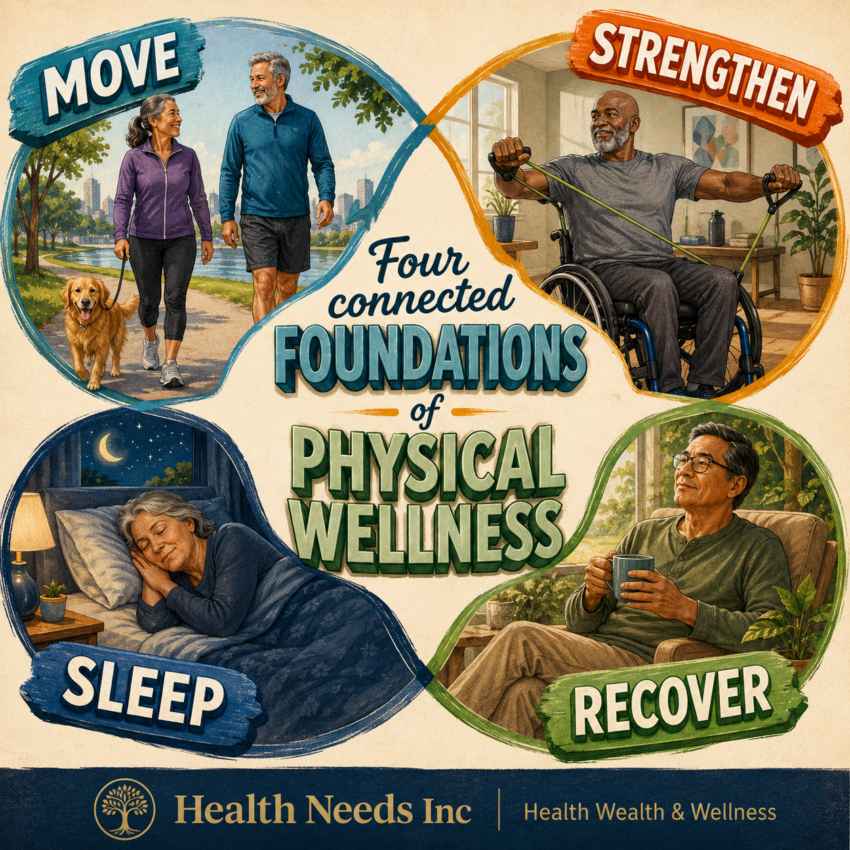
The National Heart, Lung, and Blood Institute reports that adults generally need seven to nine hours. Individual needs vary, and sleep quality, timing, medical conditions, medications, pain, caregiving, work schedules, menopause, and breathing disorders can complicate the tidy recommendation.
Recovery also includes lower-intensity days, rest between strength sessions, sufficient food, hydration, and changes in training when the body is ill or injured. Exercise creates a demand. Recovery is where adaptation has a chance to occur.
A dark room and consistent bedtime can help, but serious sleep problems are not decorative-pillow failures. Persistent insomnia, loud snoring, gasping, morning headaches, excessive daytime sleepiness, restless legs, or a major change in sleep deserves professional attention.
↪ Deep dive: Sleep hygiene for people who are tired all the time
↪ Deep dive: Mastering your circadian rhythm
Food and Hydration Without the Purity Religion
Nutrition matters. Nutritional perfection is a commercial invention used to keep normal eating permanently dissatisfied with itself.
A physically supportive eating pattern generally provides adequate energy, protein, fiber, fluids, and a variety of nutrient-dense foods while respecting medical needs, culture, budget, access, and preference. That description is less exciting than “reset your metabolism by Tuesday,” but it has the advantage of not being nonsense.
Food affects energy, training, recovery, digestion, bone health, muscle maintenance, blood glucose, cardiovascular risk, and pleasure. Pleasure belongs on the list because a life cannot be maintained indefinitely as a laboratory protocol.
Hydration needs vary with activity, climate, illness, medications, and health conditions. Anyone given fluid restrictions for heart or kidney conditions should follow individualized medical advice rather than internet commandments involving enormous branded bottles.
If eating is dominated by fear, bingeing, purging, severe restriction, or obsessive rules, the answer is not a stricter plan. It is support from appropriately qualified professionals.

Wellness Without the Fog Machine
Get evidence-aware health and wellness thinking without miracle cures, purity contests, or people shouting from stationary bicycles.
Preventive Care Is the Boring Machinery That Matters
Physical wellness includes the appointments nobody turns into cinematic social-media reels. Blood pressure checks. Vaccinations. Dental cleanings. Vision exams. Medication reviews. Age- and risk-appropriate screening.
The appropriate schedule depends on age, sex, anatomy, family history, prior results, smoking history, medications, and individual risk. The U.S. Preventive Services Task Force publishes evidence-based recommendations, but personal decisions still belong in a conversation with a clinician.
Prevention does not mean every test for everyone. More testing can create false positives, anxiety, follow-up procedures, cost, and occasionally harm.
The intelligent question is not “What can be tested?” It is “What is recommended for someone with my risks, and what would we do with the result?”
Dental, vision, and hearing care belong here too. Mouth pain, gum disease, impaired vision, hearing problems, and poorly fitting footwear can alter eating, movement, balance, sleep, communication, and social life.
Pain and Symptoms Are Information, Not Character Tests
Some discomfort can accompany unfamiliar effort. Persistent, severe, worsening, or unusual pain is not a mandatory toll paid to the gods of discipline.
Chest pressure, fainting, severe breathing difficulty, sudden weakness or numbness, a major new neurological symptom, or an acute serious injury warrants urgent evaluation. Persistent pain, weakness, fatigue, swelling, dizziness, or reduced function also deserves attention.
Pushing through everything is not toughness. It is a strategy with no quality-control department.
At the other extreme, fear can shrink movement long after tissues have healed or when safe activity might help function. A clinician or physical therapist can sometimes help distinguish protection from avoidance and plan a graded return.

Physical Wellness Is Shaped by the World Around the Body
Advice becomes dishonest when it pretends everyone is choosing from the same menu. Safe streets, stable housing, predictable work, money for food, accessible transportation, nearby care, and time not consumed by caregiving all influence health behavior.
A person working two physical jobs may not need a lecture about moving more. A wheelchair user may need accessible equipment, informed coaching, and transportation. Someone living with chronic fatigue may need pacing, not exhortation.
Personal habits matter, but so do systems. Sidewalks matter. Work schedules matter. Insurance matters. Food prices matter. Parks, stairs, air quality, heat, safety, and discrimination matter.
Shame takes structural problems, disguises them as personal failure, and then sells the victim a subscription.

Work with the constraint you actually have
When time is scarce, shorten the session. When standing is difficult, explore seated or supported options. When money is scarce, use walking, household resistance, community programs, and free credible resources.
Consistency does not mean repeating the same action forever. It means continuing the relationship.
Where Should You Start?
| Your main obstacle | Start with | A realistic first move | What to verify |
|---|---|---|---|
| Low daily energy | Sleep, recovery, symptoms | Protect sleep opportunity and note persistent fatigue | Whether symptoms need clinical evaluation |
| Long periods of sitting | Everyday movement | Add two brief movement periods to an existing routine | What intensity is appropriate for you |
| Loss of strength | Resistance work | Begin two adapted full-body sessions weekly | Technique, pain, and medical limitations |
| Unsteadiness | Balance and mobility | Use supported practice or request an assessment | Fall risk, medications, vision, and footwear |
| Food confusion | Reliable nourishment | Build two repeatable meals before optimizing details | Medical or medication-related nutrition needs |
| Pain limiting activity | Evaluation and adaptation | Identify tolerable movement and seek guidance | Whether pain signals injury or another condition |
| Too many problems at once | One weak link | Choose one action for two weeks | Whether the problem is important and changeable |
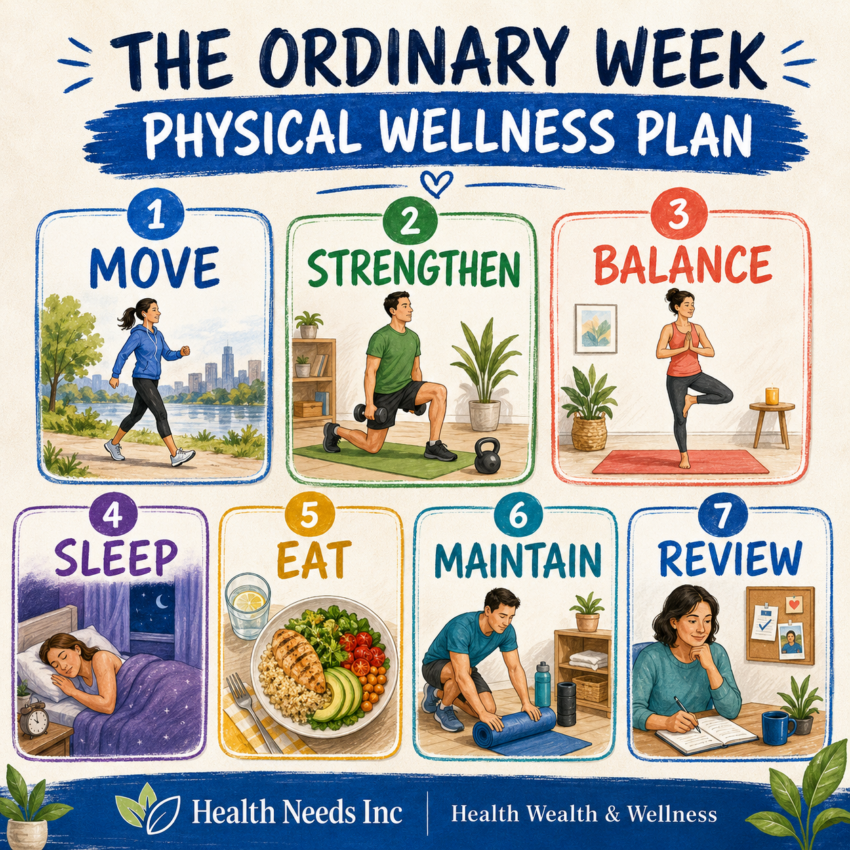
A 30-Day Physical Wellness Plan for Ordinary Life
The best routine is not the most comprehensive one you can imagine. It is the smallest complete system you can keep alive when work runs late, the weather turns, motivation disappears, and the refrigerator begins making legal arguments.
Week 1: Observe before prescribing
Notice movement, sitting, sleep opportunity, energy, pain, food reliability, and appointments you have postponed. Complete the Reality Check. Choose one weak link.
Week 2: Establish a movement floor
Choose a minimum amount of daily or near-daily movement that remains realistic. Good days can hold more. Difficult days keep the floor alive.
Week 3: Add strength and balance
Add two appropriately adapted strength sessions. Practice one physical skill you want to keep, such as stairs, balance, carrying, rising from a chair, or walking endurance.
Week 4: Repair the supporting system
Protect sleep opportunity. Make food easier. Schedule one overdue maintenance task. Review what became easier, harder, painful, unstable, or unusually exhausting.
A plan should make an ordinary week more workable. If maintaining the plan requires a second life, the plan has misunderstood its assignment.
Physical Wellness Does Not Operate Alone
Physical health influences emotional steadiness, social participation, work, money, learning, surroundings, and meaning. The arrows run both ways because life has never respected departmental boundaries.
Financial strain can delay care. Loneliness can make movement harder to sustain. A punishing job can disrupt sleep and recovery. An unsafe neighborhood can turn “take a walk” into advice written for somebody else.
This is why HNI treats physical wellness as one part of the Eight Dimensions of Wellness. The body carries the rest of life, but the rest of life also determines what the body is being asked to carry.
Final Thoughts on Physical Wellness
Physical wellness is the core of a life that actually works because the body is where life happens. Work, friendship, thought, grief, appetite, pleasure, fatigue, illness, recovery, and independence all happen there.
The body will change. That is not failure. The useful question is how to support capacity, reduce avoidable harm, respond to what changes, and remain involved in the life available now.
Move in ways you can repeat. Maintain strength. Practice balance and mobility. Protect sleep. Eat without turning lunch into a theology exam. Keep up with appropriate care. Notice symptoms. Rest when rest is intelligent.
No perfect routine is coming. Fortunately, one is not required.
A workable life is built through maintenance, adaptation, and repeated returns. The glamorous part has been wildly overstated. The returning is where most of the value lives.
The goal is not to win a body. You already have one. The goal is to keep it meaningfully involved in your life.
Your Physical Wellness Quick Start
- Complete the Reality Check without grading your character.
- Choose the lowest important area you can realistically influence.
- Define one action small enough to repeat for two weeks.
- Notice function: what becomes easier, steadier, less painful, or less exhausting.
- Seek qualified help when symptoms, risk, or uncertainty make self-direction unwise.
Frequently Asked Questions About Physical Wellness
More Physical Wellness Deep Dives

Physical Wellness Without the Fitness Cult Nonsense
Build capacity without punishment, appearance worship, or expensive theater.
Sleep Hygiene for People Who Are Tired All the Time
The daily habits that create a real opportunity for sleep.
Mastering Your Circadian Rhythm
How light, timing, routine, and biology shape sleep.
Creating the Perfect Sleep Sanctuary
Light, temperature, sound, and what the bedroom can actually fix.
The Science-Backed Benefits of Mindful Meditation
What meditation may help, what it cannot promise, and how to begin.
What Wellness Assessments Actually Measure
Use self-assessment without confusing a score with a diagnosis.
Glossary of Physical Wellness Terms
- Cardiovascular capacity
- The ability of the heart, lungs, blood vessels, and working muscles to support sustained activity.
- Moderate-intensity activity
- Activity that noticeably raises breathing and heart rate while usually still allowing conversation.
- Resistance training
- Exercise in which muscles work against resistance from body weight, bands, weights, machines, water, or other appropriate loads.
- Mobility
- Usable movement through a joint’s available range, including the strength and control required to use that range.
- Balance
- The ability to control body position while still or moving.
- Recovery
- The rest, sleep, nutrition, hydration, and adjustment that allow the body to respond to physical demands.
- Progressive overload
- A gradual increase in training demand. Progress can involve resistance, repetitions, range, time, frequency, or complexity.
- Preventive care
- Evidence-based screening, vaccination, counseling, and routine care intended to reduce risk or identify problems earlier.
- Physical function
- The practical ability to perform activities such as walking, rising, carrying, reaching, balancing, and participating in daily life.