
The 8 Dimensions of Wellness: A Practical Guide to a Life That Actually Works
Wellness is not a green drink, a morning routine, or a moral ranking system. It is the negotiation between your body, mind, money, work, relationships, surroundings, curiosity, and sense of meaning.
 By Daniel Buck
Wellness Researcher and Founder, Health Needs Inc
Published July 2026 · Reviewed against current public-health sources
Key Takeaways
- The eight dimensions are physical, emotional, financial, occupational, social, intellectual, environmental, and spiritual wellness.
- The dimensions overlap. Strain in one area can spread, while one useful change can support several areas at once.
- Balance does not mean equal scores or equal time. Priorities change with health, age, work, caregiving, grief, money, and circumstance.
- Wellness includes structural conditions such as housing, income, access to care, safe work, transportation, and community.
- Start with one pressure point. Eight simultaneous reinventions are merely burnout with a color-coded wheel.
- Use assessments as prompts for reflection, never as diagnoses or moral report cards.
Wellness has suffered the same fate as coffee, mattresses, and basic human sadness: an industry noticed people needed it and immediately made it confusing, expensive, and available by subscription.
Underneath the sales machinery sits a useful idea. A good life depends on several systems at once.
Sleep affects mood. Work affects the body.
Money affects the nervous system.
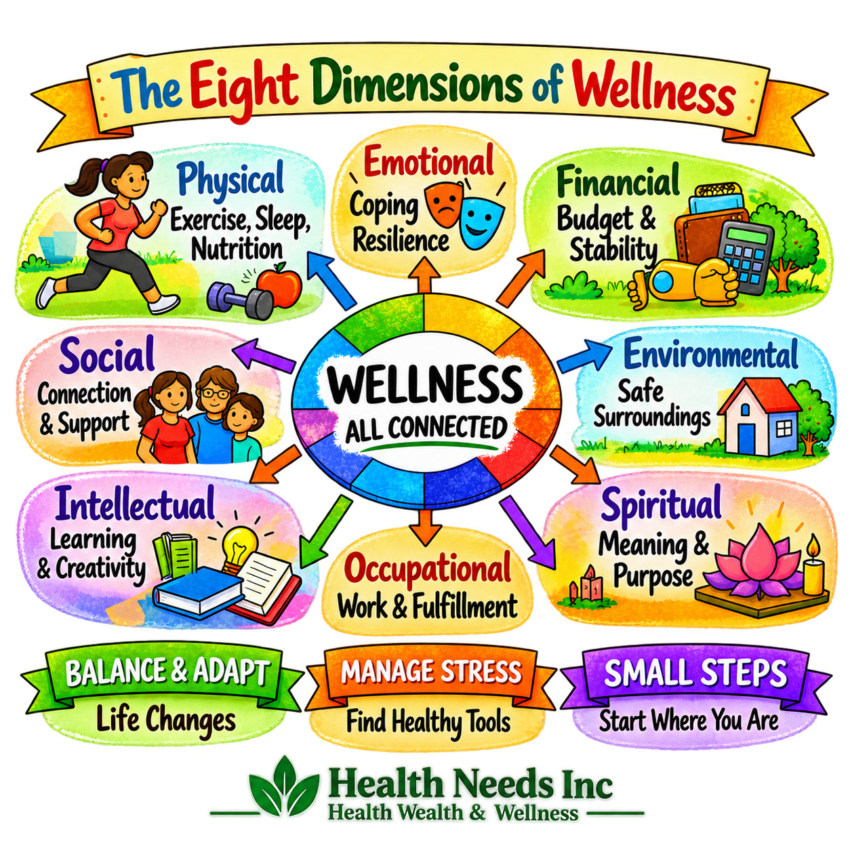
Relationships affect whether a terrible week becomes survivable or merely louder. SAMHSA organizes wellness into eight dimensions: physical, emotional, financial, occupational, social, intellectual, environmental, and spiritual. The framework is not a diagnosis or a demand for perfect balance.
It is a map. A person can exercise regularly and still be emotionally depleted.
Someone can feel purposeful at work while being financially fragile. A peaceful home can soften occupational stress; an unsafe home can make every other wellness recommendation sound like satire.
The value of the model is not that eight is a sacred number. Its value is that it forces the conversation beyond diet and exercise. Housing, purpose, curiosity, money, belonging, and meaning are not decorative accessories attached to health after the important people leave the room.
Wellness also includes conditions around us, not only choices inside us. Income, time, discrimination, safe housing, access to care, transportation, and working conditions change what advice is realistic. Personal agency matters.
So does the architecture around the person. This page provides general education, not medical, mental-health, financial, legal, or spiritual advice. Serious symptoms, immediate danger, major money decisions, and persistent distress deserve help from an appropriately qualified professional.
The point is not to become excellent in eight categories. The point is to notice which part of life is quietly setting fire to the others, then make the next honest repair available.

Wellness Is Not One Thing
Wellness has been flattened into a lifestyle product: smoothies, step counters, cold plunges, and routines elaborate enough to require a project manager.
The eight dimensions framework makes a more useful argument. Wellness is not one habit. It is a network of physical health, emotional life, money, work, relationships, learning, surroundings, and meaning.
The framework is a map, not a diagnosis or a moral report card.
What Are the Eight Dimensions of Wellness?
| Dimension | What It Means | What It Looks Like When Neglected | Image |
|---|---|---|---|
| 🏃 Physical | Body health, sleep, movement, nutrition, recovery | Fatigue, poor sleep, low energy, preventable health problems |  |
| 🧠 Emotional | Processing emotions without being ruled by them | Reactivity, avoidance, anxiety, emotional shutdown |  |
| 🤝 Social | Meaningful relationships and a sense of belonging | Loneliness, isolation, weak support systems |  |
| 📚 Intellectual | Curiosity, learning, and mental challenge | Stagnation, boredom, passive consumption |  |
| 💼 Occupational | Meaningful work, growth, and values alignment | Burnout, resentment, purposeless labor |  |
| 💰 Financial | Stability, planning, and reduced money stress | Chronic anxiety, debt pressure, limited choices |  |
| 🌿 Environmental | Supportive surroundings and connection to nature | Clutter, noise, poor sleep environment, overstimulation |  |
| 🔦 Spiritual | Meaning, values, purpose, and connection to something larger | Emptiness, drift, achievement without satisfaction |  |
Everything leaks into everything else. That is not a metaphor. It is the architecture of the model, and it has significant implications for how you diagnose your own situation.
1. What the Eight Dimensions of Wellness Actually Mean
The Eight Dimensions: What It Means
The model asks where life is functioning, where it is strained, and where one problem may be disguising itself as another. A person can exercise regularly and still be emotionally depleted. Someone can feel purposeful at work while being financially fragile.
Balance does not mean eight identical slices. Priorities change during grief, unemployment, illness, caregiving, retirement, and every other period in which life refuses to consult the diagram.
See SAMHSA’s eight-dimensions wellness guide.
↪︎ Deep dive: Wellness assessments and their limits →2. Where the Eight Dimensions Model Came From
The framework is commonly associated with the Substance Abuse and Mental Health Services Administration. SAMHSA used it to broaden recovery beyond symptoms and clinical treatment to include housing, money, purpose, relationships, physical health, learning, surroundings, and meaning.
That broader view matters. A person is not merely a diagnosis receiving services in a room.
But eight is not a sacred number discovered behind the pancreas. Other well-being models use different categories, and the dimensions overlap. The framework earns its keep by making neglected pressures visible, not by measuring them with scientific precision.
It also has a political blind spot when used carelessly. Employers can offer resilience training while preserving impossible workloads. Communities can recommend walking without providing sidewalks. A serious reading asks what the individual can influence and what institutions must change.
Use the model as a flashlight. Do not use it to diagnose illness or tell exhausted people they have failed to optimize correctly.
See SAMHSA’s Eight Dimensions of Wellness poster.
↪︎ Deep dive: Using wellness assessments with appropriate caution →3. Physical Wellness: Your Body Is Not a Rental Car
Dimension 1
Movement, sleep, nutrition, and the radical idea that your body has opinions about how you treat it.
Physical wellness includes movement, sleep, food, hydration, recovery, preventive care, medication management, pain awareness, dental and vision care, and knowing when symptoms need professional attention.
Fitness is part of it. Fitness is not the monarchy. The CDC reports that physical activity has immediate and long-term benefits, including support for sleep, anxiety, blood pressure, brain health, heart health, bone strength, and fall prevention.

The useful dose begins below perfection: less sitting and some activity are better than none. Walking, strength work, mobility, or adapted movement you can repeat.
A sleep schedule that respects biology more than late-night streaming. Food patterns that nourish without becoming a religion. Preventive visits, screenings, vaccinations, and attention to changing symptoms.
Rest and recovery without treating either as evidence of weak character. Physical wellness is not a body type. A thin person can be unwell.
A disabled person can practice meaningful physical wellness. Health exists inside bodies with histories, limitations, medications, scars, hormones, jobs, genetics, and knees that have begun issuing legal notices. ↪ Deep dive: Physical Wellness Without the Fitness Cult Nonsense See CDC guidance on the health benefits of physical activity.
Signs This Is Strong
- Consistent energy throughout the day
- Sleep that feels restorative
- Regular movement you actually look forward to
- Preventive care appointments kept
- Recovery from illness within normal windows
Signs This Is Struggling
-
Persistent fatigue unrelated to workload
-
Sleep that does not feel like sleep
-
Movement as punishment, not maintenance
-
Skipped preventive appointments for years
-
Treating physical symptoms as inconveniences to ignore
Practical Steps
- Choose movement you would do even if it did nothing for your appearance.
- Treat sleep as a performance input, not a concession to weakness.
- Schedule preventive care the same way you schedule important work meetings.
- Eat in ways that produce energy rather than in ways that require recovery.
4. Emotional Wellness: Learning to Stop Wrestling Your Feelings
You cannot think your way out of feelings you have not learned to process. Ask anyone who has tried.

Permanent cheerfulness is either marketing or a neurological event. Healthy emotional life includes anger, sorrow, fear, relief, embarrassment, pleasure, and uncertainty. The goal is not to evict difficult emotions.
It is to stop giving each one the deed to the house. Stress feels constant rather than situational. Sleep, appetite, concentration, or relationships are changing.
You avoid feelings through substances, spending, work, food, or endless scrolling. Self-criticism has become your internal management style. You feel unsafe, hopeless, or unable to function.
Emotional wellness can involve journaling, boundaries, rest, supportive relationships, therapy, medication, trauma-informed care, or crisis support. These are not interchangeable products on a self-care shelf.
Serious or persistent symptoms deserve individualized evaluation. If you may harm yourself or are in immediate danger in the United States, call or text 988 , or call emergency services. See NIMH guidance on caring for your mental health.
- Able to name what you are feeling, even when it is uncomfortable
- Disagreements do not reliably escalate into catastrophe
- Recovery time after setbacks is measured in hours, not months
- Help sought when genuinely needed
- Self-criticism that is honest rather than merciless
- Emotions arrive as physical symptoms before conscious recognition
- Reactivity that surprises you afterward
- Chronic low-grade anxiety without clear cause
- Numbing behaviors that have accumulated quietly
- Asking "why am I like this?" as a genuine question
Practical Steps
- Name the emotion before you act on it. Putting feelings into words may create a useful pause between the emotion and the response.
- Build a relationship with a qualified therapist or another genuinely trustworthy source of support. Different problems require different kinds of help.
- Notice the gap between what triggers you and what you tell yourself about what triggers you. The story is usually more volatile than the event.
5. Financial Wellness: Money Does Not Buy Happiness, but Financial Stress Buys Misery on Installment
Financial stress is not a money problem. It is a health problem with a financial address.

Income matters, but it does not tell the whole story. Know the minimum monthly cost of keeping life operational.
Create a small emergency buffer before chasing elegant optimization. Automate bills and savings where that reduces friction.
Address high-cost debt and insurance gaps.
Get fiduciary, tax, or legal advice when the decision deserves it. Money problems are mathematical, emotional, political, and relational. Telling a financially strained person to “manifest abundance” is what happens when scented candles develop monetary policy. ↪ Explore the Financial Wellness cluster: Retirement Planning Myths
For additional evidence and practical context, see CFPB’s financial well-being resources. This primary resource provides a useful place to continue the review.
- Expenses tracked, even roughly
- Some buffer between income and disaster
- Long-term goals visible enough to plan toward
- Financial decisions made deliberately rather than reactively
- Checking the account balance feels like a health risk
- Financial decisions made from anxiety rather than intention
- The word "budget" produces an immediate desire to change the subject
- Retirement feels too abstract to think about because the present is too unstable
Practical Steps
- Track spending for 30 days without judgment. Data is not a verdict. It is a map.
- Start building an emergency buffer in an amount that fits your income and obligations. Even a modest reserve can reduce the damage from an unexpected expense, while the longer-term target depends on the household.
- Read our guide to Building a Healthier Relationship With Money for concrete entry points regardless of income level.
6. Occupational Wellness: Work Matters More Than We Admit
A job that eats your soul has a very reasonable hourly rate until you calculate the actual cost.

Mini Case Study: Same Goal, Different Realities
Occupational wellness concerns purpose, contribution, competence, safety, recognition, boundaries, and fit. It includes paid jobs, caregiving, volunteering, study, creative work, retirement roles, and the unpaid labor without which many households would collapse by Wednesday.
A prestigious job can be occupationally unhealthy. A modest job can provide dignity, belonging, skill, and stability. Salary is part of the picture, especially when money is tight, but title alone is a poor detector of a livable working life.
Are the workload and hours sustainable? Do I have basic physical and psychological safety?
Can I use or develop strengths? Does work leave enough human being behind for life outside it?
If I am retired or unable to work, where do contribution and identity now live? Burnout is not always a personal resilience failure. Sometimes the building is on fire and the employee wellness program offers a breathing app.
For additional evidence and practical context, see NIOSH Total Worker Health resources. This primary resource provides a useful place to continue the review.
- Work feels connected to something you care about
- Skills are growing rather than stagnating
- Contribution recognized, at least occasionally
- Boundaries between work and rest that actually hold
- Dreading Monday on Thursday evening
- Work feels meaningless but leaving feels impossible
- Chronic resentment that has become the background noise
- The phrase "it's just a job" delivered as a coping mechanism
Practical Steps
- Define one boundary at work and enforce it for 30 days. The thing that feels like the smallest reasonable boundary is usually the right one to start with.
- Identify one aspect of your work that could produce meaning and invest time there, even marginally more than you do now.
- If the gap between your work and your values is structural rather than circumstantial, treat that as information rather than background noise.
7. Social Wellness: Humans Are Weirdly Dependent on Other Humans
You were not designed for isolation. Your immune system has strong opinions about this.

The National Institute on Aging notes that loneliness and social isolation are associated with higher risks of heart disease, depression, and cognitive decline.
Association is not destiny, but it is enough reason to treat connection as part of health rather than decorative leisure. A crowded calendar can hide loneliness.
A small circle can be deeply sustaining. Social wellness is personal: introversion is not a disorder, solitude is not automatically isolation, and group activities are not universally medicinal.
Look for relationships in which you can tell the truth, receive help, laugh without performing, and say no without triggering a constitutional crisis. CDC guidance on social connection.
- At least a few relationships where you can be honest
- Regular contact that feels genuinely nourishing
- Some sense of belonging to something beyond your immediate household
- Conflict handled rather than avoided indefinitely
- Most conversations are transactional
- No one who knows your actual situation
- Social contact reduced to obligations and screens
- The phrase "I don't really have time for people" delivered without irony
Practical Steps
- Invest in depth over breadth. A few reciprocal relationships may be more sustaining than a crowded contact list.
- Make room for in-person contact when it is practical and welcome. Phone calls, video conversations, and online communities can also provide meaningful connection, especially when distance, disability, health, or caregiving makes gathering difficult.
- Reduce the friction of staying in contact. Schedule it. The idea that good friendships sustain themselves without maintenance is a story adults tell themselves to avoid the discomfort of reaching out first.
8. Intellectual Wellness: Your Brain Wants New Toys
Stagnation is not peace. It is decline on a quiet schedule.

The common thread is engaged attention. Read beyond headlines and summaries.
Follow credible disagreement rather than only agreeable certainty. Make something instead of consuming everything.
Choose a skill difficult enough to require patience. Notice when your information diet produces agitation but no understanding.
Curiosity is a form of humility. It admits the world may contain facts we have not yet arranged around our existing opinions. National Institute on Aging guidance on cognitive health.
- Regular reading of something that requires genuine effort
- At least one ongoing skill or subject you are actively developing
- Conversations that leave you thinking afterward
- Comfort with not knowing the answer
- Passive screen consumption has replaced most active reading
- The last book you read was for a reason other than interest
- Learning feels like work rather than something you seek
- Opinions calcified rather than tested
Practical Steps
- Read 10 pages daily of something that challenges you. Consistency matters more than volume.
- Learn a skill that makes you bad at something before you become competent. The discomfort of being a beginner is the point.
- Have one conversation a month with someone who disagrees with you on something important, with the intention of understanding rather than winning.
9. Environmental Wellness: Your Surroundings Are Working on You Right Now
The environment does not wait to be noticed before it begins to affect you.

Environmental wellness includes safe housing, clean air and water, manageable noise, access to nature, transportation, neighborhood conditions, climate resilience, and the usability of the spaces where daily life happens. It also includes how our choices affect shared resources.
This dimension corrects one of wellness culture’s favorite errors: pretending every outcome is an individual decision. Advice to sleep better lands differently beside a highway, in overcrowded housing, during extreme heat, or in a neighborhood where an evening walk feels unsafe.
Reduce trip hazards and improve lighting. Create one area that supports rest or concentration.
Check smoke and carbon-monoxide alarms. Address moisture, pests, unsafe temperatures, or other hazards when possible.
Support community conditions that make healthy choices realistically available. Decluttering may help.
It will not repeal poor housing policy. Both personal action and public conditions belong in the conversation. See EPA information on environmental health.
- Regular time in natural settings, even briefly
- Sleep environment optimized for darkness, temperature, and quiet
- Primary living and working spaces feel supportive rather than draining
- Some awareness of how your surroundings affect your state
- Living or working in spaces that produce low-grade dread
- No meaningful contact with nature for extended periods
- Sleep environment working against sleep quality
- Chronic stimulation with no designed recovery spaces
Practical Steps
- Declutter one space if clutter is creating friction or distraction. Start small enough that finishing is realistic.
- Spend regular time outside when access, weather, mobility, and safety allow. It does not need to become another performance target.
- Audit your sleep environment for light, temperature, and noise. These are practical variables that may improve sleep, although health conditions, medication, pain, work schedules, and caregiving can matter more.
10. Spiritual Wellness: The Search for Something Worth Getting Up For
Purpose is not a luxury reserved for people with abundant time and money. A sense of meaning can influence how people cope with stress, loss, and uncertainty.

Spiritual wellness concerns meaning, values, purpose, belonging to something larger, and the practices that help a person face uncertainty. It may involve religion.
It may involve nature, philosophy, service, art, ancestry, meditation, community, or quiet reflection.
Spiritual practice can support compassion, courage, grief, gratitude, and ethical reflection. It becomes harmful when it denies medical care, blames suffering on insufficient positivity, protects abusive authority, or treats doubt as moral failure.
Meaning is not an anesthetic. Often it is what allows us to remain present when no anesthetic is available. See NIH overview of emotional wellness.
- Daily life contains some activities connected to something you genuinely value
- Setbacks are painful but not identity-destroying
- Some clarity about what actually matters versus what you have been told matters
- A sense of something larger than personal gain organizing your choices
- Success that does not produce the expected feeling
- Difficulty answering "what do you actually want?" without defaulting to other people's answers
- Going through days without any moment that connects to meaning
- Emptiness that productivity cannot fill, which has been tried
Practical Steps
- Write a personal values statement. Not an aspirational one. An honest one, based on what you actually spend time and attention on rather than what you think you should value.
- Spend time with people who are doing things that matter to them. Meaning is somewhat contagious in social environments.
- Consider community, creative work, service, or contemplative practice as entry points to this dimension, not as requirements but as possible pathways.
Eight Dimensions of Wellness Wheel Assessment
Rate each dimension from 1 (significant struggle) to 10 (genuinely strong). Be honest.
The worksheet does not have a face. Select “See My Results” to identify your two strongest leverage points.
This reflection tool is not a diagnostic instrument. A low score is a prompt for attention, not evidence that you have failed a category invented by a circle.
11. How the Eight Dimensions Affect One Another
The dimensions become useful when they stop behaving like separate departments. Poor sleep can weaken emotional regulation. Work strain can damage relationships. Financial stress can delay healthcare.
The best starting point is not always the lowest score. It may be the change with the widest reach. A walk with a neighbor can support physical, social, emotional, and environmental wellness at once.
Personal agency matters, but so do time, money, housing, transportation, healthcare, safe work, and social acceptance. A model that ignores those conditions becomes an unusually decorative way to blame people for the architecture around them.
See the WHO overview of social determinants of health.
↪︎ Deep dive: The connection between money stress and mental health →12. What Happens When the Dimensions Conflict?
Wellness decisions often trade time, money, energy, health, and responsibility against one another. A promotion may strengthen finances while damaging sleep. Caregiving may deepen purpose while exhausting the caregiver.
Temporary imbalance can be sensible. The useful questions are duration, consent, cost, and recovery: Did you choose the tradeoff? Is it temporary? Is it producing something you value? Is there a plan for restoring what is being depleted?
When improving one dimension repeatedly damages two or more others, stop calling the damage discipline. Revisit the plan or the conditions around it.
Some conflicts cannot be optimized away. In those cases, wellness may mean reducing harm, finding allies, seeking benefits or accommodations, and refusing the extra cruelty of self-blame.
↪︎ Deep dive: When money stress drains the rest of life →13. The Eight Dimensions Change Across a Lifetime
A wellness plan is not a tattoo. Priorities change with health, work, caregiving, relationships, money, loss, and opportunity.
Young adults may be building financial, occupational, and social stability. Midlife often compresses work, caregiving, parenting, health changes, and retirement anxiety into one package nobody remembers ordering. Later life may require rebuilding purpose, connection, mobility, income, and daily structure.
Physical wellness also changes vocabulary. It may mean performance at one stage and symptom management, accessible movement, medication coordination, or preserving independence at another.
The framework should expand dignity, not define a “well” body as young, thin, nondisabled, and photographed in excellent lighting. A person can live with illness and still experience meaning, connection, curiosity, agency, and emotional honesty.
See National Institute on Aging health resources.
↪︎ Deep dive: Aging, care, work, and the longevity economy →14. How to Recognize a Wellness Problem Before It Takes Over
Wellness problems usually arrive as friction: the appointment repeatedly postponed, the bill left unopened, the friend you keep meaning to call, the job you dread every Sunday, or fatigue treated as a personality defect.
Look for patterns rather than one bad day. Which problem repeatedly disrupts other parts of life? What happens immediately before it? What makes it worse? What briefly relieves it?
Avoidance offers immediate comfort and sends the invoice later. Before condemning yourself, ask what the task represents: shame, conflict, complexity, bad news, trauma, missing knowledge, or an inaccessible system. The answer determines whether the next step is a five-minute action, help from another person, professional care, or a change in the environment.
Persistent pain, major changes in sleep or appetite, worsening mood, substance dependence, cognitive changes, unsafe relationships, inability to meet basic needs, or thoughts of self-harm require appropriate professional or emergency help. Self-help is useful inside its jurisdiction. It becomes dangerous when it impersonates every licensed profession at once.
Choose one or two priorities. Trying to renovate all eight areas simultaneously produces an impressive planning document and a nervous system hiding under the desk.
See 988 Lifeline help and crisis resources.
↪︎ Deep dive: Anxiety coping and when to seek help →15. How to Measure Progress Without Becoming Your Own Surveillance State
Useful measurement reveals patterns without turning life into a permanent performance review.
Track function rather than prestige. Can you sleep more reliably, open bills with less panic, leave work on time, call someone when struggling, or move through the day with less pain?
Choose one signal for the dimension receiving attention and one possible spillover. If you are working on sleep, track wake-time consistency and daytime energy. If a boundary improves evening energy but creates job risk, both facts belong on the dashboard.
Most dimensions do not need daily scoring. A weekly note or monthly review is usually enough. Ask whether crises are less frequent, recovery is faster, choices have expanded, or the cost has merely moved somewhere else.
Maintenance counts. Taking medication, paying the minimum, keeping one friendship alive, preparing food, and attending the appointment may not impress a vision board. Much of adulthood is maintenance with occasional ribbon cuttings.
↪︎ Deep dive: What wellness assessments measure →A Simple 90-Day Plan for Improving Your Wellness Wheel
Days 1 to 7: Score the Wheel
Rate all eight dimensions honestly. Choose the two areas creating the most friction or the one change most likely to support several dimensions.
Days 8 to 30: Make Two Small Repairs
Choose one repeatable action for each priority. Keep it small enough to survive a difficult week. Ignore the other six unless something is genuinely on fire.
Days 31 to 90: Review and Adjust
Notice what improved, what spread into other dimensions, and what never became realistic. Keep what worked. Reduce or replace what did not. Add another priority only if capacity allows.
The Wellness Wheel Starter Kit
A printable worksheet, a 30-day habit tracker for your two weakest dimensions, and a concise reference guide to all eight wellness dimensions. No fluff. No smoothie recommendations.
- Printable wellness wheel assessment
- 30-day habit tracker (two dimensions)
- One-page quick-reference guide
- Research citations for each dimension
No spam. One email per week when there is something worth reading. Unsubscribe any time.
Explore All Eight Dimensions in More Detail
Each dimension deserves its own deep dive. Use these image-led guides as the next stop after the assessment identifies the two areas asking most loudly for attention.
 PhysicalPhysical Wellness Without the Fitness Cult Nonsense
 EmotionalEmotional Healing: Stop Pretending You Are Unbroken
 SocialMindful Living and Everyday Connection
 IntellectualBrain-Based Habits and Learning
 OccupationalIkigai, Work, and Everyday Purpose
 FinancialBuilding a Healthier Relationship With Money
 EnvironmentalCreating a Sleep-Supportive Environment
 SpiritualIkigai and Sources of Meaning
Download the Eight Dimensions Reflection Guide
A practical companion for noticing what supports your life, what drains it, and where one small repair may have the widest effect.

- Eight-dimension reflection worksheet
- Weekly friction and support audit
- One-change planning guide
- Conversation prompts for professional or family support
Unsubscribe at any time.
Final Thought: Wellness Is Maintenance, Not Moral Perfection
A workable life is not perfectly balanced. It is responsive, supported, and honest about what needs attention.
The eight dimensions offer a language for seeing the whole life. Their danger begins when a useful map becomes another scorecard used to prove we are failing.
Bodies change. Work ends. Money tightens. Relationships rupture. Meaning disappears and returns wearing different clothes. The goal is not mastery. It is noticing what is fraying and making the next honest repair available.
A well life is not a life without cracks. It is a life in which the cracks are noticed before someone sells you a twelve-month subscription for pretending they are decorative.
Frequently Asked Questions
More Deep Dives


Glossary of Key Terms
- Eight Dimensions of Wellness
- A framework organizing wellness into physical, emotional, financial, occupational, social, intellectual, environmental, and spiritual dimensions.
- Whole-Person Wellness
- An approach that considers the connected conditions affecting how a person functions, adapts, connects, and makes choices.
- Protective Factor
- A condition or resource that may reduce risk or support coping, such as safe housing, savings, access to care, or reliable relationships.
- Social Determinants of Health
- The nonmedical conditions in which people are born, grow, live, work, and age that shape health opportunities and outcomes.
- Resilience
- The capacity to adapt or recover amid strain, influenced by resources, relationships, health, history, and conditions rather than attitude alone.
- Emotional Regulation
- The ability to notice, understand, tolerate, and respond to emotions without being controlled by every immediate impulse.
- Financial Well-Being
- Having useful control over current finances, capacity to absorb shocks, progress toward goals, and freedom to make choices.
- Occupational Wellness
- Wellness related to safety, sustainability, dignity, contribution, boundaries, purpose, and fit in paid or unpaid roles.
- Social Connection
- The relationships, belonging, reciprocity, and support that help people function and endure difficulty.
- Intellectual Wellness
- Ongoing engagement with learning, curiosity, creativity, reasoning, and the willingness to revise beliefs when evidence changes.
- Environmental Wellness
- The safety, accessibility, usability, and ecological quality of the places where life occurs.
- Spiritual Wellness
- A relationship with meaning, values, purpose, transcendence, or belonging that may or may not involve religion.
- Structural Barrier
- A condition outside personal control that limits realistic choices, such as unsafe housing, discrimination, inadequate transportation, or inaccessible care.
- Harm Reduction
- A practical approach focused on reducing damage when eliminating a risk or changing a condition is not immediately possible.
- Wellness Assessment
- A reflection tool that organizes self-reported experience. It is not automatically a validated diagnostic or clinical instrument.