For educational purposes only. This article discusses general wellness practices and is not medical or mental health advice. Mindfulness should not replace professional care. If meditation intensifies distress, panic, traumatic memories, or other symptoms, stop and speak with a qualified healthcare professional.
Embrace Mindful Living Without Turning Life Into a Meditation Retreat
★ TL;DR
Mindful living means paying deliberate attention to what is happening inside and around you, then choosing your response with a little less autopilot. It can include meditation, but it also shows up in meals, conversations, spending, work, rest, and the radical act of doing one thing at a time.
- Mindfulness is attention, not permanent calm.
- Small, repeatable pauses are more useful than heroic routines.
- Evidence suggests modest benefits for stress, anxiety, and sleep, but claims often outrun the research.
- Mindful living touches all eight dimensions of wellness.
- The goal is not to escape ordinary life. It is to notice that you are already in it.
A practical, skeptical guide to becoming more present without buying a gong, abandoning ambition, or pretending your inbox is an illusion.

Mindful living is deliberate attention, not permanent calm. You are learning to notice thoughts, emotions, sensations, surroundings, and impulses before they automatically become behavior.
Meditation is one method, not the whole practice. Mindfulness can happen while eating, working, spending money, listening, walking, resting, or deciding whether your phone truly requires a 47th inspection.
The research supports modest benefits, not miracles. Structured mindfulness programs may help some people manage stress, anxiety, depressive symptoms, pain, or sleep problems, but results vary and marketing routinely outruns the evidence.
Small pauses are more durable than heroic routines. A three-minute reset attached to an ordinary transition is more likely to survive real life than a grand dawn ritual requiring silence, incense, and cooperative family members.
Attention affects all eight dimensions of wellness. Physical, emotional, intellectual, social, spiritual, environmental, occupational, and financial choices continually shape one another.
Mindfulness cannot repair every condition around you. Awareness may reveal a toxic workplace, unsafe relationship, medical problem, financial crisis, or mental health concern that requires practical action and qualified help.
What Does Mindful Living Mean?
Mindful living is the practice of paying purposeful, nonjudgmental attention to present experience and using that awareness to make more deliberate choices. The CDC describes mindfulness as awareness of what is happening inside and around us, including thoughts, feelings, physical sensations, and the environment.
That definition sounds serene. Actual practice is less photogenic. You notice that you are irritated, tired, hungry, doomscrolling, overspending, interrupting someone, or agreeing to a commitment your nervous system has already rejected.
The victory is not that you never drift. Human attention wanders because that is what human attention does. The useful moment is the return.
Mindfulness Became a Product Before Most of Us Learned the Practice
Modern mindfulness occupies a strange cultural address. One door opens into contemplative traditions developed over centuries. The other opens into an app store where inner peace renews automatically for $69.99 a year.
There is nothing inherently wrong with classes, apps, retreats, cushions, or teachers. Good instruction can help. The absurdity begins when ordinary attention is packaged as a luxury identity and sold back to exhausted people as one more task they are failing to perform correctly.
You do not need to look peaceful. You do not need to stop thinking. You do not need a spotless room, a special voice, or linen clothing the color of expensive oatmeal.
Mindfulness is not emotional anesthesia. Anger may still arrive. Grief does not evaporate because you watched three breaths, and a toxic workplace does not become healthy because management scheduled a lunchtime webinar.
Used honestly, mindfulness helps us see experience more clearly. Used cynically, it teaches people to tolerate preventable misery while the institution causing it receives a wellness award.
What the Evidence Actually Says About Mindfulness
A widely cited systematic review published in JAMA Internal Medicine found moderate evidence that mindfulness meditation programs improved anxiety, depression, and pain, with smaller or insufficient evidence for several other outcomes. The average benefits were real but not magical.
The National Center for Complementary and Integrative Health reaches a similarly sober conclusion. Mindfulness may help with some symptoms and quality-of-life measures, but studies vary, methods can be difficult to compare, and results are sometimes interpreted too optimistically.
An NIH overview of mindfulness and health also reports promising findings for anxiety, depression, sleep, blood pressure, and pain coping. “Promising” remains the responsible word. It is not a lab coat stitched around a guarantee.
Sleep is a useful example. An analysis summarized by NCCIH found mindfulness practices improved sleep quality more than educational controls, but not more than established approaches such as exercise or evidence-based treatment. In other words, meditation may be a tool. It has not been appointed emperor.
Research also has a packaging problem. “Mindfulness” can mean a structured eight-week clinical program, a guided app, a retreat, a breathing exercise, or five distracted minutes beside a washing machine. When unlike practices are placed under one umbrella, certainty gets wet.
Benefits should be described with adult-sized language
- Mindfulness may reduce perceived stress and some anxiety or depressive symptoms.
- It may support emotional regulation, sleep, pain coping, and awareness of habitual reactions.
- It does not cure every condition, replace treatment, or guarantee serenity.
- Results depend on the practice, teacher, person, setting, and outcome being measured.
This is less thrilling than “rewire your brain in seven days.” It is also less likely to make your neuroscientist roll under the table.
How Autopilot Quietly Runs a Life
Autopilot is not a character defect. It is an efficiency system. The brain builds habits so we do not have to renegotiate shoelaces, coffee, and the route to the grocery store every morning.
The trouble comes when the same machinery starts running choices that deserve attention. We answer “fine” before checking how we feel. We eat past comfort while watching a screen, buy relief disguised as a package, or spend an hour consuming information that leaves us both agitated and mysteriously uninformed.
Autopilot often announces itself through friction:
- You reach for your phone without deciding to.
- You replay an argument while missing the person in front of you.
- You rush through a meal and barely taste it.
- You say yes while internally composing a resentful no.
- You move from one task to another without finishing either.
- You treat fatigue as a scheduling inconvenience instead of information.
The point is not to scrutinize every spoonful and footstep until consciousness becomes a bureaucratic inspection. The point is to notice the moments where awareness could change what happens next.
A Three-Minute Mindful Living Practice
You do not need 45 minutes at dawn. Begin with three minutes during an ordinary transition: before opening email, entering the house, starting the car, eating lunch, or answering a difficult message.
Video: Mindfulness Meditation From UCLA Health
Use the UCLA Mindful Awareness Research Center guided meditation library for a free, institutionally produced practice. Choose a short recording, add an accessible title, and verify captions or provide a transcript before publication.
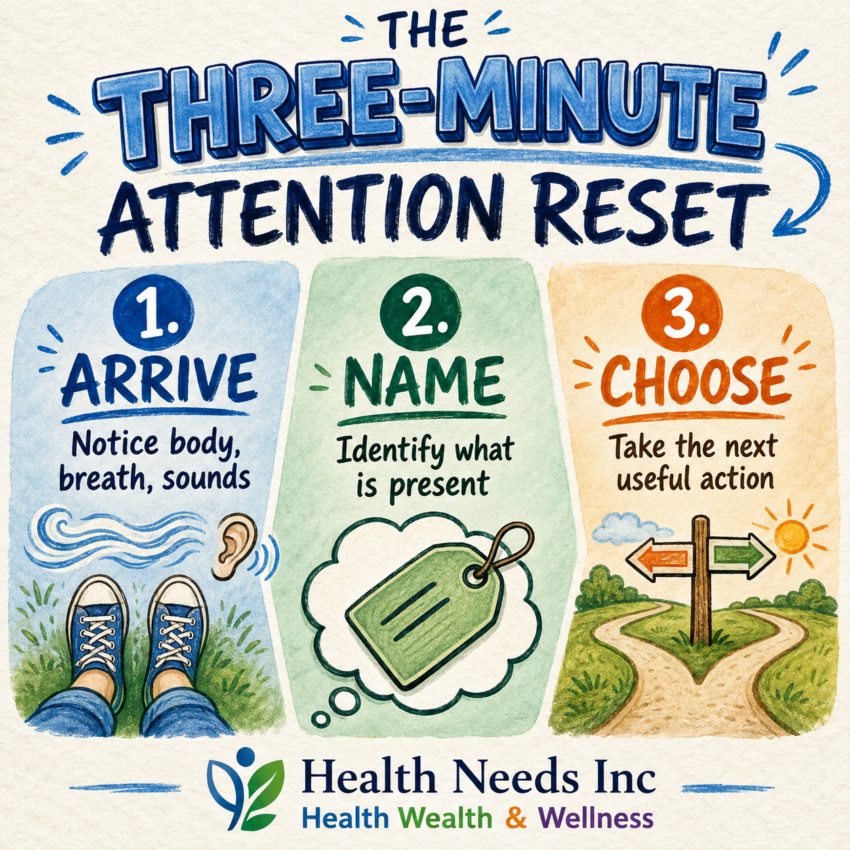
The HNI Three-Minute Attention Reset
- Arrive for 60 seconds. Notice physical sensations, sounds, breath, and the emotional weather. Do not fix anything yet.
- Name for 60 seconds. Quietly identify what is present: “tight shoulders,” “rushing,” “worry,” “hungry,” or “planning.” Plain language prevents an internal committee meeting.
- Choose for 60 seconds. Ask: “What is the next useful action?” It may be continuing, pausing, drinking water, walking, apologizing, setting a boundary, or getting qualified help.
Accessible worksheet prompt: What did I notice? What did I need? What did I choose? Repeat once daily for seven days.
This small structure separates awareness from reaction. It creates a narrow ledge between impulse and action, which is often all adulthood gives us.
Mindful Living Across the Eight Dimensions of Wellness
Mindfulness is often reduced to mental calm, but attention moves through the whole life. The Health Needs Inc Eight Dimensions of Wellness framework makes this visible: physical, emotional, intellectual, social, spiritual, environmental, occupational, and financial wellness continually interfere with one another like relatives in a small kitchen.
Physical wellness: listen before the body files a complaint
Mindful physical care means noticing hunger, fullness, pain, tension, energy, sleepiness, and the effects of movement. It is cooperation with the body, not surveillance.
The aim is not perfect eating or an impressive exercise identity. As our guide to physical wellness without fitness-cult nonsense explains, sustainable care works better than punishment wearing athletic fabric.
Emotional wellness: feelings are information, not elected officials
Mindfulness helps identify an emotion before it recruits behavior. “I feel rejected” is different from “everyone has rejected me,” just as feeling afraid is different from proving danger.
Nonjudgment does not mean approval. It means seeing what is there before deciding what it means or what to do about it.
Intellectual wellness: notice what owns your attention
An information diet can be nutritious, junky, or mostly packaging. Mindful intellectual life asks whether what you consume expands understanding, confirms a prejudice, stimulates outrage, or merely prevents silence from getting a word in.
Curiosity is especially useful when certainty feels emotionally delicious. Ask what evidence would change your mind. The ego hates this question, which is part of its charm.
Social wellness: listen without preparing your closing argument
Mindful conversation means noticing the impulse to interrupt, fix, impress, withdraw, or win. The CDC’s social-connection guidance explains that supportive relationships can improve stress coping, sleep, and overall well-being.
Presence does not require endless availability. A mindful no can be kinder than an automatic yes followed by resentment with excellent grammar.
Spiritual wellness: make room for meaning
Spiritual mindfulness may involve prayer, meditation, nature, ritual, service, awe, or reflection. Religion is one path, not an admission requirement.
The deeper question is what deserves your finite attention. A balanced life is not one where everything receives equal time. It is one where the important things are not permanently crowded out by the urgent and loud.
Environmental wellness: surroundings are silent instructions
A cluttered counter, noisy room, inaccessible park, punishing commute, or phone beside the bed shapes behavior before willpower arrives. Mindful environmental wellness notices these cues and makes modest changes where possible.
Put the desired action closer. Add friction to the unwanted one. A book on the chair is an invitation; a phone charging outside the bedroom is a tiny border patrol.
Occupational wellness: awareness cannot repair exploitation
Mindfulness at work can help with focus, transitions, and emotional reactivity. It cannot make chronic understaffing, harassment, impossible workloads, or insecure employment healthy.
Use awareness to distinguish ordinary job discomfort from a system doing damage. Breathe, certainly. Then document, negotiate, seek support, or plan an exit if the evidence keeps arriving.
Financial wellness: pause between feeling and spending
Money decisions are rarely pure arithmetic. Stress, status, shame, family history, loneliness, and fear all sit at the calculator, as explored in Why Smart People Still Feel Broken Around Money.
A mindful money pause asks three questions: What am I buying? What feeling am I trying to change? What will this choice cost my future options? The answer may still be “buy it.” Awareness is not compulsory deprivation.

Why Mindful Living Feels Harder Than It Sounds
“I cannot stop thinking”
Good. Your brain remains employed. Mindfulness does not require an empty mind; it trains recognition of thought as thought.
When planning, remembering, judging, or fantasizing appears, label it gently and return to the chosen anchor. The return is the repetition. It is the mental equivalent of one exercise rep, only with fewer mirrors.
“I do not have time”
Formal practice takes time, but mindful living can inhabit transitions already on the calendar. Feel your feet while waiting. Take one breath before answering. Eat the first three bites without a screen.
If even that feels impossible, the problem may not be a defective mindfulness routine. It may be overload. Attention cannot solve a schedule built like a structural collapse.
“It makes me more anxious”
Turning inward can intensify distress for some people, particularly when trauma, panic, severe depression, dissociation, or intrusive thoughts are present. NCCIH reports that a 2020 review estimated negative meditation-related effects in about 8% of participants, while a later study of meditation-related adverse effects found that sustained harm was less common than temporary discomfort.
Try external grounding instead: name five things you can see, walk with attention to your surroundings, keep your eyes open, shorten the practice, or work with a trauma-informed clinician. Discomfort is not always proof that a practice is working. Sometimes it is feedback.
“I keep forgetting”
Attach the practice to a stable cue: the kettle, a red light, opening a door, sitting at a desk, or beginning a meal. Environmental cues beat noble intentions because noble intentions have terrible follow-through.
A Seven-Day Mindful Living Experiment
This is an experiment, not a new personality. Keep each practice small enough that it can survive a mediocre Tuesday.
- Day 1, attention: Use the three-minute reset once. Record what you noticed, needed, and chose.
- Day 2, body: Check hunger, tension, pain, thirst, and energy before one meal or activity.
- Day 3, technology: Notice the urge to check your phone. Wait ten breaths before deciding.
- Day 4, conversation: Listen through another person’s full sentence. This sounds basic because civilization is fragile.
- Day 5, money: Pause before one unplanned purchase and name the feeling attached to it.
- Day 6, environment: Change one cue in your surroundings to support sleep, movement, focus, or connection.
- Day 7, meaning: Spend ten minutes on something important that urgency routinely displaces.
At the end, do not ask whether you became calm. Ask whether you noticed more choices. Calm is pleasant, but agency is the sturdier outcome.
When Mindfulness Is Not Enough
Mindfulness is not a substitute for treatment, medication, safety planning, financial counseling, workplace protection, sleep disorder care, or social support. The CDC’s stress-management guidance treats mindfulness as one possible coping tool within a larger mix that includes movement, sleep, connection, and professional support.
Seek professional help when distress is persistent, worsening, interfering with daily function, or connected to thoughts of self-harm. In the United States, call or text 988 for immediate crisis support. If there is immediate danger, call emergency services.
Good mindful living includes knowing when self-help has reached the edge of its jurisdiction.
Final Thoughts: Presence Is Not a Performance
Mindful living will not make ordinary life permanently balanced. Work will intrude. Bodies will complain. Relationships will become complicated, money will develop opinions, and the phone will continue behaving like a slot machine with family photographs.
The practice is smaller and more honest. Notice. Name. Choose. Then return when you forget, because forgetting is not failure. It is the reason the practice exists.
Balance is not a pose held forever. It is a series of corrections made while moving through the larger Eight Dimensions of Wellness, where attention matters precisely because no part of life stays politely in its assigned folder.
Wellness without the incense cloud.
Get skeptical, practical thinking across all eight dimensions of wellness.
FAQs About Mindful Living
One example is pausing before replying during a tense conversation. Notice physical tension and emotion, listen to the other person, then choose a response instead of letting the first impulse operate the machinery.
No. Meditation is a formal method for practicing attention. Mindful living applies attention during ordinary activities such as eating, working, spending, walking, resting, and talking with other people.
Begin with one to three minutes and increase only if the practice remains useful. Consistency matters more than duration, and a short practice that survives daily life is better than a grand routine abandoned after three mornings.
Research suggests structured mindfulness programs can produce modest reductions in perceived stress and some anxiety or depressive symptoms. Results vary, mindfulness is not a cure, and it should not replace appropriate medical or psychological treatment.
Yes. Some people report increased anxiety, distress, traumatic memories, dissociation, or other unwanted experiences. Stop or modify the practice and seek trauma-informed professional guidance if meditation makes symptoms worse.
Use brief transitions already in the day. Take one deliberate breath before email, notice your body before a meal, feel your feet while waiting, or pause before answering a difficult message.
The goal is greater awareness and choice, not constant calm or perfect concentration. Mindfulness helps you notice internal and external conditions early enough to respond more deliberately.