Relationships matter to health. That does not turn every coffee invitation into a medical intervention.

★ TL;DR
Stronger social connections are associated with better health and longer survival. The evidence is substantial, but it does not establish a friendship prescription that prevents disease.
- Loneliness, social isolation, and chosen solitude describe different experiences.
- Possible pathways include stress responses, health habits, practical help, and access to care. No single hormone explains the whole relationship.
- A useful next step addresses a specific support gap or access barrier. It does not require counting friends or guessing your cortisol level.
For educational purposes only. This article does not diagnose loneliness, hormone disorders, heart disease, or cognitive impairment, and does not replace medical or mental health care. Seek qualified care for persistent distress, concerning symptoms, or changes in memory or daily functioning.
You close the laptop and realize the delivery driver was today’s entire social calendar. A perfectly decent man. Possibly not enough of a support network.
That experience may make you want more company. It cannot tell you what your cortisol is doing, whether your immune system is inflamed, or how your arteries are holding up.
The health benefits of social connection deserve serious attention without this extra layer of biological fortune-telling. The useful question is what the research establishes, where uncertainty remains, and what that changes in ordinary life.
The association matters. Social disconnection is linked with poorer health, but an association is not a guaranteed treatment effect.
Definitions change the answer. Living alone, feeling lonely, and having limited support are not interchangeable.
Support has practical value. A ride to an appointment or help after surgery matters without an oxytocin explanation.
Context comes first. Hearing difficulties, caregiving, grief, cost, and transport can restrict connection. These are circumstances, not character flaws.
01. Solitude, Loneliness, and Isolation Are Different
The CDC distinguishes social isolation from loneliness. Isolation concerns limited contact and relationships; loneliness is the distressing feeling that your connection falls short of what you need.
Chosen solitude is different again. An afternoon alone with a book can be exactly what you wanted, while a crowded dinner can leave you feeling unseen.
These distinctions matter when reading studies. Researchers measuring household size, frequency of contact, perceived support, and loneliness are not necessarily measuring the same thing.
For a broader guide to building and maintaining relationships, see HNI’s Social Wellness pillar. Here, the focus is what health claims about connection can reasonably mean.
02. What the Health and Longevity Evidence Shows
A major 2010 meta-analysis in PLOS Medicine combined 148 studies involving 308,849 participants. Stronger social relationships were associated with better survival during follow-up, with pooled survival odds approximately 1.5 times those associated with weaker relationships.
That is an important population finding. It is not a prediction that making a friend will extend your life by 50 percent, nor a trial showing that a specific social routine produces that benefit.
Health and connection can influence each other. Illness may restrict participation, while limited support may make care and daily routines harder; income, neighborhood conditions, disability, and other factors can affect both.
The 2023 Surgeon General’s advisory uses a comparison with smoking up to 15 cigarettes daily to communicate the mortality importance of lacking connection. That comparison does not mean loneliness causes identical tissue damage or gives an individual the same risk as a smoker.

03. Heart Health: A Reason for Attention, Not a Guarantee
A 2022 American Heart Association scientific statement reviewed social isolation, loneliness, and cardiovascular and brain health. It described concerning associations while emphasizing gaps in causal understanding and intervention evidence.
The statement did not identify intervention studies specifically testing whether reducing isolation or loneliness improved cardiovascular or brain health outcomes. That was the evidence gap at the time of that review, not a claim that all subsequent research is settled.
The sensible interpretation is that disconnection belongs in a conversation about health. It does not follow that a dependable friend guarantees normal blood pressure, or that an uncomfortable dinner predicts a stroke.
Keep ordinary prevention and appropriate treatment in view. Relationships can support the routines covered in HNI’s Physical Wellness guide; they do not replace assessment, medication when indicated, or care for symptoms.
04. Memory and Dementia: Why Causation Is Difficult
The National Institute on Aging discusses links between social engagement and cognitive health. It also calls for further research to establish how activities may help maintain cognition.
Conversation can be mentally demanding: listening, remembering, interpreting, and responding all ask something of us. That plausible explanation does not establish that adding social complexity prevents dementia or preserves a particular brain structure.
Early cognitive changes can themselves make social participation harder. That complicates the direction of the relationship and is one reason an observational finding cannot settle a prevention claim.
If memory or everyday functioning is changing, arrange a clinical assessment. Joining a discussion group may be enjoyable and worthwhile; it is not a substitute for finding out what is happening.
05. How Support Might Help Without a Hormone Fairy Tale
Researchers investigate stress responses, inflammation, behavior, and practical support as possible pathways between connection and health. These mechanisms may interact, and their importance can vary across people and circumstances.
A friend may notice that you have stopped eating regular meals. A neighbor may provide transport, or a relative may help you understand discharge instructions after a hospital stay.
These examples illustrate how relationships can make care more manageable. They do not require claiming that being understood releases a predictable quantity of anti-inflammatory chemicals.
For the hormone itself, HNI’s cortisol guide explains why symptoms are not laboratory results. Feeling tense after an interaction cannot establish high cortisol, and feeling relaxed cannot confirm a healthy endocrine system.
The distinction protects readers from an increasingly popular wellness trick: invent a measurement, then sell relief from the number nobody actually measured.
06. Relationship Quality Matters, Including Online
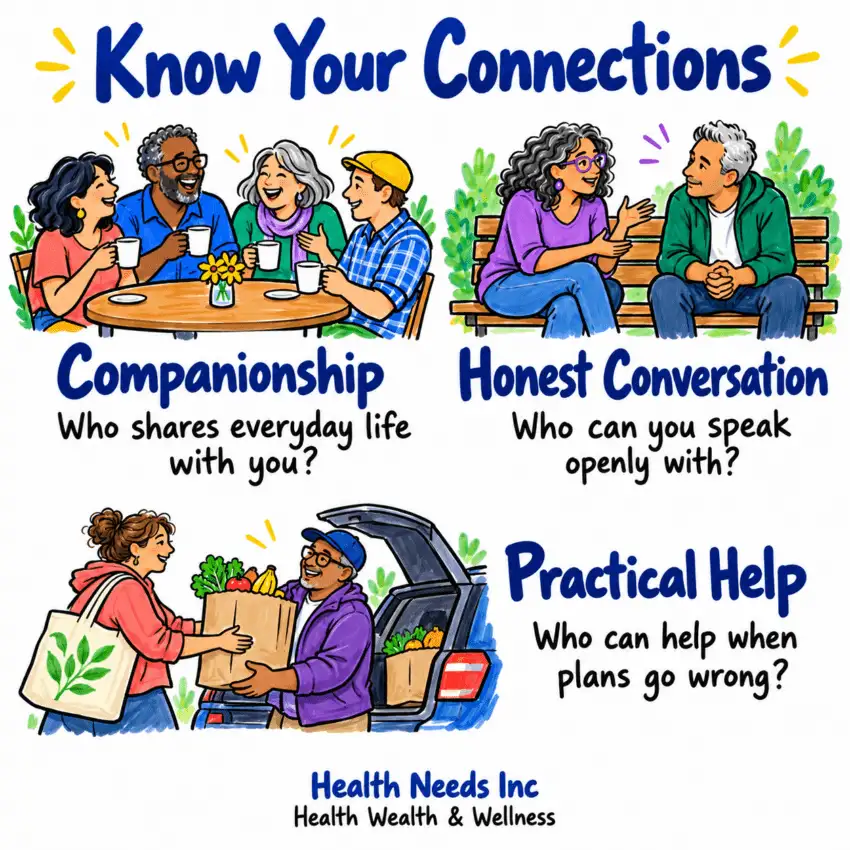
A full calendar does not guarantee dependable support. Look at recurring patterns of respect, reliability, room for disagreement, and whether help can be requested without humiliation.
Do not use one tired evening as a friendship verdict. Caregiving, grief, an honest disagreement, and an enjoyable gathering can all be exhausting for different reasons.
Digital contact also deserves more nuance than a screen-time total. A thoughtful message can sustain a relationship, and a video call can make distance easier; neither needs an unverified oxytocin claim to count as human contact.
A 2020 Cochrane rapid review found very uncertain evidence about video calls reducing loneliness in older people. Its three studies involved 201 nursing-home residents in Taiwan, limiting what the results can tell us about other settings.
That review does not establish that video calls are useless. It shows why a plausible, appealing idea should not be advertised as a proven medical intervention.
Wellness without the biological fortune-telling.
Skeptical reporting on health, relationships, and the advice industry.
Subscription is processed by Kit. Unsubscribe any time.
07. Practical Tool: Make One Useful Support Request
Purpose: Identify one task that support could make easier. Write the answers on paper; this worksheet does not save responses or assess health risk.
- Name the need. Is it company, a ride, help understanding paperwork, or someone to check in after an appointment?
- Name the barrier. Consider cost, transport, hearing access, energy, time, caregiving, or uncertainty about whom to ask.
- Choose a realistic contact. A trusted person, clinic social worker, community organization, or accessible group may fit different needs.
- Make the request specific. “Could we have a 15-minute call Thursday?” or “Do you know a local service that helps with appointment rides?”
- Choose a fallback. If the person is unavailable, try another contact or a different format. One declined invitation is not a verdict on your worth.
Use the result: Try the request and notice whether the practical gap becomes smaller. There is no score, prescribed friend count, or predicted hormone benefit.
After retirement, bereavement, relocation, or a period of caregiving, the missing piece may be access rather than motivation. Start with what makes participation possible; “try harder” is a remarkably poor transportation service.
08. Reader Quiz: Does the Health Claim Hold Up?
Choose your answer before opening each explanation. This checks understanding of research claims, not loneliness or disease risk.
1. “People with stronger relationships lived longer, so my new club will extend my life.” Does the conclusion follow?
No. An association across study participants does not establish the effect of joining your particular club. Enjoyment, belonging, and practical support remain worthwhile reasons to attend.
2. “I feel drained after dinner, so that friend raised my cortisol.” Is this a valid measurement?
No. Fatigue does not measure cortisol. Consider the setting and relationship patterns rather than assigning an unmeasured hormone result.
3. “My friend lives far away, so a thoughtful message is pointless.” Is that justified?
No. A message may help maintain a valued relationship. You do not need proof of an immediate biological effect to find it meaningful.
What the answers mean: Keep three questions handy: What was measured? Was this an association or a tested intervention? Does the claim fit the people and setting studied?
09. What to Do With This Evidence
Take persistent disconnection seriously without treating every quiet weekend as a health emergency. If loneliness, anxiety, or low mood persists or interferes with daily life, speak with a qualified professional; practical support and clinical care can happen together.
For anxiety-specific coping and treatment questions, use HNI’s anxiety guide. This article’s task is narrower: keeping the health evidence useful without inflating it into a cure.
Choose one support gap worth addressing, then take one feasible step. A friend does not need to lower your cortisol to justify an hour of your afternoon.
10. FAQs About Social Connection and Health
There is no universal clinically established friend count that guarantees better health. Consider whether you have meaningful contact and dependable support that fits your circumstances, rather than trying to reach a numerical quota.
No. Living arrangements do not establish loneliness, isolation, or health status. Someone who enjoys living alone may still have meaningful relationships and practical support; someone living with others may feel deeply disconnected.
No. Heart rate or heart-rate variability cannot establish the quality of a friendship. Consider patterns of respect, safety, reliability, and communication, and seek appropriate care for concerning physical symptoms.
Tiredness alone is not a sound basis for that decision. Look at patterns and context, including your own needs and boundaries. Threats, coercion, or repeated humiliation deserve separate attention and appropriate support.
No. This article and its worksheet provide educational information and reflection, not physiological screening, hormone testing, or diagnosis. Discuss medical concerns with a qualified clinician.