★ TL;DR
By 2035, medicine may be able to reverse particular age-related changes in selected tissues or improve function in some diseases. A safe, affordable treatment that makes the entire human body meaningfully younger remains possible, but improbable on that timetable.
-
The science is real. Partial epigenetic reprogramming has restored functions and shifted molecular markers in animal studies, and the first Phase 1 human trial of an OSK-based therapy began dosing in 2026.
-
The language is slippery. Reversing a biomarker, rejuvenating one cell type, treating one age-related disease, and reversing whole-body human aging are not interchangeable achievements.
-
2035 is close in drug-development time. Nine years is enough for early clinical signals and perhaps narrow approvals. It is not generous when safety, delivery, cancer risk, immune responses, durability, manufacturing, and long follow-up all remain unsettled.
-
Our estimated odds: about 70% for at least one therapy showing credible rejuvenating effects in a specific human tissue; 35% for an approved treatment that measurably improves an age-related condition by targeting an aging mechanism; and roughly 5% for safe, proven, broadly available whole-body age reversal.
-
Do not plan your life around a moonshot. Use established prevention and treatment now. The bridge to futuristic medicine is more likely to be built from blood-pressure control, vaccines, movement, sleep, and ordinary healthcare than from a supplement bottle wearing a laboratory costume.
The longevity industry has discovered that “promising mouse experiment” sounds better when translated into “your 74th birthday may be optional.” Biology has not signed the marketing copy.

This article provides general educational information, not medical advice, diagnosis, treatment, or a recommendation to use an unapproved longevity therapy. Drugs, supplements, gene therapies, and experimental interventions can carry serious risks and may interact with medical conditions or medications. Discuss personal health decisions with a qualified clinician, and treat commercial “age reversal” claims with particular caution when they outrun published human evidence.
The likeliest 2035 outcome is partial victory: better treatments for particular age-related damage, not a universal biological reset button.
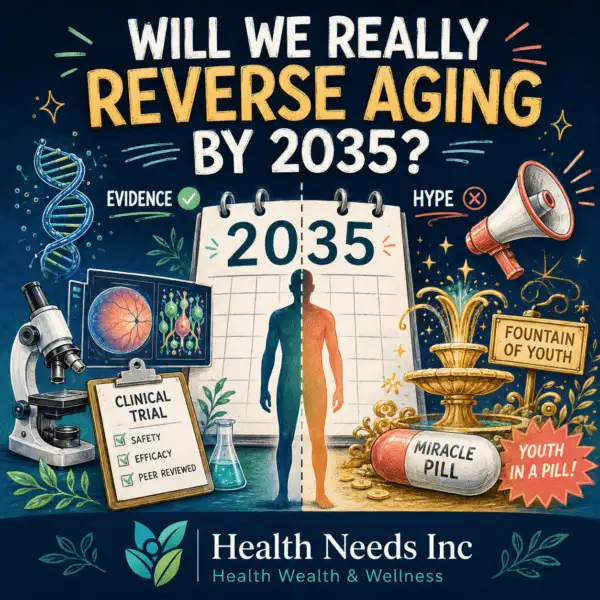
Will humans reverse aging by 2035?
- In cells or a specific tissue: probably, if “reverse” means restoring selected molecular patterns or function.
- In one age-related disease: plausibly, although proof must come from controlled human trials with meaningful outcomes.
- Across the whole body: unlikely by 2035.
- Cheaply, safely, and for ordinary patients: even less likely on that timetable.
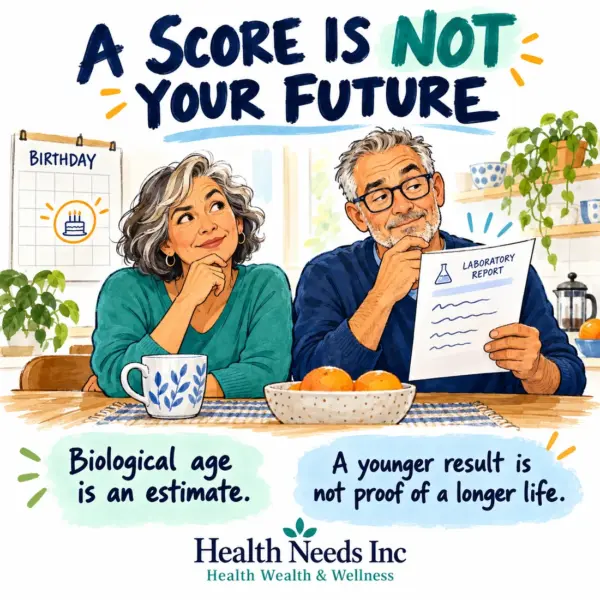
Define the claim before judging it. A younger methylation score is not automatically a younger heart, sharper memory, longer life, or lower risk of disability.
David Sinclair, PhD, advances a scientifically testable hypothesis. His laboratory argues that lost epigenetic information is a major driver of aging and that controlled reprogramming may restore youthful function. That is a serious hypothesis, not an established human fact.
Peter Diamandis, MD, is making a technology forecast. His 2035 pill scenario assumes rapid convergence among artificial intelligence, drug discovery, reprogramming, delivery, regulation, and manufacturing. Every assumption may be reasonable alone; stacking them creates a Jenga tower in a lab coat.
Human evidence is the bottleneck. Mice are essential research models, but they are not small retired people. Human aging unfolds across decades, organs, environments, diseases, and inconveniently complicated biographies.
Probability should replace prophecy. The right question is not whether optimism or skepticism wins. It is which version of age reversal has what chance of occurring by a specified date.
First, Decide What “Reverse Aging” Means
“Reverse aging” sounds precise because it contains a verb and a biological process.
It is actually a suitcase phrase into which researchers, investors, podcasters, supplement companies, and hopeful customers pack very different belongings.
At the modest end, it can mean shifting a laboratory biomarker toward a pattern commonly seen in younger people.
It can mean improving mitochondrial activity in cultured cells, reducing senescence markers, changing gene expression, or moving an epigenetic clock backward.
Those findings can be scientifically valuable. They do not necessarily mean the treated organism became younger in the way ordinary language implies.
A stronger definition requires restored function in a tissue: better vision, improved muscle repair, stronger immune response, or recovery from an age-related deficit.
Stronger still would be reducing several age-related diseases, frailty, and mortality across the entire body without creating equally serious new risks.
The grandest version is what most readers hear: take a therapy at 70 and acquire the biological resilience of 50, throughout the body, with durable benefits and acceptable side effects. That is the version most likely to sell books, conferences, clinics, and a recurring subscription to optimism.
→ The distinction matters because a claim can be true at one level and wildly unsupported at another. Restoring function in mouse retinal cells is not fake, but neither is it proof that a pill will rejuvenate a human brain, heart, kidneys, immune system, muscles, and connective tissue by 2035.

What David Sinclair, PhD, and Peter Diamandis, MD, Are Actually Claiming
David Sinclair, PhD, a professor of genetics at Harvard Medical School, advances an information-based theory of aging. His laboratory argues that aging is driven substantially by a loss of epigenetic information: the regulatory instructions that help cells remember which genes to use and when.
The analogy is attractive. DNA is the durable hardware or stored music; the epigenome is the software or control system telling each cell how to perform its role. Aging, in this view, resembles corrupted instructions rather than only accumulated, irreparable wreckage.
If that information can be restored, some youthful function might return. The laboratory of David Sinclair, PhD, describes its goal as resetting a cell’s epigenetic status and reversing its age, and its animal work provides an experimental basis for taking that possibility seriously.
Peter Diamandis, MD, operates in a different intellectual occupation. He is a physician, entrepreneur, and technology forecaster whose central instinct is that converging exponential technologies can transform fields faster than conventional institutions expect.
Peter Diamandis, MD, has promoted a scenario in which AI-discovered molecules activate cellular reprogramming and an affordable “age reversal pill” arrives around 2035. The vision is not merely a better glaucoma treatment. It is a drug that circulates broadly and resets aging across tissues.
These positions overlap, but they are not identical. David Sinclair, PhD, supplies a biological hypothesis and laboratory program; Peter Diamandis, MD, supplies an aggressive commercialization calendar. One asks whether damaged cellular information can be restored. The other asks when you can swallow the restoration with breakfast.
The calendar is where confidence becomes fragile. Moving from a mechanism to a safe systemic drug requires target discovery, validation, delivery, toxicology, dose selection, Phase 1 safety, Phase 2 efficacy, larger trials, regulatory review, manufacturing, reimbursement, and surveillance after approval.
Artificial intelligence may accelerate molecule discovery and trial design. It does not repeal tumor biology, immune reactions, heterogeneous patients, or the human body’s long tradition of refusing PowerPoint timelines.
Why Partial Epigenetic Reprogramming Is Not Nonsense
Cellular reprogramming traces partly to the discovery that a small group of transcription factors can push mature cells back toward a pluripotent state. These Yamanaka factors demonstrated that cellular identity and age-related epigenetic patterns are more malleable than biology once appeared to allow.
Full reprogramming is not a practical whole-body rejuvenation therapy. A cell stripped too far of its identity may stop behaving like a retinal neuron, liver cell, or muscle cell. Uncontrolled dedifferentiation and growth raise the specter of tumors, which is a poor trade for younger-looking methylation.
Partial reprogramming aims to stop earlier. Researchers expose cells to some factors, for a limited period or under controlled conditions, attempting to restore younger patterns while preserving cellular identity.
In a landmark 2020 Nature paper, Yuancheng Lu, David Sinclair, PhD, and colleagues used three factors, OCT4, SOX2, and KLF4, commonly shortened to OSK. In mice, the intervention promoted axon regeneration after optic-nerve injury and restored aspects of vision in glaucoma and age-related decline models.
The results were important because retinal ganglion cells are central nervous system neurons with limited regenerative capacity. The work linked changes in DNA methylation patterns with recovered function, not merely a prettier laboratory score.
Still, the experiment did not reverse every feature of aging in an intact human. It targeted a particular cell population in animal models using gene delivery. The distance from there to a systemic pill is not a hallway; it is a continent containing several regulatory agencies.
The broader field is also larger than one theory. The updated “hallmarks of aging” framework describes twelve interacting processes, including genomic instability, telomere attrition, epigenetic alterations, loss of proteostasis, impaired autophagy, disrupted nutrient sensing, mitochondrial dysfunction, cellular senescence, stem-cell exhaustion, altered intercellular communication, chronic inflammation, and dysbiosis.
Epigenetic restoration might influence several hallmarks, but no consensus establishes lost epigenetic information as the single master cause. Aging may be a network of reinforcing failures. Repairing one switchboard may help greatly without rewiring the whole city.

The 2026 Human Trial Changes the Conversation, but Not the Verdict
Speculation crossed an important line in 2026. ER-100, an investigational therapy developed by Life Biosciences, entered a Phase 1 human trial for open-angle glaucoma and non-arteritic anterior ischemic optic neuropathy, two conditions involving damage to the optic nerve.
The ClinicalTrials.gov record, NCT07290244, identifies the study’s primary purpose as evaluating the safety and tolerability of a single dose in adults with optic-nerve conditions, while also exploring visual outcomes.
ER-100 uses an adeno-associated viral vector to deliver the OSK factors to one eye, with expression controlled by doxycycline. The first participant was dosed in June 2026, according to the company.
This is a genuine milestone. A therapy rooted in partial epigenetic reprogramming has moved from mice and nonhuman primates into a regulated human study.
It is also easy to inflate. Phase 1 means investigators are beginning with safety and tolerability, not announcing that human aging has been reversed. The therapy is localized to the eye, not distributed through every tissue.
Even a successful trial could mean several different things. The treatment might prove deliverable and acceptably safe, change molecular markers, preserve remaining vision, restore a modest amount of function, or produce a dramatic clinical benefit.
Each result would deserve different language. “Safe enough to study further” is not “rejuvenates humans,” although press releases have occasionally treated those phrases as cousins sharing a condominium.
The trial nevertheless improves the probability that a narrow rejuvenation therapy could emerge by 2035. It does much less for the probability of a cheap systemic pill because the delivery system, target tissue, exposure, and safety problem are fundamentally different.
Six Obstacles Standing Between an Eye Trial and Whole-Body Rejuvenation
1. Delivery
An eye is a relatively contained target that can receive a local injection and be monitored directly. Whole-body treatment must reach many tissues at useful doses while avoiding places where the intervention could cause harm.
Brain, muscle, liver, heart, bone, immune cells, and connective tissue differ in access and biology. A pill that distributes everywhere sounds convenient until “everywhere” includes cells you emphatically did not want reprogrammed.
2. Cancer and loss of cellular identity
Reprogramming factors affect growth, identity, and gene expression. The therapeutic window must be wide enough to rejuvenate cells but narrow enough to prevent dedifferentiation, abnormal proliferation, and tumors.
Short studies may not reveal risks that emerge years later. A therapy designed for otherwise healthy adults must clear an especially high safety bar because the alternative is not immediate death; it is ordinary aging, objectionable though its customer service may be.
3. Control and reversibility
Researchers need reliable control over which cells activate the program, how strongly, and for how long. Biological systems vary among individuals, and a dose that is modest in one tissue may be excessive in another.
A controllable switch is reassuring only if it switches predictably. Gene therapy can be durable, and durable mistakes are not improved by ambitious branding.
4. Measuring success
Trials need endpoints that regulators, clinicians, and patients can interpret. Death and major disability are meaningful but require large populations and long follow-up.
Biomarkers are faster, yet their clinical meaning is uncertain. The field needs validated measures that reliably predict improved function, reduced disease, or longer healthy survival after an intervention.
5. Aging is heterogeneous
A 70-year-old with vascular disease, kidney impairment, prior cancer, and frailty is not biologically equivalent to a healthy 70-year-old athlete. Sex, genetics, exposures, medications, nutrition, infection history, and social conditions shape aging.
A therapy may help one organ, genotype, or disease while doing little elsewhere. “Human aging” is not one patient population waiting politely in a single examination room.
6. Time
By August 2026, fewer than nine years remain before the end of 2035. That is substantial for generating evidence but compressed for proving durable whole-body benefit and long-term safety.
Approvals for narrow conditions can occur within that window if early results are strong. Broad preventive use in millions of relatively healthy adults demands more certainty, not less.

When a Younger Biological Clock Is Not a Younger Person
Epigenetic clocks estimate age-related patterns from chemical marks on DNA. Some predict chronological age; newer versions attempt to estimate health risk, mortality, or the pace of aging.
They are valuable research instruments. They can identify associations, compare groups, and help investigators detect biological responses without waiting decades for everyone in a trial to grow old in real time.
But a clock is a model, not a tiny coroner living inside the genome. Different clocks can respond differently to the same intervention, and a movement in the “younger” direction may not necessarily cause improved health.
The National Institute on Aging has reported that severe stress can temporarily increase measured biological age and that recovery can move it back toward baseline. That finding supports biological malleability, but it also shows why a clock change can reflect a state transition rather than permanent rejuvenation.
Imagine a treatment lowers an epigenetic-age estimate by five years but does not improve strength, cognition, cardiovascular events, independence, or survival. Something biologically interesting happened. The patient did not necessarily receive five extra years of healthy life.
The reverse is also possible. An intervention could improve function or disease risk without impressing a preferred aging clock. Science should not become so enchanted with the dashboard that it forgets to look through the windshield.
Wellness without the miracle fog.
Get evidence-aware health, wealth, and wellness thinking without panic marketing, compulsory positivity, or a supplement stack requiring its own spreadsheet.
The HNI 2035 Probability Board
Forecasting biomedical progress is not measurement. These estimates are reasoned judgments based on the stage of evidence, clinical-development timelines, safety barriers, and the breadth of each claim.
The categories must remain separate. Otherwise, success in a narrow eye trial will be presented as proof that whole-body rejuvenation is around the corner, a corner that has been migrating down the road since alchemists had excellent branding.
Estimated probability by the end of 2035
- 90%: Researchers report multiple human interventions that move one or more aging biomarkers in a younger direction.
- 70%: At least one therapy demonstrates credible rejuvenating or restorative effects in a specific human tissue, supported by meaningful functional outcomes.
- 35%: A regulator approves at least one treatment for an age-related condition whose intended mechanism directly targets a fundamental process of aging.
- 15%: A treatment produces validated, multi-system improvements that reasonably qualify as partial whole-body rejuvenation in a defined patient group.
- 5%: Safe, durable, broadly available whole-body age reversal exists for ordinary patients.
- 2%: An inexpensive pill reliably makes most major tissues substantially younger with large health span benefits and acceptable long-term risk.
Those numbers are not contradictions. They describe a probability funnel. The science may produce important victories while the headline version fails to arrive.
David Sinclair, PhD, is more likely to be directionally right than literally right on a universal timetable. Aging biology appears modifiable, and epigenetic restoration may become a real therapeutic category.
Peter Diamandis, MD, may also be right that AI and converging technologies compress discovery. His weaker point is the assumption that every downstream step will accelerate together. The slowest constraint, often human safety, governs the arrival date.
Our base case is therefore neither cynicism nor immortality. By 2035, some patients may receive therapies described responsibly as cellular rejuvenation for particular diseases. Most people will not take a proven pill that resets the entire body.
The result may still be medically historic. Preventing blindness or restoring meaningful function is not a consolation prize merely because it fails to make a 70-year-old biologically 45.
How to Live While Waiting for the Future to Clear Phase 3
The first rule is not to convert a scientific forecast into a personal medical plan. “Remain alive until the breakthroughs arrive” is emotionally understandable but clinically vague, particularly when it becomes justification for swallowing unapproved compounds purchased from a website featuring molecules, mountains, and no customer-service address.
Use interventions with established benefits now: do not smoke, manage blood pressure and cholesterol with appropriate care, stay current on recommended vaccination and screening, preserve muscle and balance, treat diabetes, protect sleep, maintain social connection, and address hearing or vision problems.
These measures are not glamorous because familiarity is terrible at public relations. They nevertheless affect the diseases and disabilities most likely to decide whether you reach 2035 with resilience.
Second, distinguish research participation from commercial experimentation. A registered clinical trial has a protocol, oversight, eligibility criteria, informed consent, adverse-event monitoring, and a stated scientific question.
A private clinic selling “age reversal” may offer none of those protections. The fact that a treatment is biologically plausible does not establish the product’s purity, dose, effectiveness, or safety.
Third, monitor outcomes rather than celebrity routines. A scientist’s personal supplement stack is not a randomized trial, and an entrepreneur’s enthusiasm is not a regulatory decision.
Watch for replicated human evidence, clinically meaningful endpoints, transparent adverse events, trial registration, peer review, and independent confirmation. If the only outcome is a proprietary biological-age score sold by the same ecosystem, skepticism has earned a chair at the meeting.
Finally, retain philosophical proportion. Wanting more healthy life is rational. Treating aging as a personal failure to optimize every molecule is not.
Mortality gives urgency to the longevity market, and the market often repackages that urgency as a purchasing opportunity. We should fund audacious science without allowing fear of death to become an unlimited corporate expense account.
Final Verdict: Who Is Right?
David Sinclair, PhD, and Peter Diamandis, MD, are probably right about the direction and too confident about the destination date. Aging will increasingly be treated as a set of modifiable biological mechanisms rather than an untouchable background condition.
Partial epigenetic reprogramming may become one of the important tools. The 2026 ER-100 trial makes casual dismissal harder because the technology has entered human testing.
Yet 2035 will probably bring a patchwork of advances: narrow rejuvenation therapies, better biomarkers, improved treatment of age-related diseases, and perhaps early evidence of multi-system benefit. That is not the same as reversing human aging in the plain-English sense.
The mature position is conditional optimism. Cheer for the trial, inspect the endpoints, read the adverse events, and keep one hand on your wallet when “could” quietly changes clothes and reappears as “will.”
Aging research deserves ambition. Aging claims deserve grammar police, probability estimates, and the occasional raised eyebrow.

FAQs About Reversing Aging by 2035
No treatment has been proven to safely reverse whole-body human aging. Small studies and interventions have reported changes in biological-age biomarkers, but biomarker movement is not equivalent to restored multi-system function or longer healthy survival.
A Phase 1 partial-reprogramming trial began dosing in 2026 for optic-nerve diseases. It is testing a localized investigational therapy, beginning with safety, not proving systemic age reversal.
It is an attempt to expose cells to reprogramming factors in a controlled way that restores more youthful patterns of gene regulation without erasing cellular identity. Full reprogramming can push cells toward pluripotency, which is not the goal of a safe tissue-rejuvenation therapy.
The challenge is achieving enough reset to improve function without triggering abnormal growth, loss of identity, or cancer.
The laboratory of David Sinclair, PhD, and its collaborators restored aspects of youthful gene expression, axon regeneration, and visual function in mouse eye models using OSK factors. Describing that as reversal of age-related features in a particular tissue is defensible.
Describing it as proof that whole-body human aging can already be reversed is not.
A pill that affects an aging pathway or improves a particular age-related condition is plausible. A cheap pill that safely rejuvenates most tissues, produces major healthspan gains, and has durable evidence is unlikely by 2035.
Systemic distribution is an advantage only after scientists can control which cells respond, how much they respond, and for how long.
Not by themselves. Clocks can detect age-related molecular patterns, but different clocks measure different features and may respond differently.
Stronger evidence includes improved function, reduced disease, less disability, acceptable safety, and eventually longer healthy survival.
No supplement has been shown to serve as a proven bridge to future whole-body rejuvenation. Evidence varies by compound, population, dose, outcome, and safety, and products sold online may not match those used in research.
Do not copy a public figure’s regimen without medical guidance, particularly when prescription drugs or interaction risks are involved.
Protect current health with established medical care and sustainable habits, and follow registered human trials rather than promotional claims. Ask whether an intervention improves outcomes that matter to patients and whether independent researchers have replicated the findings.
The future is more useful when you arrive with functioning muscles, controlled blood pressure, and your savings still outside a cryogenic supplement subscription.