★ TL;DR
Retirement spending often falls with age, but the decline is not automatic, smooth, or reliable enough to build a plan around by itself.
-
Travel, commuting, dining out, clothing, and some discretionary spending may fall.
-
Housing, insurance, taxes, family support, health care, and long-term care can rise or arrive suddenly.
-
A stronger plan separates essential expenses, lifestyle spending, health care reserves, housing costs, and flexible spending.
The cheerful version says your expenses gently fade as you get older. The grown-up version says some expenses decline, some explode, and the spreadsheet should not be trusted just because it has pastel colors.
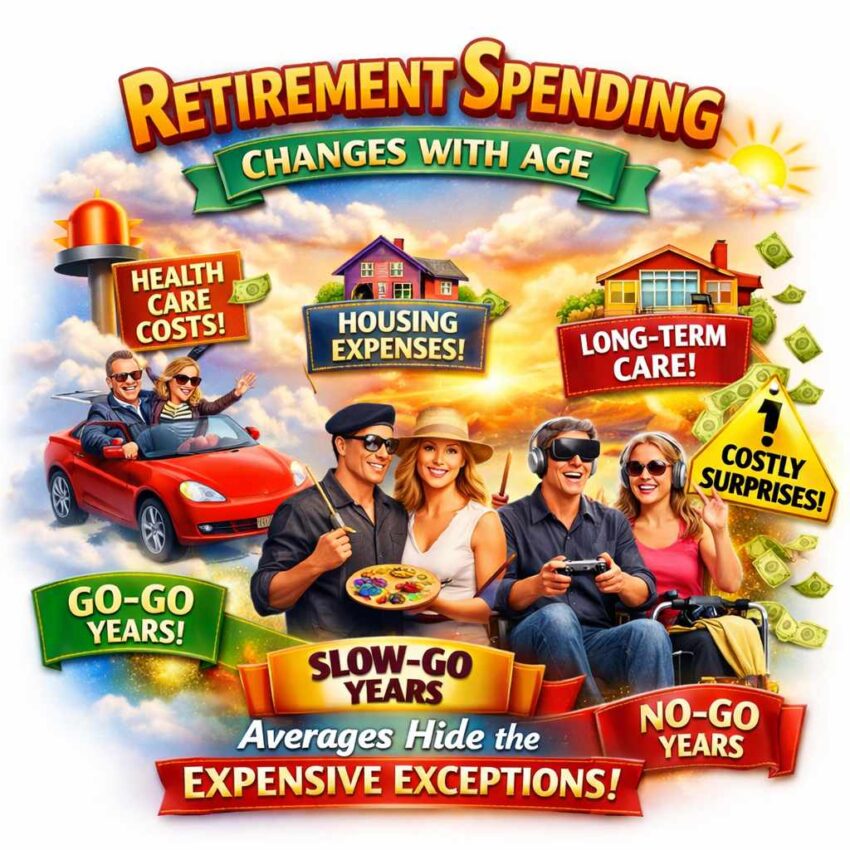 Retirement spending often changes with age, but averages hide the expensive exceptions.
This article is for educational and informational purposes only. It is not financial, investment, tax, legal, insurance, Medicare, Social Security, or retirement planning advice. Retirement spending depends on health, housing, family obligations, taxes, inflation, insurance, assets, income sources, and personal choices; consider speaking with a qualified financial professional, tax professional, Medicare adviser, or fiduciary planner before making major retirement decisions.
The useful answer is more annoying than the folklore.
Does retirement spending decline automatically as you age?
-
- Retirement spending decline often happens in real terms as people age, but it is not automatic, smooth, or reliable enough to build a plan around by itself.
- Travel, commuting, dining out, clothing, and some discretionary spending may fall. Housing, insurance, taxes, family support, health care, and long-term care can rise or arrive suddenly.
- The better planning question is not, “Will I spend less?” It is, “Which expenses are likely to fade, which are likely to resist, and which could wreck the average?”
Spending often falls with age. Research on retiree households generally shows real spending declines over time, especially in discretionary categories.
The decline is not automatic. Health shocks, housing repairs, insurance premiums, taxes, widowhood, and family support can interrupt the tidy downward slope.
Averages are dangerous little comfort blankets. They describe groups, not your roof, knees, Medicare premiums, children, or appetite for travel.
Inflation still matters. Even if real spending declines, nominal bills can keep rising because groceries, insurance, housing, and care do not observe retirement etiquette.
Plan in layers. Separate essential expenses, lifestyle spending, health care reserves, housing costs, and flexible spending before assuming age will solve the problem.
Retirement Spending Decline Usually Happens, But Not Like a Staircase
Retirement spending decline is one of the more comforting ideas in retirement planning. It suggests that the spending problem solves itself with age. You retire, enjoy the early years, slow down later, and eventually reach a peaceful budget that mostly contains soup, slippers, and a suspicious number of doctor portals.
There is evidence behind the idea. Research using retiree spending data has found that real household spending often declines as people move through retirement. David Blanchett’s work on the “retirement spending smile” argues that many planning models overstate later-life spending by assuming expenses simply rise with inflation forever.
EBRI research using Health and Retirement Study data also shows lower average spending at older ages. In one analysis, average annual spending was higher among people ages 55-64 than among people ages 65-74, and lower still among those ages 75-85.
That is not nothing. It suggests that spending often does drift downward. But the word “often” is carrying a grand piano up a flight of stairs.
The problem is that average spending decline is not the same as personal spending decline. A group average can fall while your own expenses rise because your spouse needs care, your home needs a roof, your daughter needs help after a divorce, or your prescription plan suddenly acts like it was designed by a committee of raccoons.
The Bureau of Labor Statistics Consumer Expenditure tables are useful because they show spending by age group, but even those tables describe broad households. They cannot tell you whether your furnace will die in February with a sense of theatrical timing.
Why Spending Often Drops as Retirees Age
The happy version of spending decline is that retirees become wise, minimalist, and serenely uninterested in buying things. Sometimes that is true. Sometimes they are just tired of airports.
Several spending categories really do tend to soften with age. Work-related expenses fade first. Commuting, payroll taxes, professional clothing, convenience lunches, and the emotional support coffee purchased after pointless meetings often shrink once work ends.
Travel and entertainment can also decline. Early retirement is often the “go-go” period, when people finally take trips postponed by careers, children, mortgages, and the ancient American tradition of being too busy to enjoy what you saved for. Later, energy, mobility, health, or simple preference can reduce expensive adventures.

Housing can decline if a mortgage is paid off, a retiree downsizes, or property maintenance becomes simpler. Food spending may fall if households are smaller, eating out declines, or entertaining becomes less elaborate. Transportation can fall when there are fewer cars, fewer miles, and fewer reasons to sit in traffic questioning national priorities.
The categories most likely to fade
-
- Commuting and work clothing
- Payroll taxes and retirement contributions
- Restaurant meals tied to convenience
- Travel that depends on stamina
- Large entertainment and hobby spending
- Some housing costs after downsizing or paying off debt
There is also a psychological shift. The thrill of acquisition may calm down. People who have spent decades accumulating furniture, equipment, clothing, and kitchen gadgets reach a point where buying another storage solution becomes an accusation.
Spending decline can be real because desire changes. That is not a spreadsheet assumption. That is aging, priorities, energy, and experience quietly renegotiating the household budget.
Watch: Three Unexpected Retirement Spending Trends
This independent explainer reviews J.P. Morgan retirement-spending research and helps show why household expenses do not follow one smooth line. Confirm captions and transcript availability during publication review.
Tool: The Five-Minute Retirement Spending Shock Check
Write down your normal monthly spending, then list the irregular costs that could arrive during the next five years. Use actual bills and local estimates where possible instead of asking a national average to impersonate your household.
-
- Baseline: total housing, food, utilities, insurance, transportation, taxes, and routine health costs.
- Flexible layer: total travel, dining, hobbies, gifts, entertainment, and optional upgrades.
- Known shocks: list the likely timing and cost of a roof, vehicle, dental work, relocation, or accessibility project.
- Care scenario: estimate six months of paid household or health support using local rates.
- Response rule: identify which flexible costs pause first and which reserve pays the bill.
Output: one baseline number, one flexible number, one shock-reserve target, and one written response rule. The result is a planning worksheet, not individualized financial advice.
Use the U.S. Department of Labor Retirement Toolkit and the BLS Consumer Expenditure Tables to add official context without replacing your household numbers.
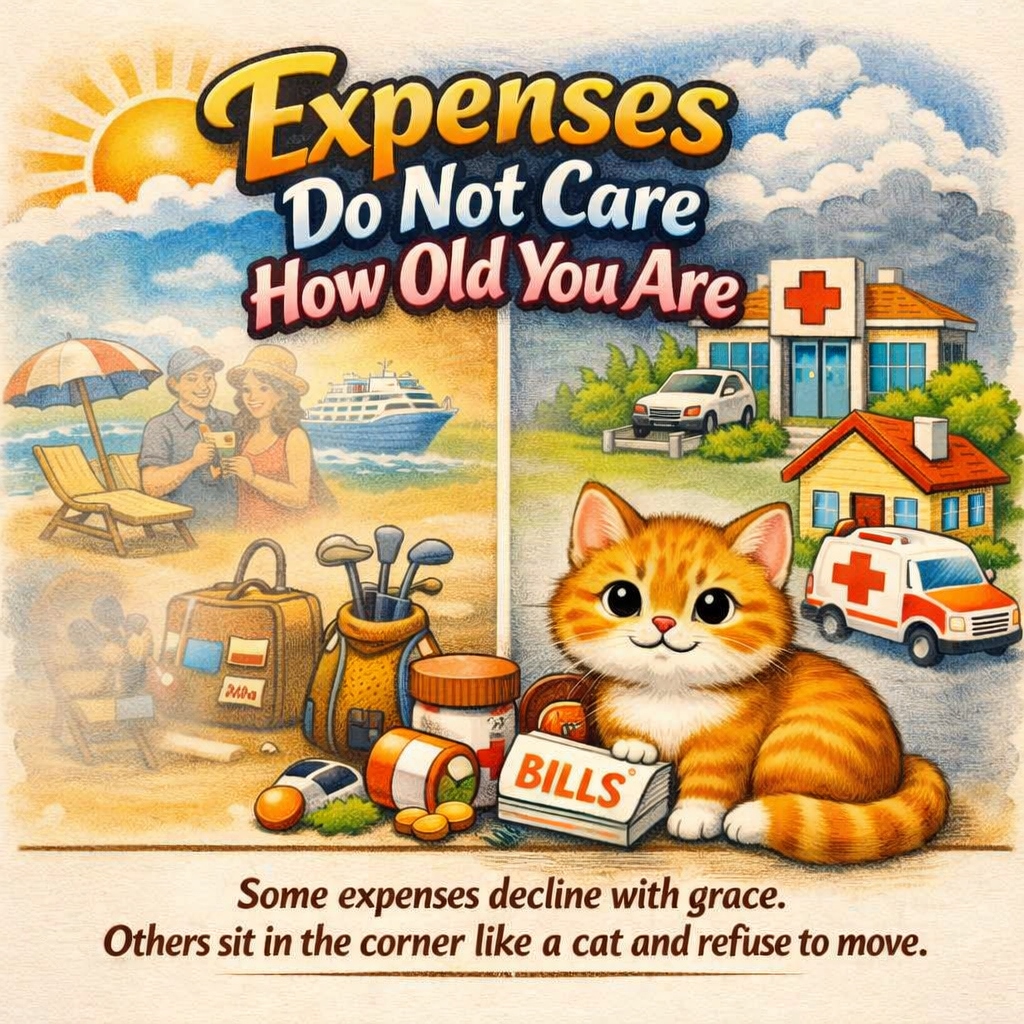
The Expenses That Do Not Care How Old You Are
Some expenses decline with grace. Others sit in the corner like a cat and refuse to move.
Property taxes do not disappear because you are 78 and have learned perspective. Homeowners insurance does not become cheaper because you now enjoy bird feeders. Utilities, groceries, prescriptions, cell phones, internet, dental work, hearing care, vehicle repairs, and gifts to family can continue rising even while your appetite for cruises collapses.
This is where retirement advice gets slippery. A planner may assume total spending declines by a tidy percentage each year. That may work in aggregate, but your personal budget is made of specific categories.
Some are flexible. Some are stubborn. Some are volatile.
Some are pretending to be small until they become a $9,400 home repair. CFPB retirement-planning resources also treat housing and later-life financial decisions as connected parts of retirement security.
Housing deserves special suspicion. A paid-off mortgage can reduce expenses dramatically, but homeownership still contains taxes, insurance, maintenance, accessibility upgrades, utilities, repairs, and the slow revenge of aging appliances.
Renters face a different problem. They may avoid major repairs, but rent can rise for decades. A retiree who assumes spending automatically declines while rent compounds is not planning.
That is just optimism wearing reading glasses.
Expenses that often resist decline
-
- Property taxes and homeowners insurance
- Rent and housing fees
- Utilities and basic household services
- Medicare premiums, deductibles, and out-of-pocket costs
- Dental, vision, and hearing expenses
- Family support and caregiving costs
- Home repairs and accessibility modifications
The planning lesson is simple: do not forecast one spending number. Forecast categories. Essential bills, lifestyle spending, housing, taxes, insurance, health care, gifts, and emergency reserves behave differently.
Health Care Is the Category That Makes Averages Nervous
Health care is the reason the phrase “spending declines with age” should always be followed by a cough and a footnote. Many retirees do not experience catastrophic medical costs every year. That matters.
The scary brochure version of retirement can make every 67-year-old feel like a pre-bankruptcy event with knees. Still, health expenses tend to become more important with age, and the timing is uncertain.
Medicare helps, but Medicare is not free. The standard Part B premium for 2026 is listed at $202.90 per month, with a $283 deductible, and beneficiaries generally pay 20 percent of Medicare-approved costs for many Part B services after the deductible. Medicare also does not erase every dental, vision, hearing, long-term care, or caregiving expense.
Long-term care is the larger planning wildcard. Government long-term care resources estimate that someone turning 65 today has a high likelihood of needing some long-term services and supports during the remainder of life. Not everyone needs paid care for years.
Some never do. But the risk is large enough that ignoring it is not frugal. It is just postponing fear until fear has invoices.
T. Rowe Price research on unexpected health care costs has also found that retirees worry about health shocks, even though catastrophic shocks affect a minority of households in a given period. The issue is not that every retiree will face a disaster. The issue is that the possibility changes how much spending flexibility you really have.
That is why later-life spending can look like a smile. Discretionary expenses may fall in the middle years, then health care and support needs can rise later. The total does not always rise dramatically, but the composition changes.
Less Paris, more premiums. Less theater, more therapy. Less golf, more grab bars.
Couples, Widowhood, and the Household Math Nobody Likes
Household spending does not simply divide by two when one spouse dies. This is one of retirement planning’s least charming arithmetic facts.
A surviving spouse may spend less overall, but many fixed costs remain. Housing, insurance, utilities, taxes, transportation, phone service, and basic maintenance do not neatly cut themselves in half out of respect for grief. Meanwhile, income may fall if one Social Security benefit disappears, a pension survivor benefit is reduced, or caregiving costs drained assets before death.

That makes widowhood a financial planning issue as well as an emotional one. It can change taxes, benefits, housing decisions, investment risk, and support needs.
It can also change behavior. Some surviving spouses spend less because life has contracted. Others spend more because they need help with tasks their spouse used to handle.
The same logic applies to single retirees. A single-person household has less income diversification and fewer internal caregiving options. Hiring help for transportation, home maintenance, meal support, paperwork, technology, and medical appointments may become part of the spending picture.
The Social Security Administration’s survivor-benefits guidance explains who may qualify after a worker dies. Health Needs Inc’s guide to Social Security strategies places that decision inside the larger retirement-income picture.
This is where financial wellness connects to broader well-being. Our guide to the 8 Dimensions of Wellness makes the same point in a different language: money does not sit in a sealed compartment. It leaks into stress, relationships, housing, health, and meaning.
Retirement spending decline is easier to assume when the household stays stable. Real households change. People die, move, get sick, help family, stop driving, need support, and discover that the cheapest plan is not always the most livable one.
Spending Volatility Is the Part the Smooth Chart Hides
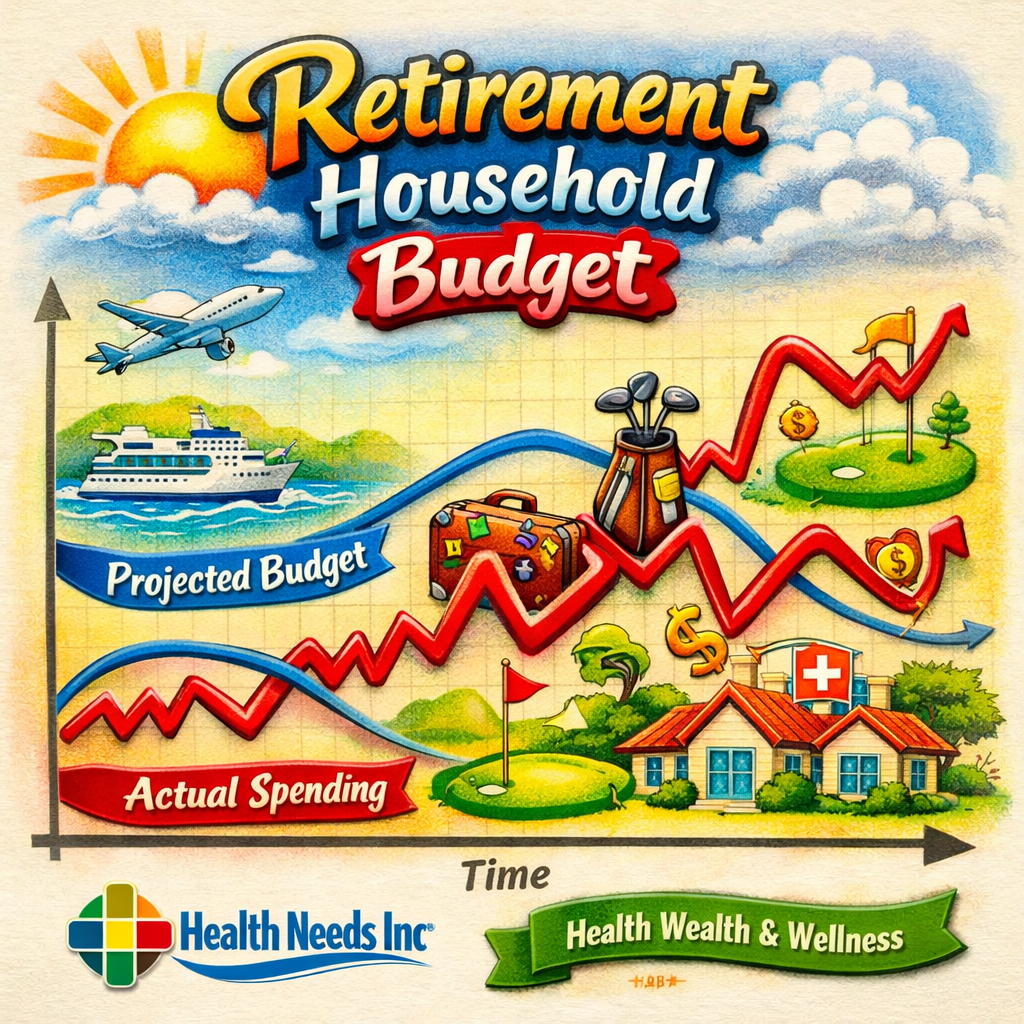
Most retirement charts are suspiciously well-behaved. They show a clean line rising with inflation or gently declining with age. Real spending looks more like a raccoon walked across the keyboard.
One year may include a roof repair, dental implant, new car, grandchild support, prescription change, appliance death, or relocation expense. The next year may look calm. The average across those years might be manageable, but averages do not pay the contractor on Tuesday.
T. Rowe Price research has found that spending can be volatile in retirement and that home expenses can be a major driver of that volatility. This is an important corrective to the idea that health care is the only unpredictable category. Sometimes the body behaves and the house commits mutiny.
The practical conclusion is that retirement plans need both a baseline budget and a shock budget. Your baseline covers predictable expenses. Your shock budget handles expenses that are irregular, lumpy, and deeply uninterested in your calendar.
Build a shock budget for categories like these
- Major home repairs
- Vehicle replacement or repair
- Dental, hearing, and vision costs
- Temporary home health support
- Family emergency help
- Relocation or downsizing costs
- Insurance deductibles and premium jumps
This is also why cash reserves matter. Not because cash is exciting. Cash is not exciting.
Cash is the beige cardigan of finance. But a decent reserve can prevent retirees from selling investments during ugly markets or putting large surprise costs on expensive debt. The HNI guide to asset allocation in retirement explains how cash can work as a timing tool rather than a permanent hiding place.
For more on how retirement myths become expensive, see our guide to Retirement Planning Myths That Cost People Money. The myth that spending automatically declines belongs in that same family. It is partly true, which is what makes it useful bait.
A Better Way to Plan for Retirement Spending Decline
Separate transition spending from recurring spending
Retirement can release years of delayed demand: a trip, a replacement car, renovations, or a move. One expensive transition year does not automatically establish the budget for every year afterward.
- Record normal annual living expenses.
- Separate temporary retirement-transition expenses.
- Identify optional lifestyle upgrades.
The familiar retirement “spending smile” describes a possible pattern of higher early spending, quieter middle years, and later care costs. Treat it as a scenario to test, not a schedule your body and household have agreed to follow.
Make family generosity visible
Family support is often called unexpected even when helping family has been a lifelong pattern. The problem is not generosity; it is treating generosity as financially invisible.
- How much can you give without weakening your own security?
- Will help come from income, reserves, or investments?
- Are you funding a temporary emergency or taking on a recurring expense?
- What boundaries apply to gifts, loans, and expectations among siblings?
For the family-care assumptions behind those decisions, see Kids as a Retirement Plan Myth.
Track what the money buys
A flat spending total can hide a shrinking life. If prices rise while the household cuts travel, gifts, or comfort to keep the same budget, stable dollar spending does not mean a stable standard of living.
The Bureau of Labor Statistics Consumer Price Index measures broad price changes. Your own mix of housing, health care, food, insurance, and leisure determines the pressure on your budget.
Review both overspending and underspending
Lower spending can reflect changing preferences, but it can also reflect fear. Sustainable spending should support a life, not merely preserve an account balance.
- Are essential costs rising faster than expected?
- Are you spending less by choice or because anxiety is making every purchase feel unsafe?
- What home, vehicle, health, or family costs are approaching?
- What changes after widowhood, caregiving, relocation, or market losses?
- What are you preserving the money for?
Review household records annually and after major life changes. A population average cannot tell you when the furnace will surrender.
The better method is not to ignore spending decline. It is to stop treating it like gravity.
Start with today’s actual spending, not a replacement-rate cliché. Many retirement calculators assume you need 70 percent, 80 percent, or 90 percent of pre-retirement income.
That can be a useful first napkin, but it is not a plan. Your actual expenses matter more than your former salary.
Then divide expenses into layers. Each layer should have a different inflation assumption, flexibility level, and funding source.
Five useful spending layers
- Essential floor: housing, food, utilities, insurance, transportation, basic care, and taxes.
- Lifestyle layer: travel, restaurants, hobbies, entertainment, gifts, and upgrades.
- Health layer: Medicare premiums, prescriptions, dental, vision, hearing, and out-of-pocket costs.
- Housing shock layer: repairs, maintenance, accessibility, rent increases, and relocation costs.
- Legacy and family layer: gifts, support, charitable giving, estate goals, and family emergencies.
Once you separate the layers, the spending decline question becomes more useful. Lifestyle spending may decline. Essential spending may not.
Health care may rise. Housing may behave for years and then send a bill with villain energy. The HNI guide to building a tax-diversified retirement plan shows why funding sources need different jobs as well.
Also build guardrails. Decide ahead of time what happens if portfolio returns are poor, inflation is higher, health costs rise, or withdrawals exceed the plan. Guardrails prevent every surprise from becoming a philosophical crisis at the kitchen table.
Good retirement planning is not about predicting the exact year you stop wanting restaurants. It is about knowing which spending can be cut, which cannot be cut, and which requires reserves because life has a habit of using the side door.
If stress itself is driving financial decisions, our guide to Understanding Cortisol may be useful. Retirement planning is partly math, but it is also nervous system management with better stationery.
Useful Tools and Sources for Retirement Spending Planning
Useful Retirement Spending Resources
- BLS Consumer Expenditure Tables, useful for seeing spending patterns by age group and household category.
- EBRI research on spending in retirement, useful for understanding how retiree spending changes across age bands.
- David Blanchett’s retirement spending smile research, useful for the argument that real spending often declines during retirement.
- Medicare.gov cost information, useful for checking current premiums, deductibles, and cost-sharing rules.
- Administration for Community Living long-term care estimates, useful for planning around later-life support needs.
- Social Security 2026 COLA fact sheet, useful for checking current benefit estimates and COLA context.
- Social Security survivor-benefits guidance, useful for widowhood and household-income planning.
- CFPB retirement-planning hub, useful for housing, debt, pensions, and later-life financial decisions.
- U.S. Department of Labor Retirement Toolkit, useful for coordinating spending, Social Security, Medicare, and workplace-plan decisions.
- T. Rowe Price research on spending volatility, useful for understanding irregular household and housing costs.
Final Thoughts on Retirement Spending Decline
So, does spending decline automatically as you age? No. It often declines, but automatically is the dangerous word.
Aging can reduce some expenses because life changes. You may travel less, drive less, buy less, entertain less, and stop spending money to survive a job you no longer have. That is real.
It deserves a place in the plan. But aging can also increase exposure to medical costs, support needs, household repairs, widowhood risk, and inflation in categories you cannot easily cut. That is also real.
Ignoring it because an average chart slopes downward is how retirees end up surprised by expenses that were never actually hiding. The wise move is to plan for a possible decline in flexible spending while protecting the expenses that do not decline on command. Build a spending floor.
Add a lifestyle layer. Hold reserves for shocks. Revisit the plan every year.
Let age reduce spending where it naturally does, but do not appoint age as your financial planner. If the plan needs rebuilding rather than minor adjustment, HNI’s catch-up strategies after 50 provide a practical next step.

Retirement without the fog.
Get practical retirement and wellness thinking without product hype, panic marketing, or golf-shirt certainty.
FAQs About Retirement Spending Decline
Retirement spending often goes down in real terms as people age, especially in discretionary categories like travel, restaurants, commuting, and entertainment. The decline is not guaranteed for every household. Health care, housing, taxes, insurance, and family support can keep spending flat or push it higher.
The retirement spending smile is the idea that spending is often higher early in retirement, lower in the middle years, and potentially higher later due to health care or support needs. It challenges the assumption that all expenses simply rise with inflation forever. It is useful, but it should not be treated as a guarantee.
Work-related expenses, commuting, professional clothing, retirement contributions, dining out, travel, and some entertainment spending often decline after retirement or later in old age. These are usually flexible lifestyle expenses. Essential expenses may behave differently.
Health care, dental care, hearing care, long-term care, home maintenance, insurance, property taxes, rent, and paid household help may rise with age. These costs can be uneven and hard to predict. That is why a retirement plan should include reserves for irregular expenses.
You can model a gradual decline in flexible spending, but it is risky to assume all spending will fall automatically. A safer approach is to separate essential spending from discretionary spending. Then stress-test health care, housing, inflation, and long-term care scenarios separately.
There is no universal number because health costs depend on Medicare coverage, prescriptions, income, location, supplemental insurance, and personal health. Retirees should track premiums, deductibles, out-of-pocket limits, dental, vision, hearing, and long-term care exposure. Health care should be its own planning category, not a vague footnote.
Review the plan at least once a year and after major life changes. Health events, widowhood, relocation, market declines, inflation spikes, tax changes, and family support needs can all change the spending picture. Retirement budgeting is a living system, not a one-time spreadsheet ceremony.