This article is for educational and informational purposes only. It is not financial, investment, tax, legal, or medical advice. Tax rules change, retirement accounts have specific requirements, and your situation may be more complicated than a cheerful internet article can safely absorb. Consult a qualified tax professional, certified financial planner, or other fiduciary professional before making major retirement or tax decisions.
Building a Tax Diversified Retirement Plan
A retirement plan is not just a pile of accounts. It is a future tax machine, and some machines are friendlier when they come with more than one lever.
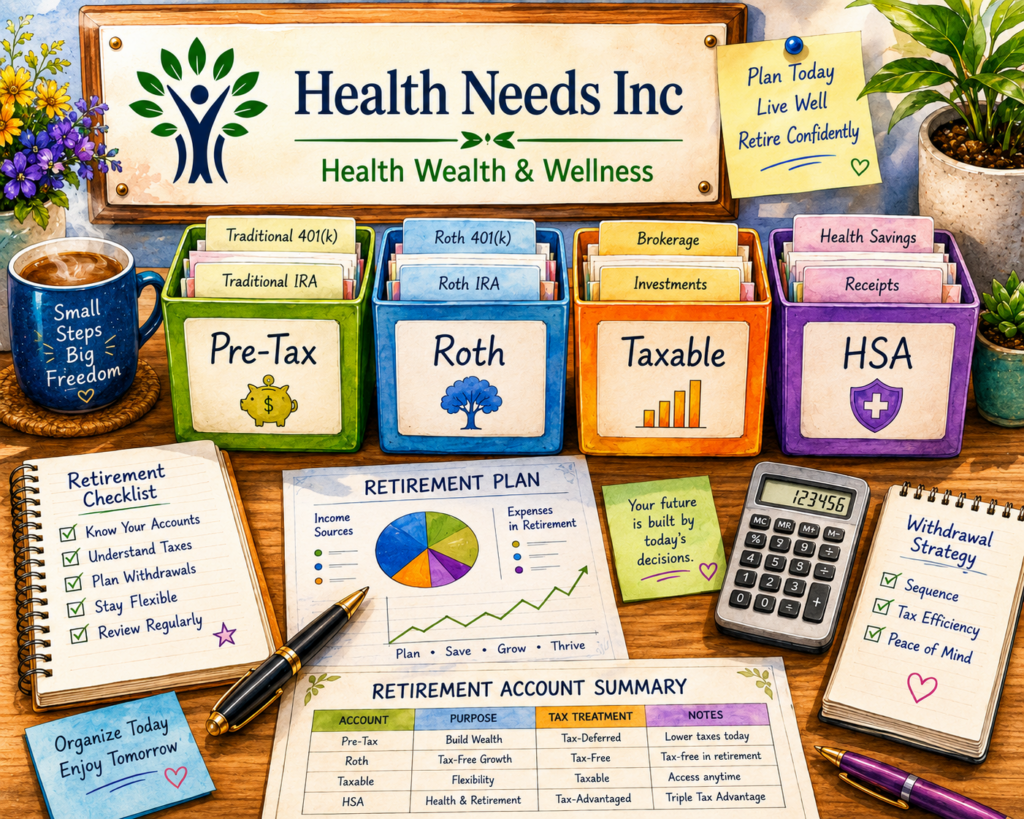
A tax diversified retirement plan spreads savings across account types with different tax treatment, usually pre-tax, Roth, taxable brokerage, and sometimes HSA accounts.
Pre-tax accounts can lower taxes today, but too much pre-tax concentration may create taxable withdrawals and required minimum distributions later.
Roth accounts can provide future flexibility because qualified withdrawals may be tax-free and may not increase taxable income.
Taxable brokerage accounts are not glamorous, but they can provide liquidity, capital gains flexibility, and fewer retirement account restrictions.
Retirement tax planning must consider RMDs, Social Security taxation, Medicare premium surcharges, Roth conversions, and withdrawal order.
The goal is not to predict future tax law perfectly. The goal is to preserve choices when future tax law, health costs, and life refuse to behave.
Why Building a Tax Diversified Retirement Plan Matters
Building a tax diversified retirement plan starts with a dull truth that becomes more exciting once it begins costing money: saving for retirement and controlling retirement taxes are not the same skill.
The first skill is accumulation. You put money away, invest consistently, and try not to sabotage the process every time the market develops indigestion.
The second skill is distribution. That is where the tax code enters wearing sensible shoes and carrying a clipboard.
Most retirement advice tells people to save more. That is useful, in the same way “drink water” is useful. It is not wrong, but it does not explain the whole organism.
If nearly all your retirement money sits in traditional 401(k)s and traditional IRAs, your future withdrawals may be taxed as ordinary income. That can be perfectly manageable.
It can also become a problem if those withdrawals collide with required minimum distributions, Social Security taxation, Medicare premium thresholds, or a year when you need cash for a roof, surgery, family emergency, or the universe’s latest invoice.
The short version is simple.
What is a tax diversified retirement plan?
A tax diversified retirement plan spreads retirement savings across accounts with different tax treatment so you can choose where income comes from later.
Pre-tax accounts may lower taxable income now, Roth accounts may offer qualified tax-free withdrawals later, taxable brokerage accounts can provide liquidity and capital gains treatment, and HSAs can help with qualified medical expenses. The point is flexibility, not tax perfection.
This is why tax diversification matters. It gives you levers. A retirement plan with one account type is not simple. It is just under-instrumented.
A broader retirement planning framework also connects with general financial wellness, not just tax spreadsheets.
That is why this topic pairs naturally with Retirement Planning Myths and The 8 Dimensions of Wellness. Money stress does not remain politely inside the finance folder.
The Four Tax Buckets in a Tax Diversified Retirement Plan
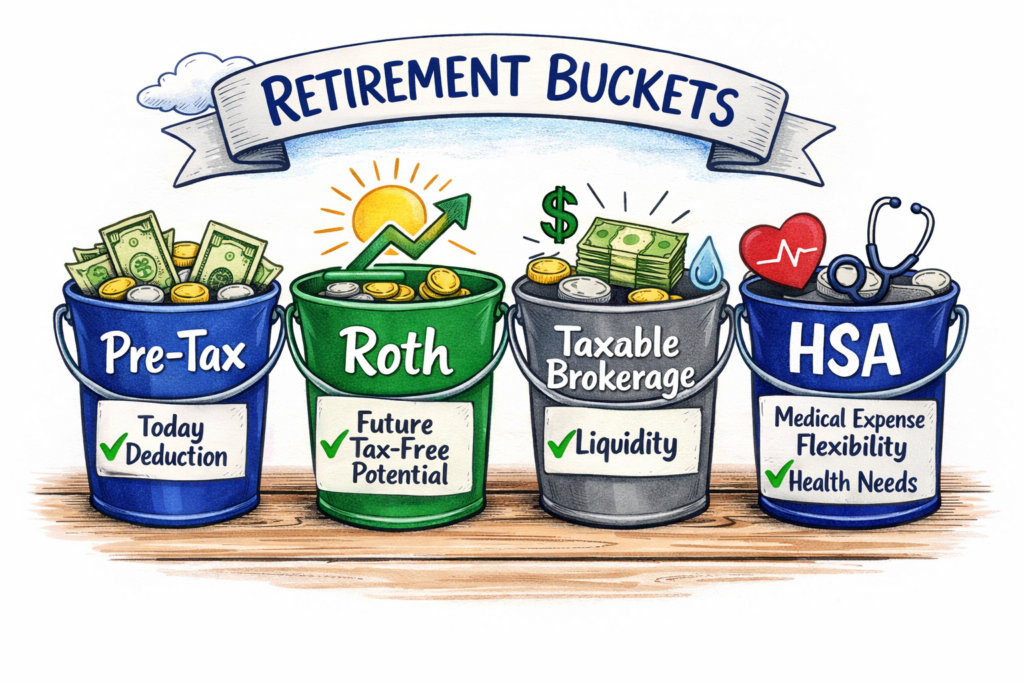
A practical tax diversified retirement plan usually includes some mix of four buckets. Not everyone can use every bucket. Not everyone needs every bucket.
The mistake is assuming one bucket is morally superior. The better question is what kind of control each bucket gives you later.
Bucket ① Pre-tax retirement accounts
Traditional 401(k)s, 403(b)s, 457(b)s, and deductible traditional IRAs may reduce taxable income in the year contributions are made. The money then grows tax-deferred.
Tax-deferred is the important phrase. It does not mean tax-forgiven. It means the tax bill is waiting in the hallway with a magazine.
Bucket ② Roth accounts
Roth IRAs and Roth employer plan contributions use after-tax dollars. You usually do not receive the same deduction now, but qualified withdrawals may be tax-free later.
That can be valuable if future tax rates are higher, if your income rises, or if you want retirement income sources that do not always show up as taxable income.
Bucket ③ Taxable brokerage accounts
Taxable brokerage accounts are ordinary investment accounts. They do not come with the retirement account velvet rope.
They may generate taxes along the way from dividends, interest, or realized gains. But they can also offer flexibility, no retirement withdrawal age, and potential long-term capital gains treatment.
Bucket ④ Health savings accounts
An HSA is not technically a retirement account, but eligible people can use it as a long-term medical expense tool. Contributions may be deductible, growth may be tax-free, and withdrawals for qualified medical expenses may be tax-free.
That triple tax advantage is why financial writers sometimes talk about HSAs with the reverence usually reserved for ancient artifacts and airport lounge access.
Pre-Tax Accounts Still Belong in the Plan
Pre-tax retirement accounts are not the villain. The villain is usually certainty wearing a nametag.
A traditional 401(k) can be extremely useful, especially when an employer match is involved. Passing up matching dollars to pursue tax sophistication is like refusing dinner because you want to study the plate.
For 2026, the IRS lists the elective deferral limit for many 401(k), 403(b), and similar plans at $24,500. The catch-up limit is $8,000 for many participants age 50 and older, and a higher catch-up limit applies for ages 60 through 63 in qualifying plans.
Pre-tax contributions may make sense when:
-
- You are in a high tax bracket now.
- You expect lower taxable income in retirement.
- You need the deduction to make saving realistic.
- You receive an employer match.
- You want to lower current adjusted gross income.
- You have no good Roth option available through work.
The problem is not the pre-tax account. The problem is letting it become the whole plan.
If all your savings are pre-tax, then retirement income may become heavily dependent on taxable withdrawals. That may be fine in some years and awkward in others.
This is where retirement planning becomes less like arithmetic and more like plumbing. You are trying to control pressure through the system before a pipe announces itself at 2 a.m.
Roth Accounts Buy Future Tax Flexibility
Roth accounts are often marketed as tax-free money, which is directionally true but annoyingly incomplete. The rules still matter. Tax law enjoys making a footnote do the work of a paragraph.
Roth IRA contributions are not deductible. If requirements are met, qualified distributions may be tax-free. Roth IRAs also do not require withdrawals during the original owner’s lifetime.
That last point matters. If you have enough money elsewhere, Roth assets can remain untouched longer, potentially providing late-retirement flexibility or estate planning options.
Roth money can be especially useful when you need income but do not want to increase taxable income.
That can matter around Social Security taxation, Medicare premium thresholds, capital gains planning, or years when required withdrawals already fill the tax bucket.
Common Roth entry points include:
-
- Roth IRA contributions, if your income allows.
- Roth 401(k) or Roth 403(b) contributions through an employer plan.
- Backdoor Roth IRA strategies, when appropriate and properly handled.
- Roth conversions from pre-tax accounts during selected tax years.
- In-plan Roth conversions, if your employer plan permits them.
For 2026, the IRS announced IRA contribution limits of $7,500, or $8,600 for people age 50 or older.
Roth IRA contribution eligibility phases out at higher income ranges, including $153,000 to $168,000 for single filers and heads of household, and $242,000 to $252,000 for married couples filing jointly.
Roth conversions deserve adult supervision. Converting pre-tax money to Roth usually creates taxable income in the conversion year. That can be wise in a low-income year and spectacularly irritating in a high-income year.
The planning window many people overlook is the gap after retiring but before required minimum distributions begin. Income may be lower. Tax brackets may be available. Roth conversions may be worth evaluating.
Not always. Not automatically. But worth evaluating.
HSAs and Taxable Brokerage Accounts Add Breathing Room
Two accounts often get treated like supporting characters in retirement planning: HSAs and taxable brokerage accounts. That is unfair. Supporting characters frequently explain the plot.
HSAs can help with medical expenses
For 2026, IRS guidance lists HSA contribution limits of $4,400 for self-only coverage and $8,750 for family coverage. Eligibility still matters, including high-deductible health plan rules and Medicare timing.
HSAs can be useful because health care expenses in retirement are not a theoretical possibility. They are more like weather. You may not know the exact day, but you should probably own an umbrella.
Some people use HSAs for current medical costs. Others pay current costs out of pocket, save receipts, invest the HSA balance, and reimburse themselves later if the rules are satisfied.
That strategy requires discipline and recordkeeping. In other words, it is perfect for people who enjoy folders and dangerous for people who think “I’ll remember” is a filing system.
Taxable brokerage accounts create liquidity
A taxable brokerage account gives you access to money without retirement account withdrawal restrictions. It can bridge early retirement years, fund large expenses, or reduce the need to pull extra money from pre-tax accounts.
It also gives you tax planning tools. You may be able to harvest losses, manage gains, or use long-term capital gains treatment depending on your situation and tax law.
Taxable accounts are not tax-free. Interest, dividends, and realized gains can all matter. But “not tax-free” does not mean “not useful.”
The taxable account is the old pickup truck of retirement planning. Not glamorous. Frequently practical. Often missed by people who are too busy admiring the shiny thing in the showroom.
RMDs, Social Security, and Medicare Are Where the Plan Gets Real
The early years of retirement can feel flexible. Then required minimum distributions arrive and begin asking questions in a government font.
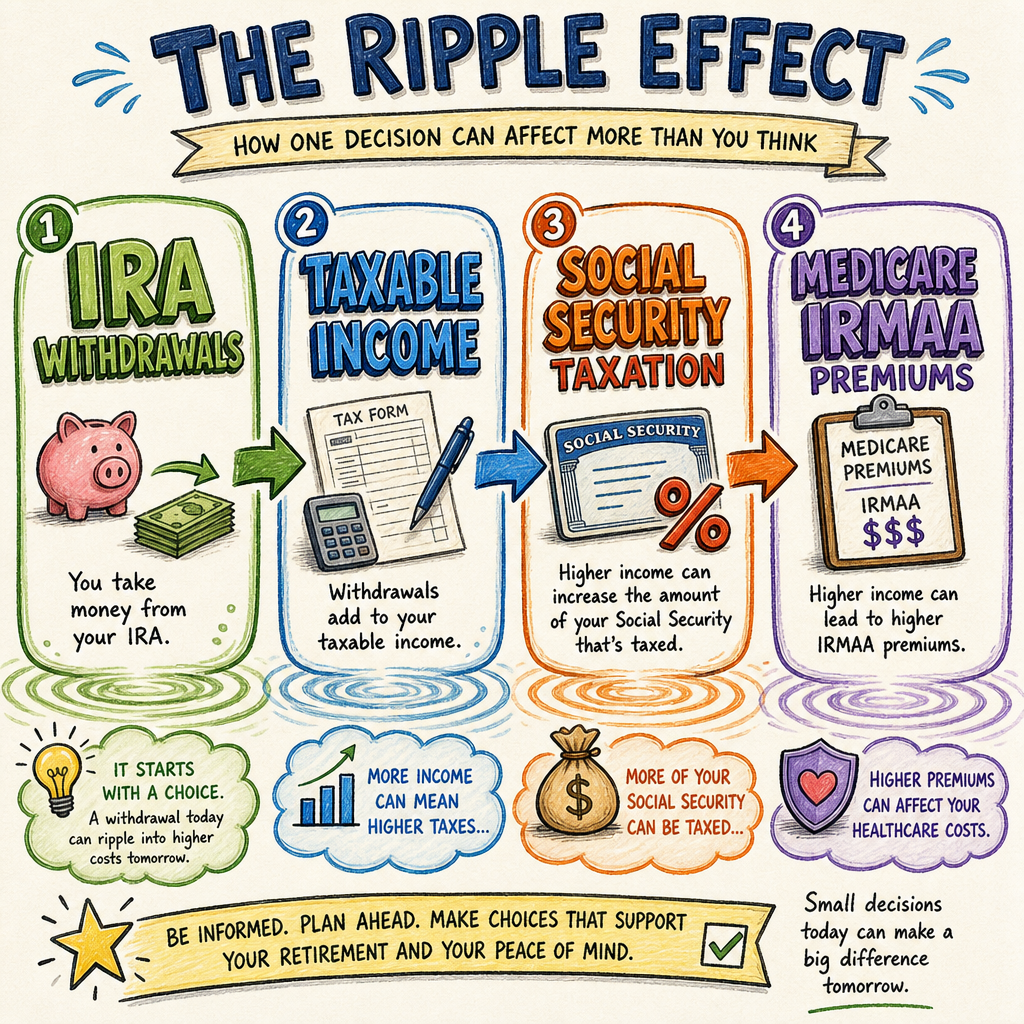
The IRS says required minimum distributions generally begin at age 73 for traditional IRAs, SEP IRAs, SIMPLE IRAs, and retirement plan accounts. Workplace plan participants may be able to delay RMDs from that plan until retirement unless they are a 5 percent owner, but traditional IRA rules are less forgiving.
RMDs usually count as taxable income, except for any portion already taxed or otherwise eligible for tax-free treatment. That income can affect more than your tax bracket.
Social Security benefits may become taxable depending on combined income. The IRS formula generally looks at one-half of Social Security benefits plus other income, including tax-exempt interest, compared with base amounts for filing status.
Medicare can add another surprise. For 2026, CMS says higher-income Medicare beneficiaries pay income-related monthly adjustment amounts for Part B and Part D based on modified adjusted gross income from two years earlier. In plain English, a high-income year can send a souvenir to your Medicare premium later.
This is why tax diversification matters. A retiree with only pre-tax money may have fewer ways to manage taxable income. A retiree with pre-tax, Roth, taxable, and HSA assets has more possible combinations.
Useful planning questions include:
-
- Will future RMDs push me into a higher bracket?
- Should I take IRA withdrawals before RMDs begin?
- Do Roth conversions make sense during lower-income years?
- Could extra income increase Medicare premiums later?
- Will taxable income make more Social Security taxable?
- Can taxable or Roth withdrawals help fund a high-expense year?
How to Build a Tax Diversified Retirement Plan
Start with inventory, not ideology. Retirement advice often begins with a confident opinion. Better planning begins with a list.
Write down every account you own. Include traditional 401(k)s, Roth accounts, IRAs, taxable brokerage accounts, HSAs, pensions, annuities, savings accounts, and any income sources that might arrive later.
For each account, note:
-
- Current balance.
- Tax treatment.
- Annual contribution amount.
- Withdrawal rules.
- Expected future contributions.
- Beneficiary designations.
- Whether the account creates RMDs.
Then ask where your retirement income will come from in each decade. The 60s, 70s, and 80s may have different tax problems.
Step 1 → capture the employer match
If your employer offers a match, that is usually the first stop. It may not be exciting, but excitement is overrated in retirement planning.
Excitement is what happens when someone discovers they have no cash cushion and a car that makes a new sound.
Step 2 → decide between pre-tax and Roth contributions
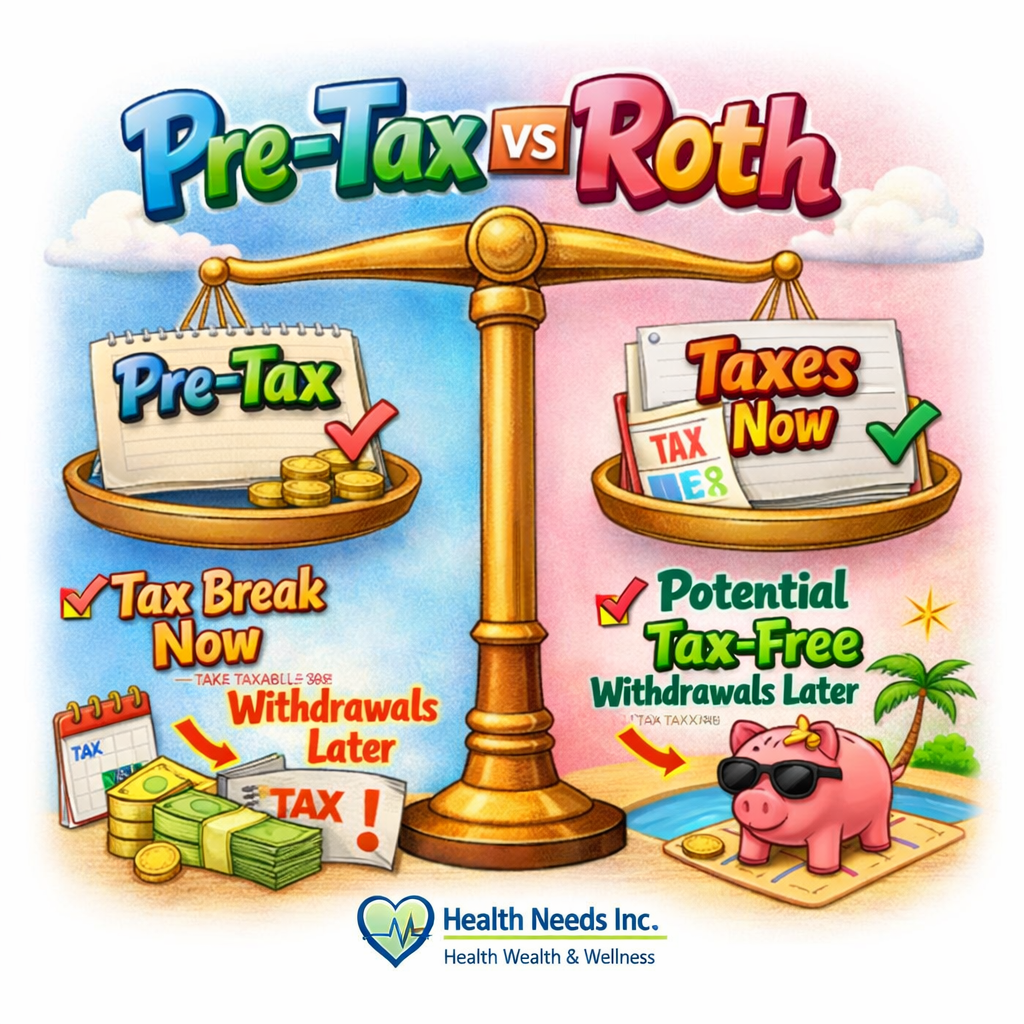
If you are in a high tax bracket now, pre-tax contributions may be attractive. If you are in a lower tax bracket or expect higher income later, Roth contributions may deserve more attention.
Many people use a split. That might mean contributing to a traditional 401(k) while also funding a Roth IRA, or splitting employer plan contributions between pre-tax and Roth if allowed.
Step 3 → use an HSA when it fits
If you are eligible and the health plan makes sense, an HSA can be a strong addition. But do not choose a high-deductible health plan solely because the tax treatment looks elegant.
Health needs, family risk, cash reserves, and plan design matter. A tax benefit that makes people avoid needed care is not financial wellness. It is just a spreadsheet with poor bedside manner.
Step 4 → add taxable savings
Taxable savings can fund goals before retirement, early retirement, home repairs, care needs, family emergencies, or years when you want to limit IRA withdrawals.
That flexibility has value. It may not show up in a simple retirement calculator, but real life has a talent for exposing simple calculators.
Withdrawal Sequencing Is the Control Panel
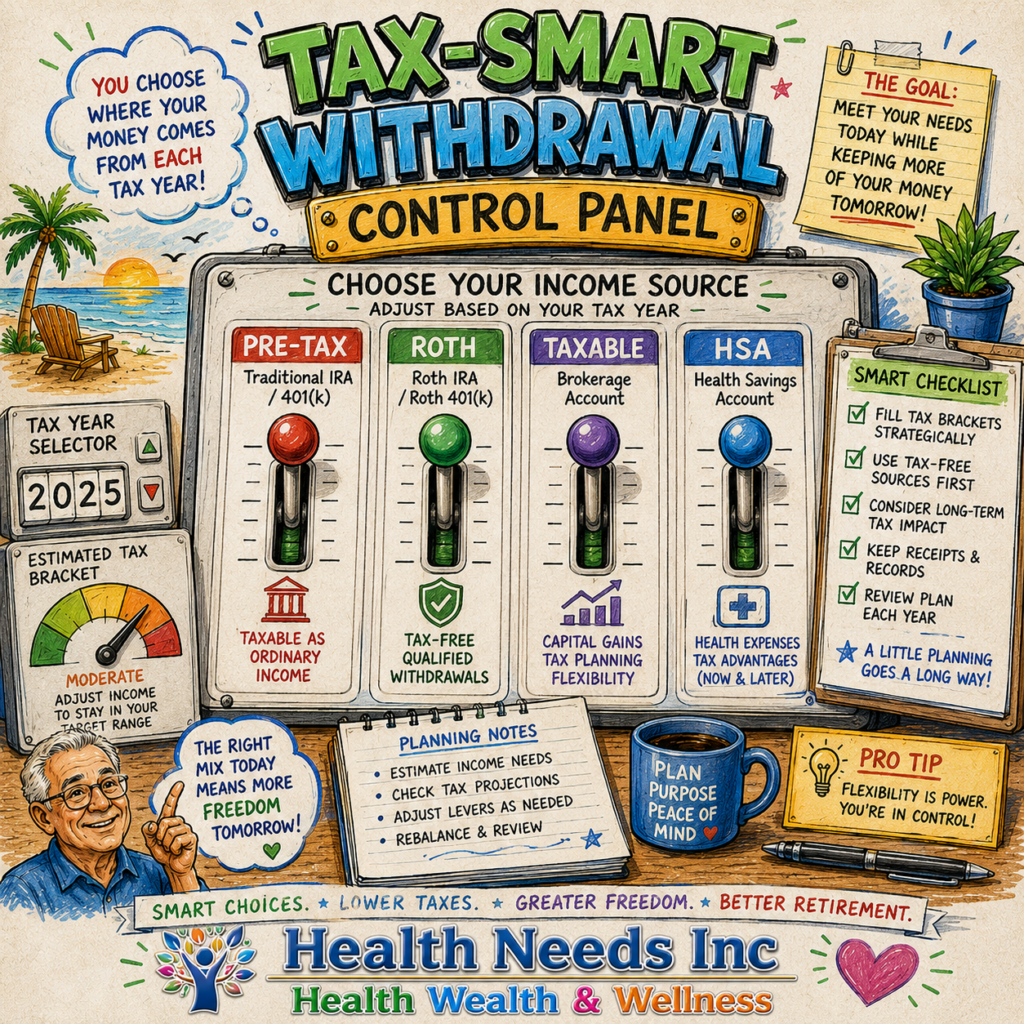
Accumulation gets the applause. Withdrawal sequencing does the quiet work after the curtain rises.
A common rule says to spend taxable accounts first, then pre-tax accounts, then Roth accounts. Sometimes that works. Sometimes it is too rigid.
A stronger approach is annual tax planning. Each year, look at your expected income, deductions, tax brackets, RMDs, Social Security, Medicare thresholds, market conditions, and spending needs.
Then choose the withdrawal mix that keeps the most useful options alive.
In one year, you might draw more from taxable accounts to avoid pushing income higher. In another year, you might intentionally take IRA withdrawals or do Roth conversions to fill a lower tax bracket before RMDs begin.
In a market downturn, you might use cash or taxable assets to avoid selling depressed retirement assets. In a high medical expense year, you might use HSA money for qualified expenses.
There is no universal perfect order. There is only a planning process that adapts.
That is less satisfying than a rule of thumb. It is also more honest.
The retirement industry loves certainty because certainty sells. A real tax diversified retirement plan is humbler. It says, “We do not know exactly what will happen, so we will avoid putting all future decisions into one taxable corner.”
The practical answer is boring, which is usually a good sign.
What is the best withdrawal order in retirement?
The best withdrawal order depends on tax brackets, RMDs, Social Security taxation, Medicare premiums, investment gains, cash needs, and estate goals.
- A common starting point is taxable accounts first, then pre-tax accounts, then Roth accounts.
- But a tax diversified retirement plan may intentionally vary that order year by year to manage taxable income.
This is where a CPA or fiduciary planner can be useful. Not because they possess secret retirement incense. Because they can help coordinate taxes, income, Medicare, and withdrawals in one view.
That coordination is the plan.
Frequently Asked Questions
A tax diversified retirement plan uses different account types so retirement income can come from multiple tax buckets. These often include pre-tax accounts, Roth accounts, taxable brokerage accounts, and sometimes HSAs. The purpose is flexibility. You are trying to manage taxable income later, not win a theoretical tax contest.
Roth versus traditional depends on your current tax rate, expected future tax rate, income stability, age, and cash flow. Traditional contributions may help if you are in a high bracket now. Roth contributions may help if your current bracket is lower or if you want more tax-free withdrawal flexibility later.
Roth conversions can be part of tax diversification because they move money from pre-tax status into Roth status. The conversion usually creates taxable income in the year it happens. The strategy may be useful in lower-income years, especially before RMDs begin, but it should be modeled carefully.
Required minimum distributions force withdrawals from many pre-tax retirement accounts once the rules apply. Those withdrawals generally add taxable income. Large pre-tax balances can create larger RMDs, which may affect tax brackets, Social Security taxation, and Medicare premiums.
Social Security taxation can matter because benefits may become taxable depending on your combined income. Traditional IRA and 401(k) withdrawals can increase that income. Qualified Roth withdrawals generally do not create the same taxable income, which can make Roth assets useful in some retirement years.
An HSA can help cover qualified medical expenses with tax advantages if you are eligible. Contributions may be deductible, growth may be tax-free, and withdrawals for qualified medical expenses may be tax-free. It works best when paired with good records, adequate cash flow, and a health plan that actually fits your life.
A taxable brokerage account can be very useful in a retirement plan. It provides liquidity, has no retirement account withdrawal age, and may allow capital gains planning. It is not tax-free, but it can help reduce pressure on pre-tax accounts during high-expense or low-income planning years.