The trust fund is not a dragon guarding your retirement check, but it is not a bedtime story either. Here is how to think clearly about claiming, timing, taxes, spouses, work, and the uncomfortable arithmetic Congress keeps leaving on the kitchen counter.

This article is for educational and informational purposes only. It is not financial, investment, tax, legal, or Social Security claiming advice. Social Security rules, tax rules, Medicare premiums, and household circumstances can change. Consult Social Security, a qualified tax professional, certified financial planner, or fiduciary adviser before making permanent retirement income decisions.
The short version is useful.
What are the smartest Social Security strategies when the trust fund is under pressure?
- Social Security strategies should start with your full retirement age, life expectancy, household income needs, spouse or survivor benefits, work plans, taxes, Medicare premiums, and cash reserves.
- The trust fund is projected to face depletion pressure, but that does not mean Social Security disappears. It means scheduled benefits may be reduced if Congress does nothing.
- The practical response is not blind panic. It is building a claiming plan that protects lifetime income while leaving room for tax planning and policy uncertainty.
Social Security is not projected to vanish. Payroll taxes would still fund most scheduled benefits even if trust fund reserves run down.
The OASI trust fund is projected to deplete in 2032. At that point, current projections show about 78 percent of scheduled retirement and survivor benefits payable.
Claiming early permanently reduces your monthly benefit. Age 62 looks tempting because it is visible, not always because it is optimal.
Delaying can increase lifetime security. It often matters most for people with longevity, savings, work income, or a spouse who may depend on a survivor benefit.
Couples should optimize the household, not two separate checks. Survivor benefits can make the higher earner’s claiming age more important.
Taxes, earnings limits, and Medicare premiums can change the answer. Social Security planning is not one lever. It is a drawer full of levers, some of them sticky.
Social Security Strategies Start With Trust Fund Reality
Building smart Social Security strategies is harder now because the phrase “trust fund depletion” sounds like someone backing a truck up to the retirement system at midnight. It is emotionally effective. It is also incomplete.
The Social Security Trustees project that the Old-Age and Survivors Insurance Trust Fund, the part tied to retirement and survivor benefits, will deplete its reserves in the fourth quarter of 2032. At that point, continuing income would be enough to pay about 78 percent of scheduled benefits unless Congress changes the law.
That is not nothing. A 22 percent gap would hurt real households, especially retirees with no private pension, no large investment account, and no rich uncle with suspiciously liquid assets.
But it is also not the same as Social Security going bankrupt. Payroll taxes would still come in. Benefits would still be payable, just not fully payable under current projections if lawmakers sit motionless like decorative furniture.
For retirees and near-retirees, the planning lesson is simple and annoying. Do not build your whole strategy around blind confidence or theatrical doom. Build a flexible claiming plan that works under several reasonable futures.
This is the same basic discipline behind good retirement planning generally. In our article on Retirement Planning Myths, we argue that certainty is usually the most expensive product in the room. Social Security proves the point with government stationery.
How the Social Security Trust Fund Actually Works
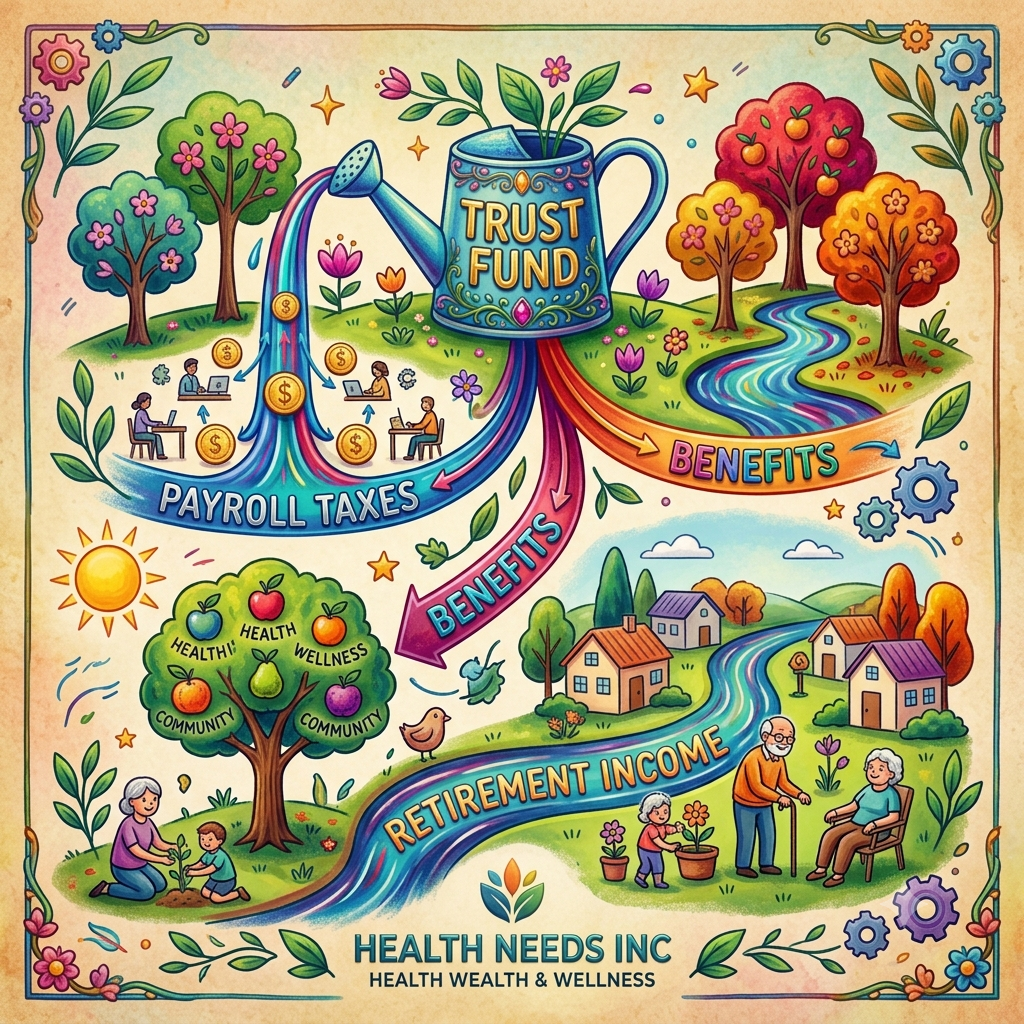
The Social Security trust funds are accounting mechanisms that hold Treasury securities. Workers and employers pay payroll taxes into the system, benefits are paid out, and any surplus is credited to the trust funds.
The retirement trust fund is under pressure because benefits paid out are exceeding dedicated income. The demographic reasons are familiar:
- More retirees collecting benefits.
- Longer average benefit periods.
- Lower birth rates than earlier generations.
- A smaller worker-to-beneficiary ratio.
- Political reluctance to raise taxes or slow benefit growth.
The trust fund reserves make up the difference while they last. Once reserves are depleted, Social Security can generally pay only what current income supports unless Congress acts.
The 2026 Trustees Report also projects that the Disability Insurance Trust Fund remains positive throughout the 75-year projection period. The combined OASDI trust funds, retirement plus disability, are projected to deplete in the third quarter of 2034, with 83 percent of scheduled benefits payable at that time.
That distinction matters. Headlines often blend the retirement trust fund, the disability trust fund, and the combined projection into one large fog machine. Fog is excellent for haunted houses. It is less helpful for retirement income planning.
For the official numbers, start with the Social Security Trustees Report summary. Then come back to your personal claiming decision, because national solvency and household solvency are related, but they are not the same problem.
Claiming Age Is the Biggest Social Security Strategy Lever
You can usually claim retirement benefits as early as 62. Full retirement age depends on your birth year, and for people born in 1960 or later it is 67.
Claim before full retirement age, and your monthly benefit is reduced. Claim after full retirement age, and delayed retirement credits can increase your benefit until age 70.
This is the part everyone wants reduced to a refrigerator magnet. “Claim at 62.” “Always wait until 70.” “Take the money and run.” “Delay or you hate math.” Unfortunately, people are not spreadsheets with knees.
The better question is not “What is the best age?” The better question is “What risk am I trying to reduce?”
- Claiming early may reduce the risk of running out of cash before retirement stabilizes.
- Delaying may reduce the risk of poverty in very old age.
- Claiming at full retirement age may balance income need and benefit size.
- Coordinating with portfolio withdrawals may reduce tax friction.
- Coordinating with a spouse may protect a survivor.
The break-even question matters, but it can be overused. Yes, delaying means you collect fewer checks at first. But a larger inflation-adjusted check later can be valuable if you live into your 80s or 90s.
That is why Social Security is best viewed as longevity insurance. It becomes more valuable the longer life keeps billing you.
Health matters. Family longevity matters. Cash reserves matter. Job stability matters. So does temperament, because some people will claim early simply because waiting makes them mentally chew the furniture.
The Social Security Administration explains early and delayed claiming on its retirement age and benefit reduction page. Use that as the rulebook, not your brother-in-law’s golf cart seminar.
Couples Need Household Social Security Strategies
Married couples often make Social Security decisions as if each spouse lives in a separate financial terrarium. That is a mistake. The household is the unit that pays the electric bill.
The higher earner’s claiming age can affect survivor income. When one spouse dies, the survivor generally continues with the larger benefit, not both benefits. This makes the larger check especially important for the spouse who may live longer.
That is not a romantic thought, unless your preferred love language is actuarial prudence. Still, it may be one of the most important retirement income decisions a couple makes.
A household strategy should ask:
- Which spouse has the higher benefit?
- Which spouse is more likely to live longer?
- Does one spouse have poor health or a shortened life expectancy?
- Can household savings support one spouse delaying?
- How would the survivor pay fixed expenses on one check?
- Are spousal or divorced-spouse benefits relevant?
Divorce can also matter. In some cases, a divorced spouse may qualify for benefits based on an ex-spouse’s work record if the marriage lasted at least 10 years and other rules are met. Widows, widowers, and eligible divorced surviving spouses may have separate survivor benefit options.
The official survivor benefit rules are worth reviewing directly at SSA’s survivor benefits page. Do not guess here. Guessing is for jellybean jars, not lifetime income.
This is also where wellness and financial wellness stop pretending they are separate planets. Money stress does not stay in the checking account. It moves into sleep, cortisol, patience, and the charming marital habit of discussing grocery prices with courtroom energy.
If retirement money anxiety is becoming a daily biological event, our article on Understanding Cortisol may help explain why the body treats uncertainty like an unpaid debt collector.
Work, Taxes, and Medicare Can Complicate the Plan
Social Security claiming does not happen in a vacuum. It happens in the swampy real world, where people work part time, sell investments, take required withdrawals, and discover that “retirement” sometimes includes a consulting invoice and a knee brace.
If you claim before full retirement age and keep working, the retirement earnings test may temporarily reduce your benefits above certain annual limits. In 2026, SSA lists an annual earnings limit of $24,480 for people under full retirement age for the entire year.
In the year you reach full retirement age, a higher limit applies before your birthday month. For 2026, that amount is $65,160. The withholding formula is different too.
This does not mean work is bad. It means claiming early while still earning wages needs math, not vibes.
Taxes can also surprise people. Depending on your combined income, a portion of Social Security benefits may be taxable at the federal level. This is where “I paid into it already” meets “yes, and here is another form.”
Medicare adds another wrinkle. Higher income can raise Medicare Part B and Part D premiums through IRMAA surcharges. A Roth conversion, investment gain, business sale, or consulting income can accidentally turn into a premium increase two years later.
The goal is not to fear income. Income is useful. We have built entire civilizations around wanting more of it.
The goal is sequencing. You may want to coordinate Social Security with withdrawals from traditional IRAs, Roth accounts, taxable brokerage accounts, pensions, annuities, and part-time work.
That is why a one-year claiming decision can echo through taxes, premiums, and survivor income. Retirement planning is less like flipping a switch and more like landing a small plane while someone reads tax code over the intercom.
Use SSA’s earnings test exempt amounts, the IRS page on Social Security income taxation, and the CMS information on Medicare premiums and income-related adjustments as starting points.
Fear-Based Claiming Is Usually an Expensive Social Security Strategy
Many people want to claim early because they fear Social Security will not be there. This is understandable. It is also not automatically wise.
If you claim at 62 because you need the income, that is a real constraint. Food, rent, prescriptions, and utilities do not accept white papers as payment.
If you claim at 62 only because the trust fund headline scared you, pause. You may be locking in a permanently reduced benefit to avoid a possible future reduction that Congress may still address.
That does not mean waiting is always superior. Someone with serious health issues, a short life expectancy, no savings, or urgent family needs may reasonably claim early. The adult answer is conditional, which is less fun than slogans but more useful.
Fear also distorts the trust fund issue. A projected benefit gap does not mean zero. It means scheduled benefits exceed projected dedicated revenue. Politicians dislike touching Social Security because voters dislike having their retirement checks used as budget confetti.
That political reality does not guarantee a clean fix. It does mean that assuming total disappearance is probably too crude for serious planning.
A better approach is scenario planning:
- Run your plan with full scheduled benefits.
- Run it with a 10 percent benefit reduction.
- Run it with a 20 percent benefit reduction.
- Run it with higher taxes or delayed claiming.
- Run it with one spouse living into their 90s.
That exercise is not cheerful. Neither is checking a roof before hurricane season. Cheerfulness is not the metric. Resilience is.
For a broader wellness framework, see our guide to the 8 Dimensions of Wellness. Financial stress has a way of impersonating every other wellness problem if you ignore it long enough.

A Practical Social Security Strategy Checklist
Before choosing a claiming age, build a household claiming file. Not a shrine. Not a 94-tab spreadsheet with conditional formatting and a personality disorder. Just a clear file.
Start with your current SSA benefit estimate. Create or review your my Social Security account and verify your earnings record. Mistakes happen, and the best time to correct a record is before you need the check.
Then gather the pieces that shape the decision:
- Your full retirement age.
- Your estimated benefit at 62, full retirement age, and 70.
- Your spouse’s or ex-spouse’s potential benefit information.
- Your current savings and expected withdrawals.
- Pension income, if any.
- Part-time work plans.
- Health status and family longevity.
- Expected housing, health care, and caregiving costs.
Next, decide what Social Security needs to do in your plan. Is it baseline income? Longevity protection? Survivor protection? A bridge while investments recover? A supplement to pension income?
The answer matters because the same claiming age can be smart in one household and foolish in another. A retired teacher with a pension, a paid-off home, and family longevity is not in the same position as a 62-year-old warehouse worker with back pain, rent, and no emergency fund.
Also ask whether delaying Social Security would force you to draw too aggressively from investments. Sometimes delaying creates a larger guaranteed check later, but drains too much liquidity now. That trade-off deserves attention.
A good Social Security plan usually has three qualities:
- It keeps essential bills covered.
- It protects the longest-living household member.
- It leaves enough flexibility for tax changes, health shocks, and market downturns.
That is less glamorous than “maximize your benefits,” but it is better. Maximization without context is how calculators become tiny tyrants.
What Congress May Change About Social Security
Congress has several broad ways to address Social Security’s funding gap. None are politically painless, which is why the topic keeps returning like a raccoon in the attic.
Possible changes include:
- Raising payroll taxes.
- Increasing or eliminating the taxable wage base.
- Changing benefit formulas for higher earners.
- Gradually increasing full retirement age.
- Changing cost-of-living adjustments.
- Increasing taxation of benefits.
- Transferring or reallocating revenue sources.
Some changes would affect future retirees more than current beneficiaries. Others could affect everyone. The details matter, and anyone claiming certainty is either guessing or selling something with a webinar countdown timer.
Your job is not to predict the legislative sausage factory. Your job is to avoid making fragile plans.
That means keeping some savings liquid, reducing high-interest debt before retirement, understanding your tax brackets, reviewing Medicare timing, and not assuming Social Security will cover every fixed expense forever.
It also means preserving your health where possible. Working longer, delaying benefits, or earning part-time income is easier when the body is not filing daily complaints. Our piece on the Five Pillars of Holistic Brain Health is useful here because cognitive stamina is part of financial independence, even if Wall Street rarely puts that in a pie chart.
The trust fund debate is national. Your response is personal. You cannot vote your way into a perfect claiming age. You can prepare your household for more than one future.
Resources for Social Security Strategy Planning
- my Social Security account, review your earnings record and benefit estimates directly with SSA.
- SSA Retirement Estimator, estimate future retirement benefits based on your actual earnings record.
- Social Security Trustees Report Summary, read the current trust fund projections from the official source.
- SSA Retirement Age Planner, compare early, full retirement age, and delayed claiming rules.
- IRS Social Security Income FAQ, review when benefits may be taxable.
Want Less Retirement Fog?
Get practical retirement, wellness, and financial wellness thinking without product hype, panic marketing, or golf-shirt certainty.
No spam ever. Unsubscribe any time.
Final Thoughts
Maximizing Social Security is not about squeezing the government vending machine until it drops an extra candy bar. It is about building durable lifetime income in a world where longevity, inflation, taxes, health, politics, and family needs all refuse to stand still.
The trust fund matters. It should be watched, understood, and fixed. But it should not bully you into a claiming decision that damages your household for decades.
Start with the official numbers. Know your full retirement age. Understand the trade-off between claiming early and delaying. Coordinate with your spouse. Check the tax consequences. Leave room for Congress to do something brilliant, foolish, partial, late, or all four.
That is the real strategy. Not certainty. Margin.
Frequently Asked Questions
Social Security is not projected to disappear, but the retirement trust fund is projected to deplete its reserves if Congress does nothing. Payroll taxes would still come in, which means benefits could still be paid at a reduced level. The current issue is a projected funding gap, not a total shutdown.
Trust fund depletion means reserves are exhausted and incoming revenue may not cover all scheduled benefits. Under current projections, the OASI trust fund would still have enough income to pay most scheduled benefits. Congress could change taxes, benefits, eligibility rules, or funding sources before that happens.
Claiming age depends on health, income needs, savings, spouse or survivor benefits, work plans, and life expectancy. Claiming at 62 gives earlier income but permanently reduces the monthly benefit. Waiting until 70 can increase monthly income, but only works well if you can cover expenses while delaying.
Claiming early only because of trust fund fear can be expensive. You may lock in a lower monthly benefit to avoid a future cut that may be smaller, delayed, or changed by Congress. Claim early when your household needs the income or your health and life expectancy make early claiming reasonable.
Spousal benefits can change the best household claiming strategy, especially when one spouse earned much more than the other. Couples should consider not only today’s two checks but also the future survivor benefit. The larger benefit may become the surviving spouse’s main income source.
Working while collecting Social Security is allowed, but benefits may be temporarily reduced if you are under full retirement age and earn above SSA’s annual earnings limits. Once you reach full retirement age, the earnings test no longer applies. Taxes and Medicare premiums may still be affected by higher income.
Social Security benefits may be taxable depending on your combined income, filing status, and other income sources. Wages, IRA withdrawals, pensions, investment income, and tax-exempt interest can all matter. This is why claiming strategy should be coordinated with tax planning, not treated as a separate decision.
The safest Social Security strategy is usually the one that keeps essential expenses covered, protects the longer-living spouse, and preserves flexibility. For some people, that means delaying. For others, it means claiming earlier because health, work, or cash flow makes waiting unrealistic.