TL;DR
Yoga can improve movement, balance, strength, body awareness, and stress management, but it is not magic and it is not a competitive folding contest.
-
Choose a style and class level that match your body, goals, and current ability.
-
Start with basic poses, ordinary breathing, and short sessions rather than advanced shapes.
-
Yoga can complement aerobic and resistance exercise, but it may not replace either one.
-
Pain, dizziness, numbness, or pressure to ignore your limits are reasons to stop, not evidence of spiritual progress.
Yoga is useful when it helps you move, breathe, balance, and pay attention. It becomes less useful when it turns into expensive clothing, impossible poses, and a stranger whispering that discomfort is merely your ego leaving the body.
 Yoga works best as a practice, not a performance.
For educational purposes only. This article is not medical advice or a substitute for individualized evaluation. If you have an injury, chronic condition, balance problem, glaucoma, recent surgery, pregnancy, or other health concern, ask a qualified health professional which activities and modifications are appropriate.
The quick answer
Is yoga actually good for beginners?
-
- Yes, when the practice is appropriate for the person. Yoga can combine mobility, balance, muscular endurance, controlled breathing, and focused attention in one adaptable activity.
- Research summarized by the National Center for Complementary and Integrative Health suggests possible benefits for balance, stress management, sleep, mental well-being, and some pain conditions, especially chronic low back pain.
The evidence is not equally strong for every claim, every style, or every health problem. Yoga should be treated as a useful form of movement, not a universal cure wearing linen pants.
Yoga has survived several thousand years, crossed continents, entered gyms, hospitals, community centers, phone apps, luxury resorts, and airport terminals. Along the way, a broad family of philosophical and physical traditions became, in the modern wellness market, a class schedule and a very profitable category of leggings.
That commercial history does not make yoga useless. It simply means we should separate the practice from the incense cloud around it. You can benefit from steady movement, balance work, breathing, and attention without accepting every claim made by someone selling a retreat in a location with suspiciously photogenic stones.
This guide focuses on practical yoga for beginners and returning adults. It explains what yoga can realistically do, how the main styles differ, how to start safely, and where it fits beside walking, cardio, and strength training.
Flexibility is not the admission fee. A suitable yoga practice meets your current range of motion and develops from there.
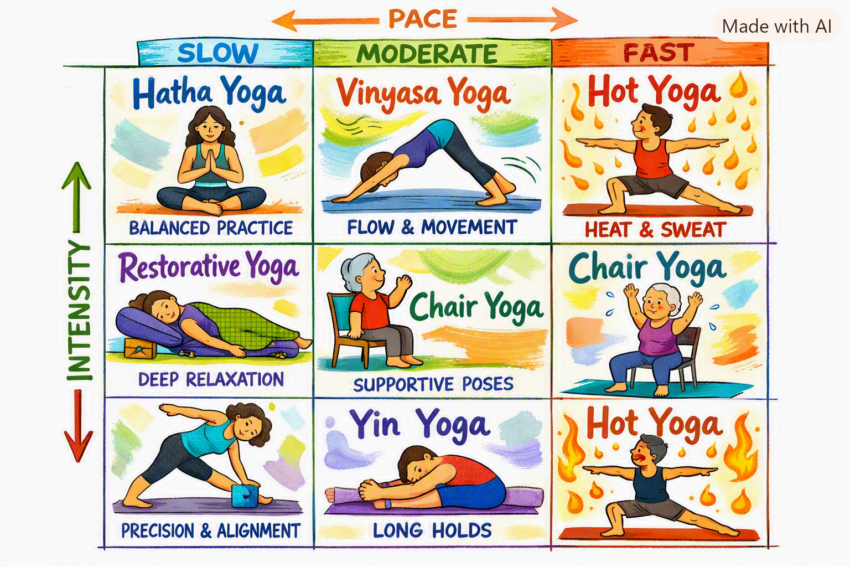
Style matters. Gentle, restorative, chair, Iyengar, Hatha, Vinyasa, and hot classes can feel like entirely different activities.
Yoga is not automatically complete exercise. Some practices challenge muscles and heart rate; others primarily train mobility, balance, relaxation, or attention.
Good instruction respects limits. Modifications are part of yoga, not a remedial corner for the insufficiently enlightened.
Consistency beats spectacle. Fifteen useful minutes repeated through the week can matter more than one heroic class followed by four days of negotiating with your hamstrings.
What Yoga Is When Nobody Is Trying to Sell You a Lifestyle
Modern yoga classes usually combine physical postures, transitions, breathing practices, and attention. Depending on the teacher and tradition, a class may also include meditation, chanting, philosophy, or extended relaxation.
The physical practice is often called asana. It includes familiar shapes such as mountain pose, child’s pose, downward-facing dog, bridge, warrior poses, and seated twists. Those names can make a class sound like a children’s book written after a complicated dream, but the movements train recognizable physical skills.
You shift weight. You control joints through a range of motion. You stabilize the trunk. You coordinate breathing with movement. You notice where effort, stiffness, fear, or impatience appears. In a well-designed class, none of this requires acrobatics.
Yoga is not one standardized dose
A ten-minute chair sequence and a ninety-minute power class are both called yoga, yet they deliver very different physical demands. This is important when reading claims that “yoga improves strength” or “yoga burns calories.” Which yoga? How often? For whom? Wellness advice has a habit of treating broad nouns as precise prescriptions.
A gentle class may improve confidence, joint movement, balance, and relaxation without providing much aerobic training. A demanding Vinyasa class may raise heart rate and challenge muscular endurance but still fail to train pulling strength or progressive lower-body loading as effectively as resistance exercise.
Yoga can be valuable without being everything. Walking is not a failure because it does not train the upper back. Soup is not morally compromised because it is not breakfast.
The Realistic Benefits of Yoga for Body and Mind
The National Center for Complementary and Integrative Health describes research suggesting that yoga may support general wellness, stress management, sleep, balance, and positive mental health. It also notes evidence of benefit for some conditions, including chronic low back pain.
“May support” is not evasive language. It is honest language. Effects vary by the practice, instructor, frequency, comparison group, health condition, and the quality of the study. Science is often less thrilling than marketing because science has met other variables.
Mobility and useful range of motion
Yoga repeatedly moves joints through controlled ranges. Over time, that can improve flexibility and the comfort with which you reach, turn, bend, and get down to the floor. The goal is not maximum range everywhere. More mobility is useful only when it is controlled and appropriate for the joint.
People who are naturally very flexible may need more stability and strength, not deeper stretching. If a pose looks impressive but relies on hanging passively in joints, the photograph may be healthier than the person.
Balance and body awareness
Standing poses, weight shifts, and transitions can challenge balance. NCCIH’s review of yoga research reports evidence of balance improvements in healthy people. For older adults, balance matters because it interacts with confidence, mobility, independence, and fall risk.
The CDC recommends balance activities for adults 65 and older, along with aerobic and muscle-strengthening exercise. Some yoga practices can contribute to the balance portion, especially when poses are adapted and a wall or chair is available.
Strength and muscular endurance
Holding a plank, rising from a lunge, controlling a squat-like chair pose, or supporting weight through the arms requires strength. Beginners can make meaningful gains because the body is meeting a new challenge.
Eventually, progress may require more resistance than body weight and repeated familiar poses provide. Yoga can complement strength training, but a relaxed stretching class does not become a comprehensive resistance program merely because everyone’s quadriceps had an emotional moment.
Stress, sleep, and attention
Slow breathing, physical movement, focused attention, and a structured pause from daily demands may help some people feel calmer. Research summarized by NCCIH suggests possible improvements in physical or psychological aspects of stress, sleep, and well-being.
Yoga is not psychotherapy, and breathing through a difficult pose does not settle a mortgage dispute. Still, practicing attention without immediately obeying every thought can be useful. The mind produces commentary. Yoga gives it fewer microphones.
How to Choose a Yoga Style Without Needing a Sanskrit Dictionary
Class names are inconsistent. One studio’s “gentle flow” is another studio’s athletic audition. Read descriptions, contact the instructor, and ask what the class actually involves.
Hatha yoga
In many Western studios, Hatha describes a slower class that teaches individual poses with pauses between them. It can be a sensible starting point when the class is explicitly labeled beginner-friendly.
Vinyasa or flow yoga
Vinyasa links poses into sequences, often synchronized with breathing. It can range from gentle to vigorous. Faster transitions may be challenging for beginners, people with wrist or shoulder issues, or anyone who would prefer time to determine where the left foot has gone.
Iyengar yoga
Iyengar teaching emphasizes alignment, precision, and props such as blocks, belts, blankets, and chairs. It can be helpful for learners who value detailed instruction. The quality of adaptation still depends on the instructor and the individual.
Restorative yoga
Restorative classes use props to support comfortable positions held for longer periods. The primary goal is often relaxation rather than fitness. It may be useful during stressful periods, but it does not replace strength or aerobic training.
Yin yoga
Yin classes hold mostly floor-based stretches for several minutes. Some people enjoy the stillness. Others may find long passive holds irritating, especially if they are hypermobile or have certain joint problems. Intensity is not automatically therapeutic.
Chair yoga
Chair yoga adapts movements for people who prefer or need seated support. Some practices include standing balance work while holding the chair. It is not pretend yoga. It is yoga adjusted to a real person, which is what intelligent exercise has always done.
Hot yoga
Hot classes add heat and sometimes humidity. They can increase dehydration and heat-related risk, and the warmth may encourage people to move beyond their normal range. Beginners do not need heat to prove commitment. The room already contains enough human ambition.
Video and Tools for Choosing a Sensible Starting Point
VIDEO PLACEHOLDER, POSITIONED ABOUT 30% INTO THE ARTICLE
Recommended HNI video: “A 10-Minute Beginner Yoga Practice Without Floor Acrobatics.”
Thumbnail alt text: Adult beginner using a chair, mat, and yoga blocks during a calm introductory practice.
Useful beginner tools
- NCCIH Yoga Effectiveness and Safety for a plain-language evidence and safety overview.
- CDC Physical Activity Guidelines for understanding how yoga fits beside aerobic and strength activity.
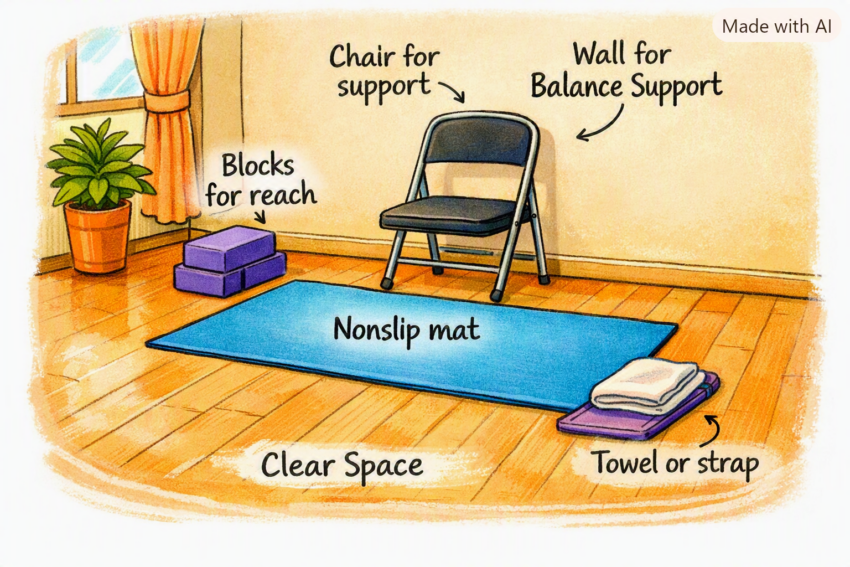
- Chair or wall: Stable support for balance and controlled transitions.
- Two blocks: They bring the floor closer, which is more civilized than demanding that your hamstrings negotiate the distance.
- Strap or towel: Useful for extending reach without forcing a joint.
- Practice log: Record comfort, pain, balance, energy, and what you want adjusted next time.
What Your First Yoga Practice Should Actually Look Like
Begin with fifteen to twenty minutes. Wear clothing that lets you move and breathe. You do not need specialized equipment, spiritual accessories, or a water bottle that costs more than lunch.
Step 1: Check the environment
Use a nonslip surface with enough clear space. Keep a stable chair or wall nearby if balance is uncertain. Make sure pets, loose rugs, and aggressively decorative furniture are outside the landing zone.
Step 2: Start with ordinary breathing
Sit or stand comfortably. Notice the breath without forcing it. Let inhalations and exhalations become steady. If breath work makes you dizzy, anxious, numb, or uncomfortable, return to normal breathing and stop the technique.
Step 3: Move through basic patterns
A beginner session might include shoulder circles, gentle spinal movement, a supported hip hinge, chair pose near a wall, a low lunge with support, bridge pose, a simple twist, and rest. The exact sequence matters less than controlled movement and an appropriate challenge.
Step 4: Use a workable effort
Mild muscular effort and a tolerable stretching sensation can be normal. Sharp pain, pinching, electrical sensations, numbness, dizziness, chest discomfort, or a feeling that a joint is unstable are not goals. Stop and change the position.
Step 5: Finish before form collapses
A short practice that ends well builds confidence. A long practice that becomes a survival documentary teaches the body mostly that yoga is to be avoided.
Yoga Safety: Your Body Is Not an Obstacle to the Pose
NCCIH considers yoga generally safe for healthy people when practiced properly under qualified guidance. Sprains and strains are the most common reported injuries, while serious injuries are rare. Lower risk does not mean no risk.
Beginners should be cautious with headstands, shoulder stands, lotus position, forceful breathing, extreme backbends, and any pose that places unfamiliar load on the neck. There is no beginner prize for selecting the pose most likely to frighten your cervical spine.
Tell the instructor what matters
Before class, mention relevant injuries, joint replacements, osteoporosis, balance problems, pregnancy, glaucoma, high blood pressure, recent surgery, or other conditions that may require modification. A competent teacher should welcome the information and offer options without staging a public diagnosis.
Do not let the room set your range
Comparison is particularly foolish in yoga because anatomy differs. Hip sockets, limb proportions, injury histories, and natural mobility affect how poses look. The person beside you may have practiced for fifteen years or may simply possess joints designed by a different committee.
Be skeptical of hands-on adjustments
An instructor should obtain consent before touching or physically adjusting you. A deeper pose is not automatically a better pose. If an adjustment feels unsafe or unwanted, say no. Personal boundaries do not become less relevant because someone rang a small bell.
Choose instruction, not charisma
Teacher training varies. Look for someone who explains purpose, offers modifications, respects pain, understands when to refer out, and does not promise to cure disease. Confidence is not anatomy education. A microphone can conceal only so much.
How Yoga Fits Into a Balanced Week
The CDC recommends that most adults accumulate at least 150 minutes of moderate-intensity aerobic activity weekly and do muscle-strengthening activities on at least two days. Adults 65 and older should also include balance activity. Individual needs and abilities vary, but the categories provide a useful map.
Yoga may contribute to strength, balance, mobility, and sometimes aerobic activity. Whether it “counts” depends on the class. A quiet restorative session and a continuous power flow cannot be filed under the same physiological receipt.
A realistic beginner week
- Monday: Twenty minutes of beginner Hatha or chair yoga.
- Tuesday: Brisk walking or another suitable aerobic activity.
- Wednesday: Full-body resistance training plus five minutes of gentle mobility.
- Thursday: Restorative yoga, breathing, or an easy walk.
- Friday: Twenty to thirty minutes of beginner flow or balance-focused practice.
- Saturday: Resistance training and ordinary recreational movement.
- Sunday: Rest, walking, or a short recovery sequence.
This is an example, not a commandment discovered beneath a yoga mat. Adjust volume, intensity, and exercise selection to health, recovery, schedule, and goals.
Progress one variable at a time
Add a few minutes, one additional weekly session, or a modestly harder variation. Do not simultaneously increase duration, frequency, heat, complexity, and your belief in destiny. The body prefers smaller negotiations.
Track what improves outside class. Can you turn more comfortably, rise from the floor, stand on one foot near support, recover from stress, or move with less apprehension? Those outcomes matter more than producing an impressive shape for an audience that was not invited.
The Mind-Body Connection Without the Mystical Fog
The phrase “mind-body” can sound like a wellness brochure attempting to sell moonlight. The underlying idea is ordinary. Thoughts, attention, breathing, muscle tension, emotion, pain, and behavior influence one another.
During yoga, you notice a sensation, interpret it, and decide how to respond. You may soften unnecessary tension, change the pose, slow the breath, or remain with manageable effort. That is not supernatural. It is practicing regulation and choice.
For some people, this focused movement feels calming. For others, stillness or body attention can feel uncomfortable, especially with trauma, anxiety, or certain pain experiences. Eyes can stay open. A pose can be skipped. A class can be left. Autonomy is part of safety.
Yoga should not become another system for blaming people when symptoms persist. If breathing and stretching do not resolve depression, chronic pain, insomnia, or illness, the person has not failed yoga. The claim may simply have exceeded the evidence.
This perspective connects yoga to the broader 8 Dimensions of Wellness. Physical practices affect emotional steadiness, social connection, daily function, environment, and meaning. Wellness is interconnected, but interconnected does not mean one pose fixes the plumbing, marriage, metabolism, and existential crisis before breakfast.
Wellness without the fog.
Get practical, evidence-aware thinking without miracle language, panic marketing, or compulsory enlightenment.
Useful Yoga and Physical Activity Sources
Final Thoughts on Starting Yoga
Yoga can be a practical way to develop movement, balance, body awareness, and a steadier relationship with effort. It can also become another wellness identity project filled with expensive props, inflated promises, and the peculiar belief that pain becomes wisdom if spoken about softly.
Keep the useful part. Begin with a suitable class. Move within a controllable range. Breathe normally. Use props. Ask questions. Stop when something feels wrong. Combine yoga with the aerobic and resistance exercise your health and goals require.
Most importantly, judge the practice by what it adds to ordinary life. Better movement. More confidence. A calmer transition out of stress. The ability to reach the floor and return without summoning a committee.
Continue exploring the larger system through the 8 Dimensions of Wellness. Physical wellness is not a body project. It is the ongoing work of supporting the body that carries every other part of your life.
FAQs About Yoga for Beginners
No. Flexibility is not a prerequisite. Begin with a suitable class, use props, and work within your current range. Mobility may improve through consistent practice, but forcing range can increase irritation or injury risk.
Two or three short sessions per week can be a manageable starting point. Even ten to twenty minutes can help establish skill and consistency. Increase gradually based on recovery, comfort, and goals.
Some yoga poses develop strength and muscular endurance, especially for beginners. Many practices do not provide systematic resistance for all major muscle groups. Separate strength training may still be needed.
Some vigorous, continuous styles may raise heart rate enough to contribute to aerobic activity. Gentle, restorative, and slower classes usually should not be assumed to replace moderate-intensity cardio.
Yoga can be adapted for many older adults, including with chairs, walls, and blocks. Health conditions, osteoporosis, balance limitations, joint replacements, medications, and injury history may require professional guidance and specific modifications.
No. Muscular effort and a mild stretching sensation can occur, but sharp pain, pinching, numbness, electrical sensations, chest discomfort, dizziness, or joint instability are reasons to stop and modify the activity.
A nonslip surface and comfortable clothing may be enough. Two blocks, a strap or towel, and a stable chair can make poses more accessible. Expensive equipment is optional; your hamstrings do not check brand names.