
Emotional Wellness: How to Feel Without Letting Every Feeling Drive the Car
A practical guide to feelings, coping, connection, and knowing when to seek help.
 By

Table of Contents
Someone tells you to stay positive while you are exhausted, worried, and halfway through a family crisis. You briefly consider being positive that they should leave the room.
There is the problem, neatly packaged. Emotional wellness has been confused with performing happiness. The result is an industry selling serenity to people who sometimes need sleep, honest company, practical help, or qualified care.
Emotional wellness is not the elimination of difficult feelings. It is developing enough awareness, flexibility, and support to experience them without handing each one the keys.
Sadness, anger, fear, frustration, grief, embarrassment, and uncertainty are not system errors. They are part of being human. The question is how you understand them, what you do next, and when you need assistance.
This guide maps the important branches of emotional wellness and links to narrower HNI articles. It offers a practical way to examine a response, without scoring your personality or promising to renovate it over a weekend.
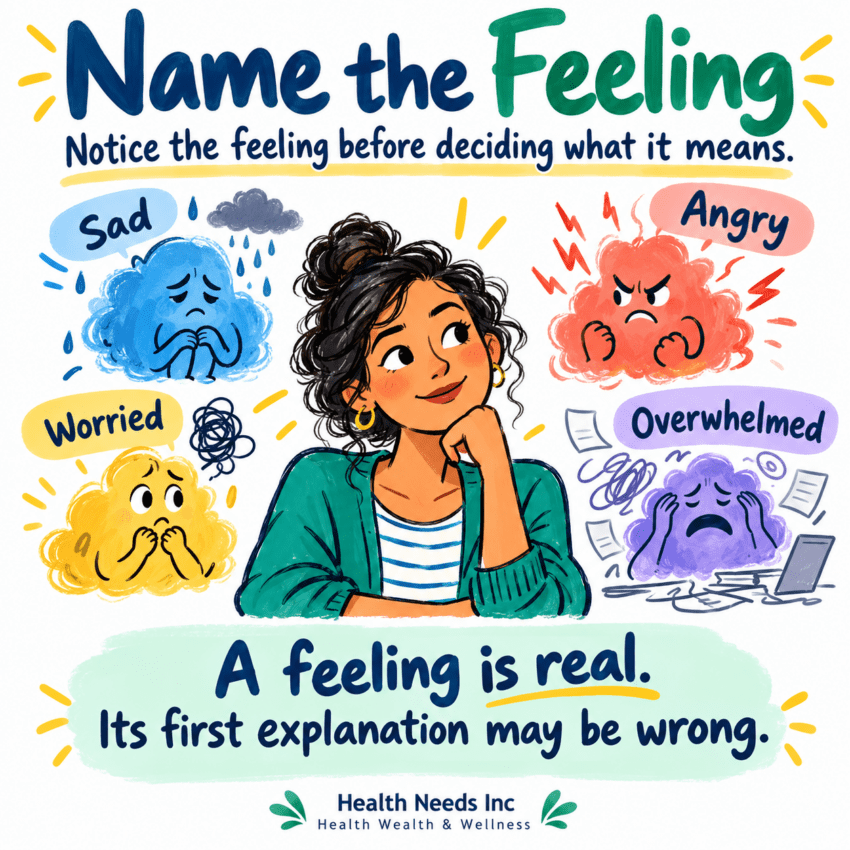
A feeling can be real without its first explanation being correct.
Key Takeaways
- Emotional wellness leaves room for difficult feelings. Constant happiness is a poor benchmark.
- Recognizing an emotion is different from obeying it. Separate the feeling, interpretation, and response.
- Coping should address both distress and the conditions producing it. Some problems need practical change.
- Sleep, physical health, relationships, work, money, and life changes belong in the picture.
- Professional support is part of emotional wellness. Severe, worsening, or disruptive symptoms deserve attention.
01 What Emotional Wellness Actually Means
Emotional wellness is the capacity to recognize feelings, make sense of them, respond with some choice, and obtain support when life exceeds your current resources. It leaves room for sadness, anger, fear, embarrassment, uncertainty, and delight. A functioning emotional life has a range, not a permanent smile.
Wellness culture has occasionally treated negative emotion as bad housekeeping. Think positively. Raise your vibration. Remove negativity. Apparently the human nervous system failed to attend the seminar.
The problem with this sales pitch is that it turns an ordinary human experience into evidence that you are doing life incorrectly. You feel bad, then feel bad about feeling bad. An impressive business model, if your product is the second problem.
The NIH Emotional Wellness Toolkit treats emotional health as a set of capacities involving stress, resilience, sleep, loss, mindfulness, and connection. HNI’s interpretation is straightforward: these capacities belong in ordinary life, not just in a retreat brochure.
Ask what your emotional life allows you to do. Can you disagree without destroying a relationship? Can you recover after disappointment? Can you ask for help before the situation becomes unbearable? These questions reveal more than whether you felt cheerful on Tuesday.
Emotional wellness is one part of the Eight Dimensions of Wellness. Money, work, relationships, surroundings, physical health, and meaning all enter the conversation. Nobody’s feelings operate in a sealed laboratory.
02 Emotional Awareness: Notice Before You Explain
Before regulating an emotion, you have to notice it. That sounds obvious until you consider how often people identify anger after the message has been sent, the door has been slammed, and the family group chat has entered a constitutional crisis.
Start with a description rather than a verdict. “I feel rejected” is more useful than “Everyone is selfish.” “I am worried about money” is more specific than “My entire life is a disaster.” Specificity gives you something to investigate.
Notice the situation, the feeling, and the impulse separately. A friend canceled dinner. You feel disappointed and unimportant. You want to withdraw for a month. Those are three different pieces of information, even when they arrive wearing one coat.
Your first explanation may be wrong. The cancellation could reflect exhaustion rather than rejection. Equally, repeated cancellations may reveal a relationship that needs discussion. Awareness leaves both possibilities open long enough to find out.
Try asking: What happened immediately before this feeling? What am I afraid it means? What do I want to do next? You are observing a pattern, not conducting a prosecution.
Keep notes brief if you use them. A few words about the trigger, response, and consequence can be enough. If writing becomes another way to rehearse grievances, stop the rehearsal and try a concrete next step instead.
03 Regulation Is Not Suppression
Regulation does not mean pretending anger is serenity or grief is gratitude. It means choosing what you do with a feeling. You can acknowledge anger and decide that the email needs to wait.
Suppression may hide what you feel from other people, and sometimes discretion is necessary. You do not owe every passing emotion a public statement. The trouble comes when concealment becomes your only strategy and the underlying problem never gets examined.
A practical pause can be modest. Put down the phone. Leave an argument with a clear promise to return. Take a short walk if that is comfortable and possible. The purpose is to create room for a less impulsive choice, not to achieve instant tranquility.
Consider two responses to the same criticism. One person retaliates immediately. Another says, “I need a little time to think about that, then I want to talk.” The second response does not prove the criticism was fair. It protects the ability to decide.
Regulation also includes action. If a repeated behavior is hurting you, settling down is only the beginning. A conversation, a boundary, practical assistance, or professional support may matter more than becoming exceptionally calm about an unchanged problem.
Use calm as a resource, not a moral ranking. People who sound composed can behave cruelly. People who cry can make excellent decisions. Volume is an unreliable measure of wisdom.
04 Stress and Resilience: Humans Are Not Tennis Balls
Resilience is often marketed as the ability to bounce back. Humans are not tennis balls. Sometimes we recover. Sometimes we adapt. Sometimes an experience changes what recovery can reasonably mean.
After a loss, illness, job disruption, or family crisis, the useful question may be: What would make the next week more manageable? A demand to become your old self immediately can become another burden.
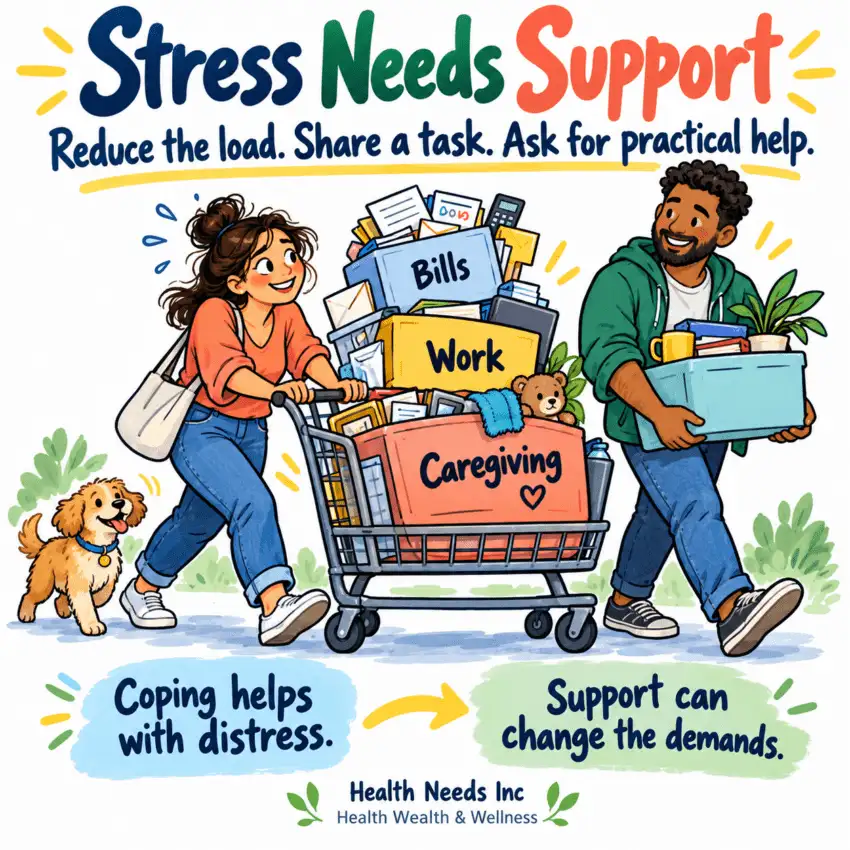
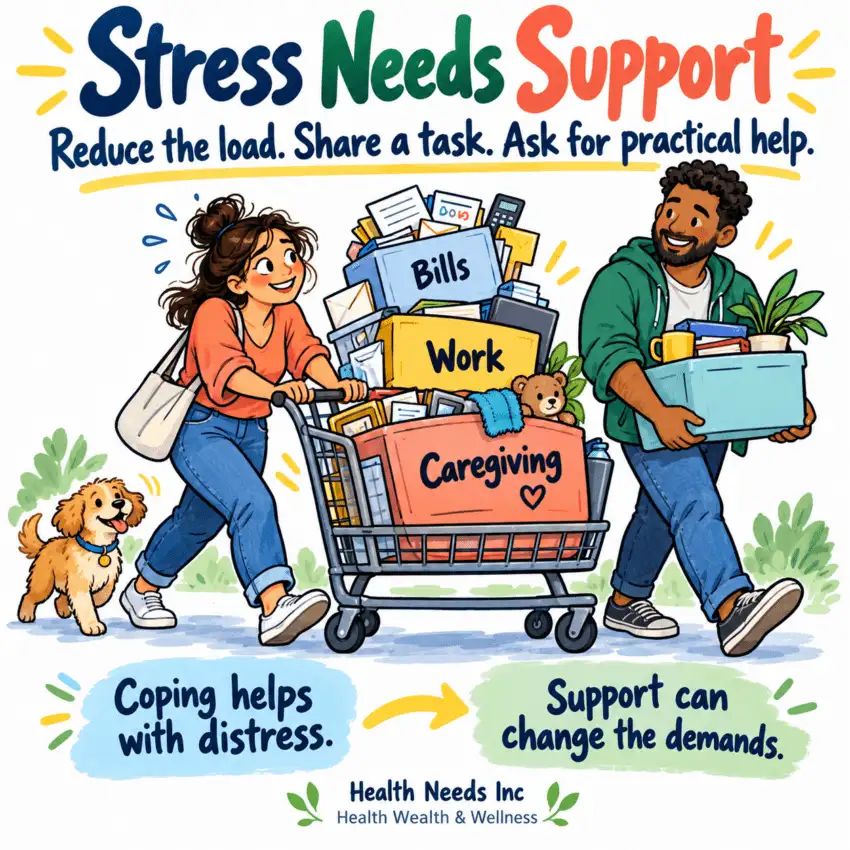
Distinguish a problem you can change from a demand you need help carrying. An overdue bill may require a call and a payment arrangement. Caregiving may require another pair of hands. An uncertain medical result may require tolerating uncertainty while getting appropriate information.
These situations can feel similar inside your body. Their solutions differ. A breathing exercise cannot negotiate a bill, although a little composure may make the phone call easier.
Watch the accumulation of demands. People sometimes search for the single thing that broke them when the more accurate answer is several months without enough rest, help, or margin. The final inconvenience gets blamed because it was standing nearest the wreckage.
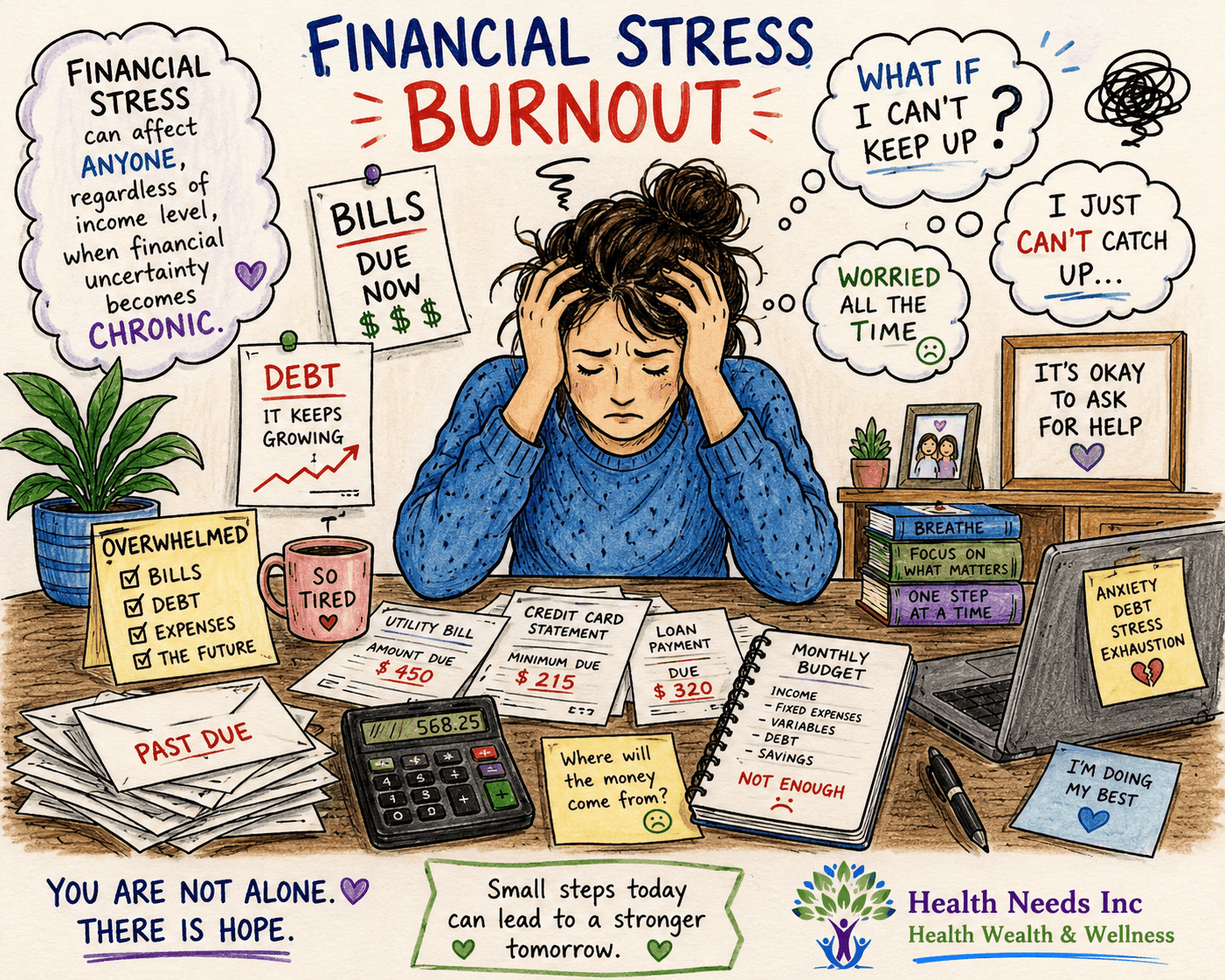
Our coverage of financial stress and burnout examines one version of that accumulation. A coping plan should address both the immediate distress and the conditions repeatedly producing it.
05 A Practical Emotional Wellness Framework
Use this sequence when an ordinary situation is pushing you toward a response you may regret. It is an educational reader aid, not a clinical assessment or a method for managing an emergency.
Notice and name. Describe the feeling as precisely as you can. “Frustrated and afraid of being ignored” offers more information than “bad.” You do not need perfect vocabulary to begin.
Separate the event from the story. Write or say what happened, then what you believe it means. “My daughter has not called” is an event. “I no longer matter to her” is an interpretation that needs evidence.
Identify the impulse and its likely cost. You want to send an accusatory message. It might relieve tension briefly and make the conversation harder tomorrow. That consequence deserves a vote.
Choose one useful response. Ask a direct question, request help, take a break, solve one practical problem, or postpone a decision until you can think more clearly. Small and specific generally beats dramatic and irreversible.
Review and connect. Did the response help? Is the same situation recurring? Would a trusted person or qualified professional add perspective? Repeating a strategy that does not work is persistence with a clerical error.
Imagine someone feels furious after being left out of a gathering. They can recognize the hurt, check whether the omission was deliberate, and decide whether to discuss it. The aim is neither to excuse everyone nor to treat the first explanation as established fact.
For a week, try observing one recurring situation using this sequence. Look for changes in your behavior and its consequences. There is no score, diagnosis, or promised transformation attached.
06 Anxiety, Rumination, and the Search for Certainty
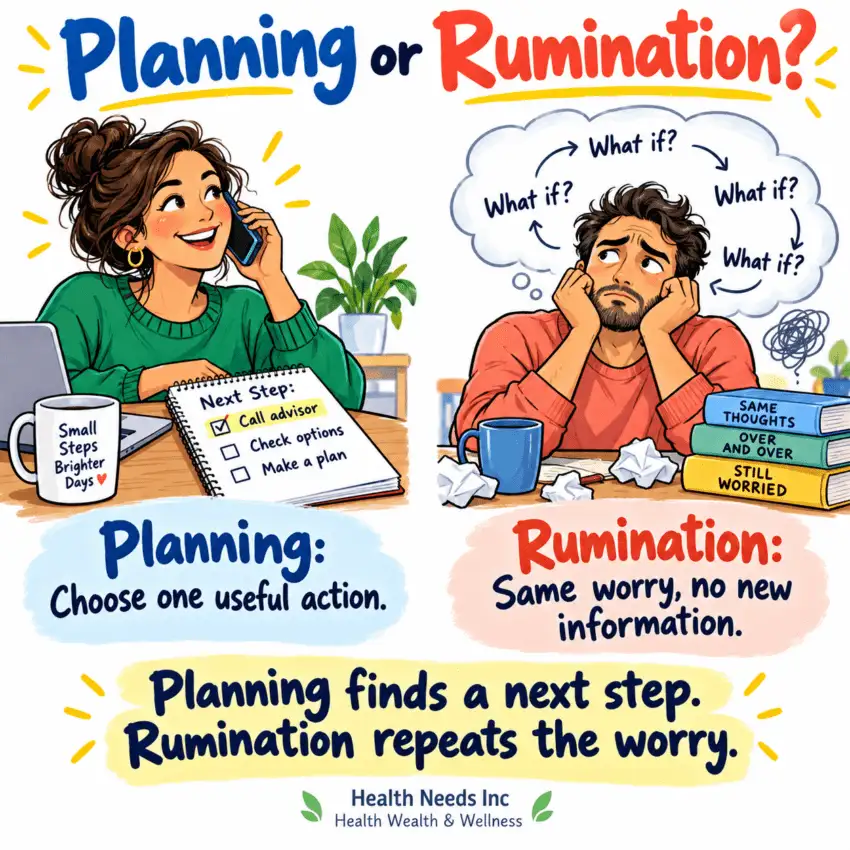
Worry can point toward something worth addressing. It can also become a meeting that never adjourns. Thinking about the same possibility repeatedly does not necessarily produce new information.
Distinguish planning from circling. Planning identifies an action, a question, or a decision. Circling revisits the same feared outcome while making you feel increasingly obliged to solve an unknowable future.
If there is a practical step, name it. Schedule the appointment. Review the account. Ask the question. If no new information is available, another hour of mental argument may simply be another hour of mental argument.
Avoid treating every anxious experience as proof of an anxiety disorder. Also avoid treating disabling anxiety as a personality quirk that someone should overcome through willpower. The effect on daily life matters.
HNI’s guide to coping techniques for anxiety explores this narrower topic. The pillar’s job is to help you recognize where that deeper discussion belongs.
When worry repeatedly disrupts sleep, work, relationships, or ordinary tasks, bring the pattern to a health professional. You do not need to solve the label before asking for help.
07 Anger: Information With an Expensive Delivery System
Anger can accompany unfairness, fear, hurt, exhaustion, or frustration. Its presence does not automatically establish which explanation is correct. Feeling strongly about something is different from knowing everything about it.
The impulse to make another person understand can become an impulse to make them suffer. That is the moment to slow the delivery system. Humiliation rarely improves a conversation about respect.
A useful boundary describes what you will do. “If shouting continues, I will end this conversation and return later” gives a concrete limit. “You are never allowed to upset me” asks another person to administer your entire emotional life.
Make any return clear enough that a break does not become punishment through silence. In an ordinary disagreement, say when you can resume and what you hope to discuss. Safety takes priority when threats or violence are present.
After a bad response, repair what is yours. “I was angry, and speaking to you that way was wrong” is more accountable than “I’m sorry you were offended.” An explanation can supply context without becoming a pardon.
Emotional skill includes disagreement, apology, and changed behavior. Being wonderfully articulate about your childhood is not much help if everyone still has to duck.
08 Grief Does Not Follow the Wellness Calendar
Loss can change the shape of an ordinary day. A quiet kitchen, an unused chair, or a familiar errand can become unexpectedly difficult. Grief deserves room without becoming a competition over who is coping correctly.
The National Institute on Aging’s guidance on grief and loss describes varied experiences of mourning and sources of support. There is no reason to expect every person or every relationship to produce the same response.
Practical help can be more useful than a polished sentiment. Offer a meal, transportation, company, or help with a specific task. “Let me know if you need anything” puts the grieving person in charge of designing and dispatching the assistance.
People may want to talk, sit quietly, return to a routine, or step away from reminders temporarily. Ask what would help rather than prescribing the correct emotional performance.
Giving grief room does not mean leaving serious suffering unattended. If distress feels unmanageable, functioning is badly affected, or safety is in question, seek professional support promptly. Support groups and bereavement services may also provide companionship through loss.
HNI’s discussion of emotional healing considers the pressure to appear unbroken. Returning to life need not mean pretending the loss became small.
09 Relationships, Loneliness, and Boundaries
Emotional wellness is partly social. Another person can help you see the event you are experiencing more clearly, share a practical burden, or remind you that the whole world has not agreed with your worst interpretation.
Connection does not require a large social calendar. It requires opportunities for contact that feel worthwhile and relationships in which some honesty is possible. A crowded room can still be a lonely place.
The NIH Social Wellness Toolkit discusses strengthening connections and healthy relationships. The practical implication is to make contact possible: a recurring walk, a class, a phone call, or an activity with people you can gradually get to know.
Boundaries protect those connections from becoming an unlimited claim on your time and energy. They are decisions about what behavior you will accept, what responsibilities belong to you, and when saying yes has quietly become self-erasure.
Start with the actual limit. “I can drive you on Tuesday, but I cannot handle every appointment” is clearer than resentment followed by a mysterious disappearance. The other person may dislike the limit. Dislike does not automatically make it unfair.
Relationship advice has limits where intimidation, coercion, or violence is present. Those situations require attention to safety and appropriate specialist help, rather than a better script for an ordinary disagreement.
10 The Body Has a Vote in Your Emotional Life
Before building a grand theory about your temperament, consider what the day contained. Little sleep, irregular meals, pain, endless demands, and no time outside may be part of the picture. This is context, not a diagnosis.
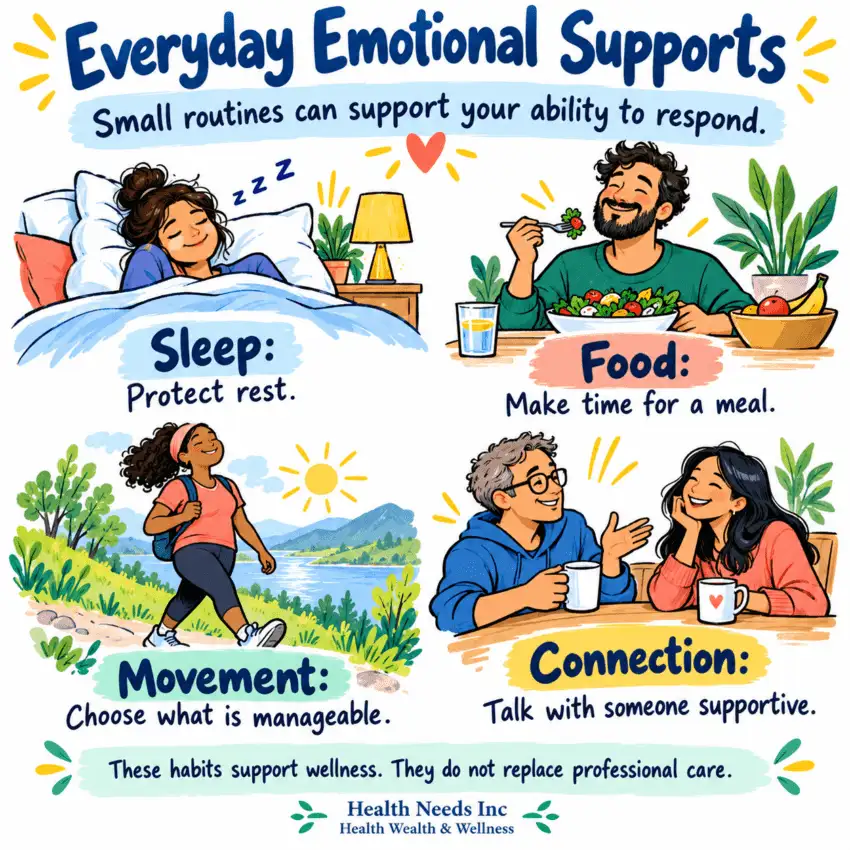
The NIMH guidance on caring for mental health includes sleep, regular meals, movement, relaxation, and connection among everyday supports. These can complement treatment; they should not be presented as substitutes for it.
Choose a manageable starting point. Protecting a reasonable bedtime or making time for a meal may be more useful than acquiring a sophisticated routine you cannot sustain. The nervous system has never asked to see your subscription tier.
HNI’s sleep hygiene guide covers the everyday habits in greater detail. Persistent sleep problems deserve their own attention rather than becoming a permanent explanation for everything else.
Take new or marked emotional changes seriously, particularly when they coincide with illness or medication changes. Describe the timing to a clinician rather than stopping prescribed treatment or assuming that age explains it.
Physical and emotional concerns can coexist. You are allowed to investigate both. The insistence on choosing just one explanation often serves the observer’s convenience more than the person’s needs.
11 Emotional Wellness Across Life Changes
Retirement, caregiving, bereavement, divorce, relocation, changing health, and adult children’s independence can alter identity as much as daily routine. Calling every difficult response a disorder would be absurd. Ignoring persistent suffering would be equally foolish.
Retirement may remove structure, companionship, status, and a familiar answer to “What do you do?” A financial plan can be sound while a Tuesday afternoon feels strangely vacant. The two facts do not contradict each other.
If a transition removes something meaningful, name what disappeared. Was it regular contact? A sense of usefulness? Predictable activity? Rebuilding the missing function is more specific than ordering yourself to enjoy the new chapter.
Caregiving creates another problem: love can coexist with frustration, fatigue, and a desire to be somewhere else. Admitting those feelings does not cancel the love. It may reveal that the arrangement needs more support.
Ask for assistance in concrete terms. Someone may be able to handle transportation, paperwork, groceries, or a regular visit even when they cannot share every responsibility. A specific request is easier to answer than a general declaration of exhaustion.
HNI’s long-term care planning guide addresses the practical side of support. Better arrangements can reduce avoidable burdens; they cannot promise an effortless emotional life.
Age alone does not determine resilience, loneliness, or contentment. Circumstances matter. The question is what this particular change requires from this particular person, with the resources actually available.
12 Mindfulness, Self-Help, and the Commercial Noise
Mindfulness can be understood as paying attention to present experience with less immediate judgment. In ordinary terms, you notice that you are having a thought rather than automatically appointing it director of the afternoon.
The National Center for Complementary and Integrative Health reports potential benefits alongside limitations in the research and possible adverse experiences. Meditation should not delay conventional care.
That leaves room for useful practice without treating it as a universal cure. If an approach makes you more distressed, you do not owe the technique your continued obedience. Stop and discuss the response with an appropriate professional when needed.
Our mindful meditation guide explores the evidence more closely. An application, course, or instructor should explain what is being offered and what it cannot establish.
Apply the same skepticism to supplements, emotional “detoxes,” and claims to reset the nervous system. Ask for evidence for the actual product and outcome. A plausible biological story is not the same thing as proof that the purchase will help you. HNI’s cortisol explainer examines what the hormone does and when it warrants attention.
Beware of advice that converts every problem into an internal attitude defect. An unsafe relationship, unaffordable housing, or impossible workload may need external change. Self-awareness should help you see that, not train you to smile through it.
The useful purchase, if there is one, earns its place by meeting a specific need at an acceptable cost. You should not have to buy a new identity to obtain a little help.

13 When Self-Help Is Not Enough
Professional support belongs within emotional wellness. It is not a prize reserved for people who have exhausted every coping technique and successfully concealed the problem from everyone they know.
The National Institute of Mental Health advises seeking professional help for severe or distressing symptoms lasting two weeks or more. Worsening symptoms, major disruption, or immediate safety concerns warrant help sooner; the two-week guidance is not an instruction to wait.
Describe what has changed: sleep, appetite, concentration, interest, mood, daily functioning, or substance use. Include when it began, how often it occurs, and what makes it better or worse. A primary care provider can be a starting point.
Treatment decisions depend on the person and the problem. Ask about the professional’s qualifications, the proposed approach, costs, availability, and how progress will be reviewed. You are allowed to ask practical questions while feeling vulnerable.
In the United States, if you are struggling or having thoughts of suicide, call or text 988 for the Suicide & Crisis Lifeline. Call 911 in a life-threatening emergency. Outside the United States, use your local crisis or emergency service.
Knowing where self-management ends is part of judgment. Wellness habits have limits. Respecting those limits can be the most useful habit of all.
Final Thoughts: The Feeling Can Come Along
Emotions are information, not instructions. Some deserve action. Some deserve examination. Some need time and company. None automatically deserves control of the steering wheel.
The goal is not to become emotionally unchanged by life. A person who loves, works, risks, ages, and loses will be changed. That is not a defect in the project.
A more useful ambition is to notice what is happening, protect your ability to respond, repair what you can, and obtain help where you need it. Emotional wellness is less about an immaculate interior and more about living in the house without setting it on fire.
The goal is not to feel good all the time. It is to become better at being human when you do not.
One Useful Place to Start
Choose one recurring situation this week. Notice the trigger, name the feeling, consider your interpretation, and choose one response with fewer unwanted consequences. Review whether it helped. If distress is severe or disruptive, seek support rather than waiting for a self-help experiment to work.
Frequently Asked Questions
More Deep Dives

Coping Techniques for Anxiety
Ways to examine worry and choose a useful response.

Emotional Healing
The pressure to look unbroken, and what healing can mean.

Money Stress and Mental Health
The practical and emotional sides of money worries.
Financial Stress and Burnout
How financial demands can accumulate across daily life.

Sleep Hygiene
The daily routines that belong in a discussion of sleep.

Mindful Meditation
A closer look at the evidence and its limits.