Long-Term Care Planning Is a Family Systems Problem
⭐ TL;DR
Long-term care planning is not merely deciding whether to buy insurance. It is designing a system for care, money, housing, authority, and family labor before a crisis assigns those jobs badly.
-
Medicare generally does not cover ongoing custodial long-term care.
-
Family care may be unpaid, but it is never free.
-
The healthy spouse needs protection from financial depletion and caregiver exhaustion.
-
A useful plan names decision-makers, limits, backup providers, funding sources, and the first steps after a sudden decline.
The future care problem is rarely one enormous bill. It is a chain of smaller decisions made by tired people who cannot find the insurance policy, disagree about the house, and have just discovered that Medicare was not cast in the role everyone assumed.
For educational purposes only. This is not individualized financial, legal, tax, insurance, Medicare, Medicaid, medical, or caregiving advice. Rules, costs, eligibility, and services vary by state and household. Consult qualified professionals before making major decisions.
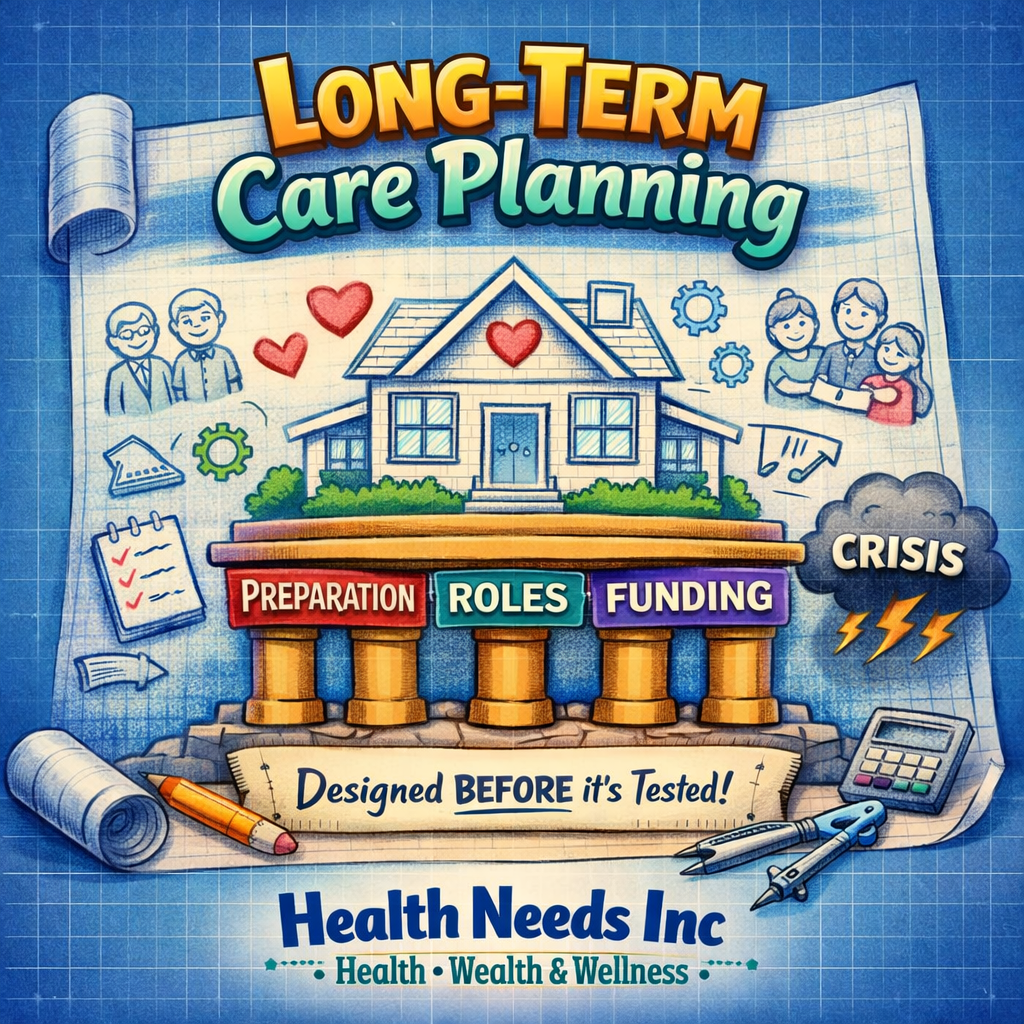 Long-term care planning works better when the family system is designed before it is tested.
The quick answer
What does a complete long-term care plan need?
- A complete plan identifies likely care settings, decision-makers, funding sources, family roles, caregiver limits, housing options, legal authority, local service providers, and what happens during the first ninety days after a fall, diagnosis, hospitalization, or cognitive decline.
- Insurance may be one component. It cannot decide who answers the phone at 2 a.m., whether the spouse can safely provide care, where essential documents are kept, or which sibling has authority when three siblings have opinions.
Long-term care is usually presented as a financial product question. Buy insurance, self-fund, qualify for Medicaid, or hope for robust descendants. This framing is convenient for brochures. It is incomplete for human beings.
Care happens inside a household and a family. It changes work, sleep, housing, marriage, retirement income, sibling relationships, transportation, privacy, and dignity. Money matters enormously, but money enters a system already crowded with love, guilt, geography, old resentment, physical limits, and the child who is always “happy to help” as long as help remains theoretical.
This article takes a different approach. Instead of asking only, “How will we pay?” it asks, “How will this system function when somebody needs help?”
Care is a workflow. Someone notices problems, makes calls, attends appointments, manages money, provides help, supervises providers, and responds when arrangements fail.
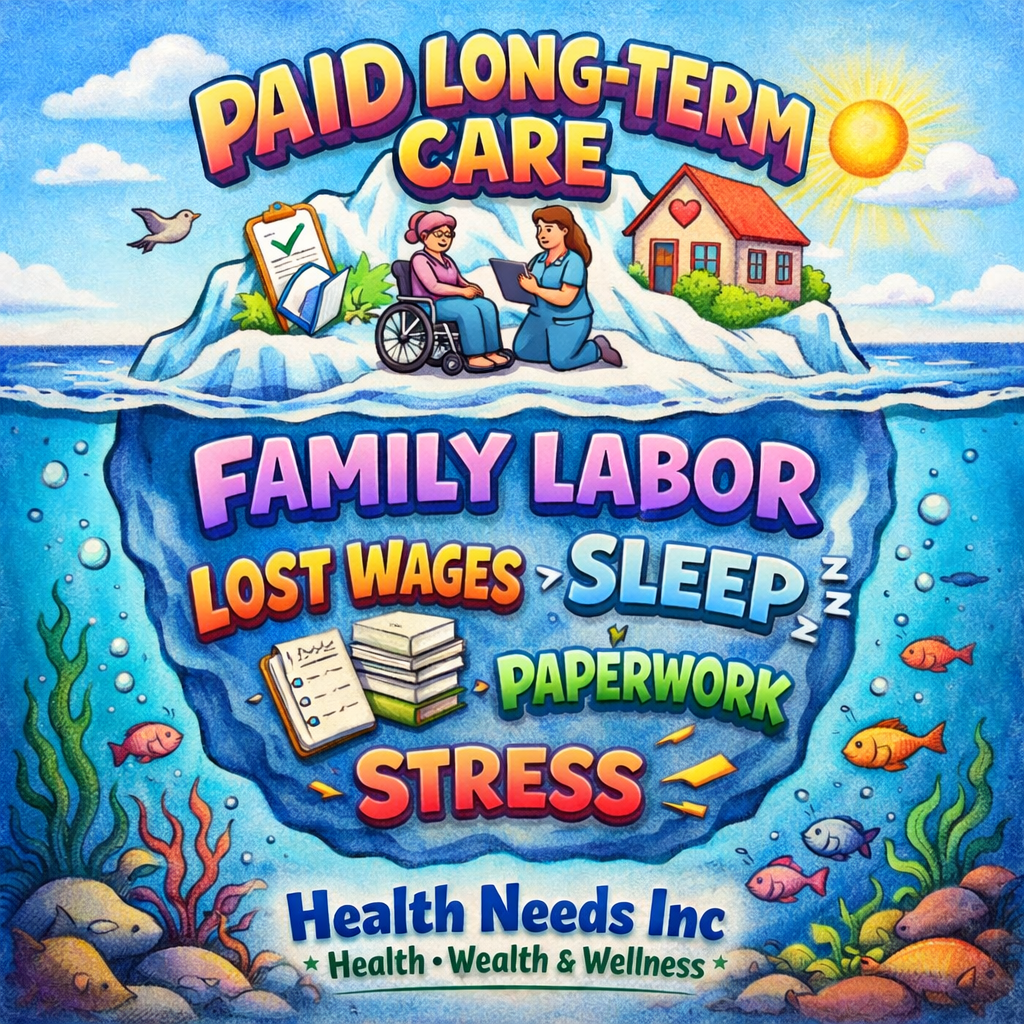
Unpaid care transfers costs. The bill may appear as lost wages, depleted retirement savings, damaged health, or family conflict.
Coverage language matters. Skilled medical care and ongoing custodial support are not interchangeable.
Housing is part of care. Stairs, bathrooms, transportation, maintenance, isolation, and local services determine what “aging at home” really requires.
Backup is essential. Every family caregiver, provider, and arrangement can become unavailable.
Long-Term Care Is a System, Not a Place
Many people hear “long-term care” and picture a nursing home corridor. That is one possible setting. It is not the definition.
Long-term services and supports include assistance with activities of daily living such as bathing, dressing, eating, toileting, transferring, and moving safely. They can also include transportation, meals, housekeeping, medication reminders, supervision, adult day services, and help managing a household.
Care may occur at home, in the community, in assisted living, in memory care, or in a nursing facility. It may last several weeks after a serious event or continue for years as physical or cognitive ability changes.
The Administration for Community Living estimates that a person turning 65 has almost a 70% chance of needing some type of long-term care service or support during the remaining years of life. This does not mean almost everyone enters a facility. Much of the care is delivered at home, often by relatives.
The system has at least six jobs
- Personal care: direct help with daily activities and safety.
- Clinical coordination: medications, appointments, therapies, and communication with professionals.
- Household operation: meals, cleaning, laundry, repairs, transportation, and bills.
- Financial administration: benefits, insurance claims, provider payments, taxes, and cash flow.
- Legal authority: consent, health decisions, contracts, account access, and estate documents.
- Emotional support: reassurance, companionship, conflict management, and the preservation of personhood.
A policy may pay for some personal care. It does not automatically fill the other jobs. Families discover this after the first hospital discharge, when five professionals provide eight telephone numbers and the patient would chiefly like to go home.
Planning begins by naming the jobs. If work remains invisible, it lands on whoever is closest, most conscientious, least able to say no, or female. The care system then runs on guilt, which is an abundant fuel but terrible infrastructure.
The Most Expensive Care May Never Produce an Invoice
Family caregivers provide much of the nation’s long-term support. The Administration for Community Living reported in 2026 that more than 70 million people provide essential support helping older adults and people with disabilities live independently.
Calling this care “informal” makes it sound like somebody drops by with soup. In reality, relatives may coordinate medical care, assist with bathing, manage incontinence, lift another adult, monitor dementia-related behaviors, miss work, lose sleep, and keep the household from collapsing.
The absence of a bill does not erase the cost. It moves the cost onto the caregiver.
What unpaid care can consume
- Hours and job flexibility
- Wages, promotions, and Social Security earnings
- Retirement contributions and investment growth
- Physical health and sleep
- Marriage, parenting time, friendships, and privacy
- The caregiver’s ability to recover from their own health problems
Caregiving can also be loving, meaningful, and deeply human. Both things can be true. Love does not cancel exhaustion. Meaning does not refill a retirement account.
A responsible plan treats family help as a limited resource. It asks who is willing, able, nearby, trained, physically capable, and financially protected. It also asks what happens when the caregiver becomes ill, needs a break, changes jobs, or simply reaches the end of reasonable capacity.

The Medicare Assumption That Breaks Family Plans
Medicare is essential health coverage. It is not comprehensive long-term care coverage.
Medicare.gov explains that most long-term care is nonmedical and that Medicare and most health insurance do not pay for ongoing custodial services in a nursing home or community setting. Custodial care includes help with ordinary daily activities such as dressing, bathing, and using the bathroom.
Medicare may cover qualifying skilled nursing facility care, home health services, rehabilitation, hospice, and medical treatment under specific conditions. That is different from indefinite supervision or personal care because a person can no longer live independently.
This distinction is routinely discovered at the worst time. A person leaves the hospital medically stable but functionally unable to manage alone. The family hears “home” and imagines recovery. The discharge team hears “home” and assumes somebody at home can provide the missing labor.
Medicaid is crucial and complicated
Medicaid is the nation’s primary payer for long-term services and supports. It can cover services in institutional and community settings for eligible people.
Eligibility is means-tested and varies by state. Financial rules, functional eligibility, home and community-based waivers, provider availability, and estate recovery can be complex. Couples also need to understand protections intended to reduce impoverishment of a spouse when the other spouse qualifies for Medicaid-funded care.
Do not rearrange assets based on folklore from a waiting room. Medicaid planning can involve look-back rules, penalties, tax effects, estate consequences, and state-specific law. Qualified elder law guidance exists because one confident nephew cannot safely improvise federalism.
Video and Tools for Mapping the Care System
Useful planning tools
- Eldercare Locator for connecting with local aging services and caregiver resources.
- Medicare Care Compare for researching Medicare-certified providers and facilities.
- State Medicaid contacts for current eligibility and program information.
- National Family Caregiver Support Program for information about locally administered caregiver supports.
- Care task inventory: list every current and potential task, its frequency, required skill, and backup person.
- First-90-days folder: keep contacts, legal documents, medication lists, insurance information, and immediate funding sources together.
Protecting the Healthy Spouse Is Central, Not Secondary
For couples, the long-term care problem has two clients. One may need assistance. The other may be providing assistance while trying not to become the next person who needs it.
A spouse often becomes the default caregiver because they are present and trusted. This can preserve intimacy and control. It can also create physical strain, isolation, disrupted sleep, depression, and medical neglect.
The financial risk is equally serious. Care costs can drain savings intended to support both lives. A spouse may spend aggressively to keep a partner at home, then face widowhood with reduced assets, lower household income, a house that still needs maintenance, and years of retirement remaining.
A spouse-protection review should ask
- Which income continues if either spouse dies?
- Which accounts can each spouse access independently?
- How much care can be paid from recurring income?
- Which assets are intended for care, and which protect the survivor?
- How many hours of personal care can the healthy spouse safely provide?
- What paid respite or backup begins before exhaustion?
- Would the home still work for one person?
The heroic caregiver story is culturally attractive. It is also dangerous. A plan that requires one older adult to lift, supervise, medicate, feed, and monitor another around the clock is not preserving independence. It may be concealing two emergencies inside one house.

The House Is Part of the Care Team
“I want to stay in my home” is a preference, not yet a plan.
The plan begins with the building. Are there stairs at the entrance? Is a bedroom and full bathroom available on one level? Can a walker fit through the doorways? Is the bathroom usable with limited mobility? Who handles snow, repairs, groceries, and transportation? How far away are family, care workers, and medical services?
Aging at home can preserve familiarity, autonomy, and connection. It can also require modifications, paid help, reliable transportation, technology, meal support, housekeeping, and a family member acting as unpaid operations director.
Home care is sometimes assumed to be cheaper than residential care. It may be when support needs are limited. As hours increase, staffing a home can become expensive and logistically fragile. Twenty-four-hour supervision is not merely four times six hours. It is scheduling, turnover, nighttime coverage, sick calls, and the startling discovery that human beings require days off.
Housing options belong on a continuum
- Current home with minor adaptations
- Current home with recurring paid assistance
- Move near family without moving into family
- Accessory dwelling unit or shared household
- Independent living community with services nearby
- Assisted living, memory care, or skilled nursing when appropriate
No option is automatically moral. Staying home is not always brave. Moving is not always surrender. The best setting is the one that can safely deliver needed support without destroying the people or finances holding it together.
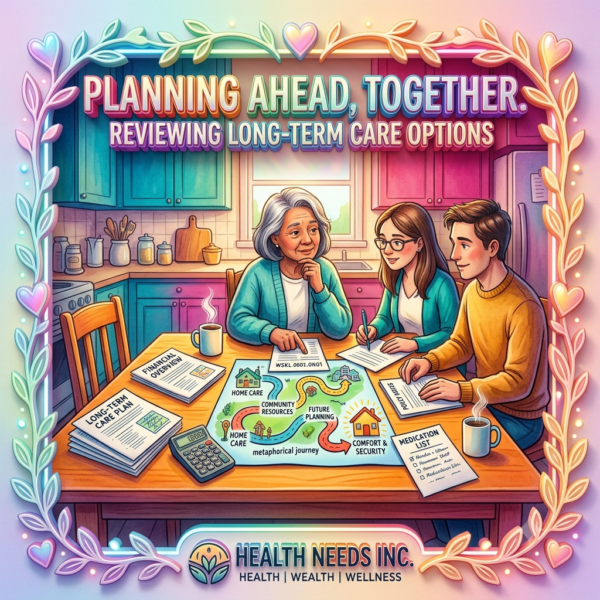
The Family Meeting Needs Decisions, Not Vague Warmth
Families often postpone care conversations because they fear conflict. Postponement does not prevent conflict. It schedules conflict for the emergency department.
A useful meeting should include the older adult whenever they can participate. It should focus on preferences, authority, resources, realistic limits, and next actions. It should not become an amateur trial about who has historically done more for the family, although history will attempt to enter wearing a name tag.
Seven questions worth answering
- Where would you prefer to receive help, and what conditions might change that preference?
- Who has legal authority for health and financial decisions if you cannot act?
- Which relatives or friends can provide specific tasks, and how often?
- What care will always require a paid professional?
- What money, insurance, benefits, or housing resources may fund care?
- What are the caregiver’s nonnegotiable limits?
- Who coordinates the plan, and who is the backup?
Specificity prevents fantasy. “The children will help” is fantasy. “Maria can manage bills remotely for two hours each week; James can attend one medical appointment monthly; neither can provide personal care” is a plan fragment.
Discuss compensation if one person will provide extensive care. A written caregiver agreement may be appropriate with legal and tax guidance. Paying a relative can recognize labor, clarify expectations, and reduce resentment, but it can also affect benefits and family dynamics if improvised.
Keep the conversation connected to the 8 Dimensions of Wellness. Care affects physical health, emotional security, finances, housing, work, relationships, and meaning. It is the place where every supposedly separate dimension discovers they have been sharing a kitchen.
Build the First 90 Days Before Building the Next 10 Years
Families freeze because long-term care appears too large to solve. Do not begin by predicting every year. Begin with what happens after the first serious disruption.
Days 1 through 7: stabilize
Clarify the medical situation, functional limits, medication changes, follow-up appointments, immediate safety needs, and who can stay or check in. Confirm whether the person is formally admitted or under observation when hospital status affects coverage questions.
Locate powers of attorney, health care directives, insurance cards, medication lists, provider contacts, and account information. One accessible folder is worth more than a gorgeous estate binder vacationing in a safe deposit box nobody can open.
Days 8 through 30: build the temporary system
Arrange transportation, meals, home safety changes, therapy, personal care, medication support, and respite. Assign a coordinator. Create a shared task list that respects privacy and does not distribute medical information indiscriminately.
Price the temporary plan. Determine what Medicare or other insurance covers, what is private pay, and what programs may be available. Contact the local Area Agency on Aging through the Eldercare Locator.
Days 31 through 90: decide whether temporary is becoming permanent
Review what is working, what is unsafe, who is exhausted, and what the monthly cost has become. Reassess housing, staffing, legal authority, benefits, and the healthy spouse’s condition.
This is the moment to replace heroic improvisation with durable arrangements. If one daughter has provided nighttime supervision for six weeks while working full-time, the system has not succeeded. It has borrowed against her collapse.
Fund the plan in layers
- Income layer: Social Security, pensions, retirement withdrawals, and other recurring income.
- Reserve layer: liquid savings for immediate care and home modifications.
- Insurance layer: long-term care, hybrid, life, disability, health, and applicable veterans benefits.
- Housing layer: downsizing, home equity, relocation, or a setting with services.
- Public-benefit layer: Medicaid and local programs for those who qualify.
- Family layer: specific, voluntary, limited help with paid backup.
No single layer must solve everything. That is the point of layers. The plan should remain functional when one source is insufficient, unavailable, delayed, or accompanied by seventeen pages of conditions.
Retirement planning without the fog machine
Get skeptical, practical wellness and retirement essays from Daniel Buck. Useful, human, and allergic to beige advice.
Useful Long-Term Care and Caregiver Sources
- Administration for Community Living: How Much Care Will You Need?
- Medicare.gov: Long-Term Care Coverage
- Medicare.gov: Home Health Services Coverage
- Medicaid.gov: Long-Term Services and Supports
- ACL: National Family Caregiver Support Program
- Eldercare Locator
- Family Caregiver Alliance: Caregiver Health
Final Thoughts: Design the System Before the System Designs the Family
Long-term care planning is often delayed because every option feels imperfect. Insurance has limits. Self-funding has limits. Medicaid has rules. Family caregivers have bodies, jobs, and lives. Housing options involve loss, cost, or compromise.
That is not evidence that planning is futile. It is evidence that planning must be layered.
Name the work. Protect the spouse. Clarify Medicare’s limits. Learn the state Medicaid landscape before depending on it. Price local services. Decide who has authority. Treat housing as infrastructure. Give caregivers boundaries and backup.
Then create the first-90-days plan. You do not need to know exactly what care will look like at 87. You need enough preparation that a fall at 77 does not appoint the emergency room, the nearest daughter, and a missing password as the executive committee.
For the broader financial context, continue with Retirement Planning Myths That Cost People Money and the Kids as a Retirement Plan Myth. Care is never only a cost. It is a test of the entire life built around the cost.
FAQs About Long-Term Care Planning for Families
Long-term care includes medical and nonmedical support for people with chronic illness, disability, cognitive decline, or difficulty performing everyday activities. Services may include personal care, meals, transportation, supervision, home support, adult day care, assisted living, memory care, or nursing facility care.
Generally, no. Medicare may cover qualifying skilled nursing, rehabilitation, medical treatment, hospice, and limited home health services under specific conditions. It generally does not cover ongoing custodial help when that is the only care needed.
Care affects the entire household. Someone must provide or coordinate personal care, transportation, appointments, finances, legal decisions, housing, and paid services. Those responsibilities can affect caregivers’ work, health, relationships, and retirement security.
Medicaid is the primary public payer for long-term services and supports and may cover eligible people in institutional or community settings. Financial and functional eligibility, covered services, waivers, and provider availability vary by state.
Review survivor income, account access, housing, caregiver capacity, insurance, legal authority, liquid reserves, and Medicaid spousal protections. The plan should fund care without unnecessarily destroying the healthy spouse’s future security.
Discuss care and housing preferences, legal decision-makers, available money and benefits, specific family roles, tasks requiring professionals, caregiver limits, emergency contacts, document locations, and who coordinates the plan.
Start with a task and resource inventory. Identify who would perform care, coordination, finances, legal decisions, transportation, and household work. Then price local services and create a plan for the first ninety days after a sudden decline.