This article is for educational and informational purposes only. It is not financial, investment, insurance, tax, legal, Medicare, Medicaid, or medical advice. Long-term care planning depends on your state, health, household income, assets, family structure, insurance eligibility, and public benefit rules. Consult Medicare, Medicaid, an elder-law attorney, a qualified tax professional, and a fiduciary financial planner before making permanent care or asset decisions.
Critical Considerations for Long Term Care & Preparation and Eligibility
Long-term care is the retirement expense everyone knows exists and almost everyone files mentally under “future me problem.” Future you would like a word, preferably before a hospital discharge planner starts using phrases like “placement options.”
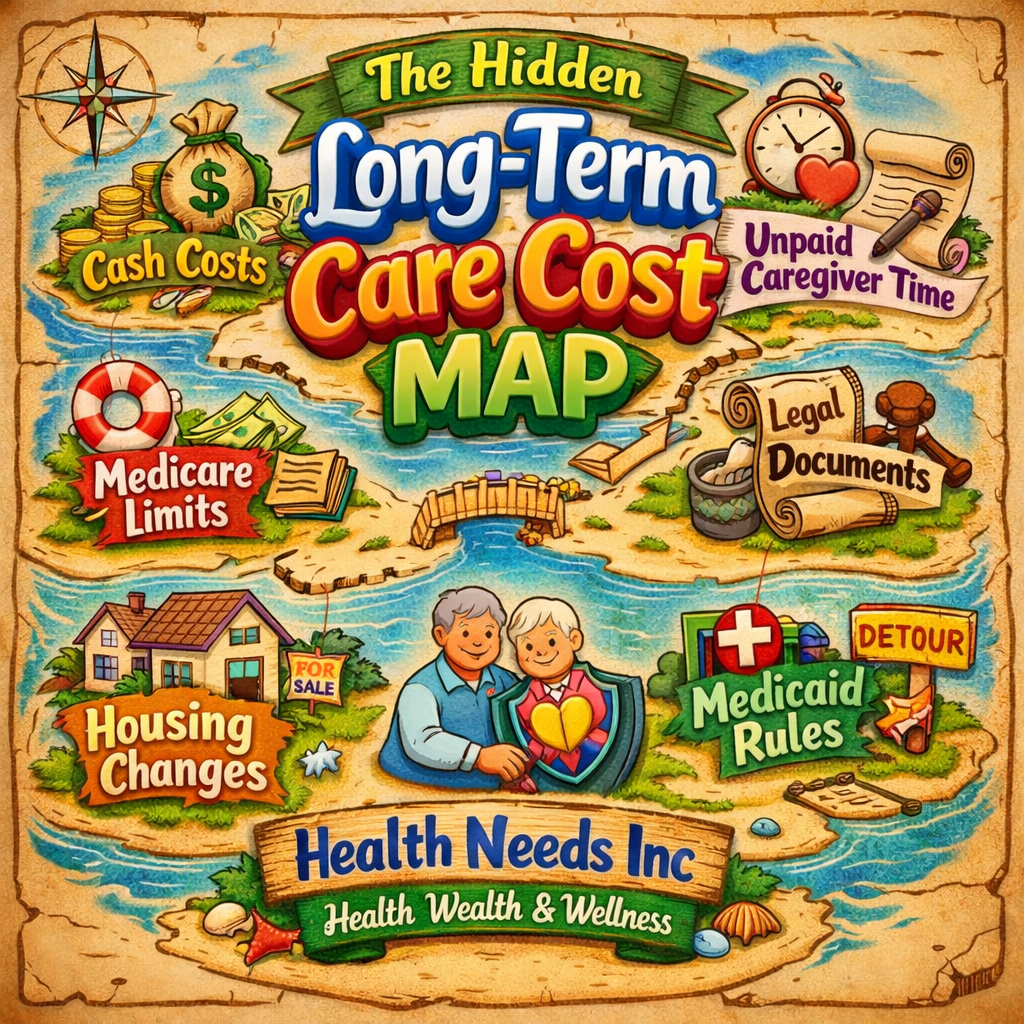
↬ They are a moving mix of home care, adult day care, assisted living, memory care, nursing home care, family caregiving, legal planning, and state benefit rules.
↬ The practical plan is to price local care, understand Medicare’s limits, review Medicaid rules before a crisis, protect the healthy spouse, and decide which funding tools actually fit your household instead of pretending future you will become a spreadsheet wizard under fluorescent lights.
The short version is useful.
How much do long-term care costs run, and how should you plan?
-
- Long-term care costs can range from about $24,700 a year for adult day health care to more than $129,000 a year for a private nursing home room, based on 2025 national median data.
- A realistic plan starts by pricing care in your ZIP code, deciding whether home care, assisted living, memory care, or nursing home care is most likely.
- Understanding what Medicare does not cover, checking Medicaid rules before crisis hits, and choosing a funding mix such as savings, insurance, home equity, family support, veterans benefits, or state programs.
Long-term care is usually help with daily living. Bathing, dressing, eating, transferring, toileting, supervision, meals, and transportation can become the real bill.
Medicare is not a long-term care plan. Medicare may cover limited skilled care when rules are met, but most ongoing custodial care is not covered.
Costs vary wildly by setting and location. National medians are useful for perspective, but your local numbers decide the plan.
Medicaid can help, but it is not casual backup. Eligibility, home and community-based services, asset rules, look-back periods, and estate recovery vary by state.
Insurance is one tool, not a virtue badge. Traditional and hybrid long-term care policies can help some households, but premiums, underwriting, limits, inflation protection, and exclusions matter.
The family plan matters as much as the money plan. Caregiving can damage sleep, health, work, marriages, and sibling diplomacy if nobody names the responsibilities early.
What Counts as Long-Term Care?
Long-term care is help with daily life when aging, disability, chronic illness, injury, cognitive decline, or frailty makes ordinary tasks difficult.It may include help bathing, dressing, eating, transferring, toileting, taking medications, preparing meals, getting transportation, or staying safe at home.
That is why long-term care costs are so slippery. The care may happen in your home, an adult day center, an assisted living community, a memory care unit, or a nursing home. The invoice changes with the setting, but the underlying need is the same: a human being needs another human being to help them get through the day.
Common long-term care settings
- At home: help with meals, bathing, mobility, medication reminders, transportation, and household tasks.
- Adult day services: daytime supervision, activities, meals, and caregiver relief outside the home.
- Assisted living: housing plus support with daily living, usually without the same medical intensity as a nursing home.
- Memory care: structured care for dementia-related safety, wandering risk, and supervision needs.
- Nursing home care: facility-based care for people who need more continuous support or skilled services.
The National Institute on Aging defines long-term care as services that help people meet health or personal care needs when they can no longer perform daily activities independently. That definition matters because the “care” may be medical, personal, practical, emotional, logistical, or all of the above before lunch.
The Administration for Community Living estimates that someone turning 65 has almost a 70 percent chance of needing some type of long-term care services and supports later in life.That does not mean everyone will spend years in a facility. It means many people will need some combination of family help, paid help, home modifications, supervision, or facility care. Planning only for a nursing home is like planning fire safety by buying one enormous sprinkler for the attic.
The actual fire may start in the kitchen.
What Long-Term Care Costs Look Like Now
The national numbers are uncomfortable, and the local numbers can be rude. CareScout’s 2025 Cost of Care data lists a national median of $74,400 per year for assisted living, $24,700 per year for adult day health care, and more than $129,000 per year for a private nursing home room.For non-medical in-home caregiver services, CareScout lists a 2025 national annual median of $80,080 based on 44 hours a week over 52 weeks.
That detail matters because home care sounds inexpensive when you picture four hours on Wednesday. It starts sounding less adorable when Wednesday becomes every weekday and then nights.
Cost variables that change the bill
- Location: the same service can cost very different amounts across states, counties, and metro areas.
- Hours of care: a few weekly hours is not the same budget problem as daily help or overnight supervision.
- Care setting: adult day care, home care, assisted living, memory care, and nursing home care each price risk differently.
- Medical complexity: dementia, mobility limitations, wound care, medication management, and fall risk can increase the level of support needed.
- Family capacity: unpaid caregiving may reduce cash spending while increasing stress, lost income, and burnout.
For comparison, the National Institute on Aging’s guide to paying for long-term care notes that many older adults pay some or all care costs out of pocket. The Administration for Community Living cost overview is also useful for understanding why the setting and duration matter.

- Adult day health care: about $24,700 per year.
- Assisted living community: about $74,400 per year.
- Non-medical in-home caregiver services: about $80,080 per year, assuming 44 hours per week.
- Nursing home, semi-private room: about $114,975 per year.
- Nursing home, private room: about $129,575 per year.
The first quote is rarely the final cost. Assisted living may charge more as care needs increase. Home care may begin at a few hours a week and become daily coverage. Families often discover that the cheapest plan on paper is the most expensive plan emotionally.
 A notebook, calculator, printed care cost estimates, and a pen
 Why Medicare Is Not a Long-Term Care Plan
The most expensive misunderstanding in retirement planning is the sentence, “Medicare will cover it.”Sometimes Medicare covers skilled medical care after certain conditions are met. That is not the same as paying for years of help bathing, dressing, eating, toileting, supervision, or living in a facility.
Medicare.gov says long-term care, also called custodial care or long-term services and supports, often includes help with everyday personal tasks. Medicare also says that because most long-term care is non-medical, Medicare and most health insurance, including Medigap, do not pay for long-term care services.
Skilled care is different from custodial care
This is the part that wrecks a lot of family assumptions. Medicare may help with medically necessary skilled care under specific rules, but that is not the same as covering ongoing help because a person cannot safely live alone.
- Skilled care: medical or rehabilitative services that meet Medicare rules.
- Custodial care: help with daily living, supervision, meals, dressing, bathing, toileting, and routine safety.
- Home health: limited covered services may apply when Medicare conditions are met; see Medicare’s home health services coverage.
- Nursing home care: Medicare’s own nursing home care page explains that long-term stays are generally not covered unless skilled care requirements are involved.
That distinction belongs in the first family meeting, not the last one. It is also why long-term care planning should sit next to broader retirement planning myths, because “Medicare pays for the nursing home” is one of the most expensive myths wearing sensible shoes.
Original Medicare may cover short-term skilled care in a nursing home or at home if you need skilled care for an illness or injury and meet the rules. That is not the same as ordinary long-term custodial care.This matters because the family conversation often begins after a hospitalization. Everyone thinks the discharge plan is the care plan. Then the Medicare clock, the facility invoice, and the adult children all enter the room wearing steel-toed boots.
Medicaid Is a Safety Net, Not a Casual Backup Plan
Medicaid is the largest public payer for long-term services and supports, but that sentence should not be translated as “no need to plan.” Medicaid eligibility, covered settings, income rules, asset rules, waiver availability, home and community-based services, and waitlists vary by state.State Medicaid programs generally must cover long-term services and supports provided in nursing homes, while many home and community-based services depend on optional state programs and waivers. This creates a planning trap: the care setting you prefer may not be the setting most easily funded.
Medicaid planning questions to ask before crisis mode
- What long-term services and supports does your state Medicaid program cover?
- Are home and community-based services available, capped, or waitlisted?
- How does your state treat income, countable assets, home equity, and spousal protections?
- What is the look-back period for asset transfers?
- How does estate recovery work after death?
Start with Medicaid.gov’s long-term services and supports overview, then check your state’s Medicaid office. The spousal impoverishment rules are especially important when one spouse needs care and the other still has to buy groceries like a living person.
Asset transfer rules also matter. Medicaid long-term care eligibility can be affected if assets were transferred, sold, or given away for less than fair market value during the look-back period. Many states use a 60-month look-back for nursing home Medicaid or certain long-term care programs.Medicaid estate recovery is another reason to get professional advice. Medicaid.gov says states may not recover from the estate of a deceased Medicaid enrollee who is survived by a spouse, a child under age 21, or a blind or disabled child of any age, and states must have hardship waiver procedures.
The details still depend heavily on state law. Medicaid planning should happen with an elder-law attorney who knows your state. Not your cousin’s realtor. Not a Facebook comment section. Not a seminar speaker who keeps saying “bulletproof” while standing next to a plate of cookies.
Insurance, Hybrid Policies, and Self-Funding
There are three broad ways families try to pay long-term care costs: self-funding, insurance, and public benefits. Most real plans use a messy blend of all three, because retirement never read the brochure.How to compare long-term care funding options
- Self-funding: flexible, but it requires enough liquid assets to survive an ugly care sequence.
- Traditional long-term care insurance: targeted protection, but underwriting and premium changes can be difficult.
- Hybrid life/LTC policies: may appeal to households that dislike “use it or lose it,” though benefits and costs vary.
- Home equity: possible funding source, but it can affect housing security, heirs, taxes, and Medicaid planning.
- Veterans benefits: worth investigating for eligible veterans and surviving spouses through the VA Aid and Attendance or Housebound benefits.
Also review the National Association of Insurance Commissioners consumer guide to long-term care insurance. Insurance is not automatically good or bad. It is math, underwriting, tradeoffs, inflation assumptions, and a sales presentation trying very hard not to sweat.
Traditional Long-Term Care Insurance
Traditional long-term care insurance may reimburse care costs up to policy limits after eligibility triggers are met. Policies vary by daily or monthly benefit, benefit period, elimination period, inflation protection, covered settings, shared-care riders, and premium structure.The Administration for Community Living explains that long-term care insurance is designed to cover services and supports such as personal and custodial care in settings that may include the home, community organizations, or facilities. It also notes that people in poor health or already receiving long-term care may not qualify because many individual policies require medical underwriting.
Hybrid Policies
Hybrid products pair life insurance or annuities with long-term care benefits.Some households like them because unused benefits may still provide value through a death benefit or contract value. Others find the costs, complexity, and tradeoffs less attractive than they sounded on the polished seminar slide.
Do not compare policies by premium alone. Compare what problem the policy solves, what it refuses to solve, whether benefits grow with inflation, what care settings qualify, and whether the household can keep paying if circumstances change.
Self-Funding
Self-funding means using savings, retirement income, taxable investments, home equity, pensions, family help, or other assets to pay care bills.It can work for affluent households and for households that deliberately reserve a care fund. It can also fail if the plan assumes a short care event and life responds with a long one.
A three-year nursing home stay can consume several hundred thousand dollars before anyone has finished arguing about which sibling never answers texts.
Build the Long-Term Care Budget Before You Need It
A useful care budget is not a philosophical statement about independence. It is a written estimate with numbers, settings, people, timing, and backup plans.Build a written care-cost model
A useful model does not have to be pretty. It has to be honest enough to survive contact with actual invoices.
- Estimate local hourly home-care costs.
- Estimate monthly assisted living and memory care costs.
- Estimate nursing home costs for semi-private and private rooms.
- Add inflation assumptions for care costs.
- List liquid assets, income sources, insurance benefits, home equity, and family support boundaries.
- Stress-test one spouse needing care while the other remains financially independent.
For local support resources, the federal Eldercare Locator can help families find Area Agencies on Aging and nearby services. For home-based aging plans, the National Institute on Aging’s aging-in-place guide is a helpful companion.
Start with local costs using the CareScout Cost of Care tool, then model at least four scenarios:- Six months of part-time home care after illness or injury.
- Two years of assisted living.
- Three years of nursing home care for one spouse.
- A dementia-related care path involving home care, respite care, memory care, and facility care.
- A surviving-spouse scenario after one partner spends heavily on care.
This might include cash reserves, taxable investments, retirement account withdrawals, Social Security income, pensions, long-term care insurance benefits, veterans benefits, home equity, Medicaid after spend-down, or family contributions. Then stress-test the plan.
What happens if markets are down when care is needed? What happens if the healthy spouse lives another 20 years? What happens if the adult child who promised to help moves, burns out, or discovers that good intentions do not provide bathing assistance at 2 a.m.?
Long-term care can disrupt taxes, withdrawal strategies, housing decisions, estate goals, and the soothing fantasy that the future will be tidy because you own binders.
For a broader retirement reality check, read Retirement Planning Myths.
Protect Family Caregivers and the Healthy Spouse
Long-term care planning is usually described as asset protection.That is too narrow. The plan should also protect the spouse, the daughter with the flexible job, the son who lives nearby, the friend who becomes the emergency contact, and the person who quietly becomes the family operations department.
Caregiver stress belongs in the budget
Caregiver strain is not a personality flaw. It is a predictable result of too few hours, too many appointments, too much lifting, and one family group chat slowly becoming a courtroom.
- Plan respite care before the primary caregiver is exhausted.
- Name backup drivers, backup decision-makers, and backup emergency contacts.
- Discuss paid help before unpaid help becomes the family default.
- Protect sleep, work schedules, medical appointments, and mental health for caregivers.
Caregiver health connects directly to stress physiology, which is why this topic naturally overlaps with Health Needs Inc’s guide to understanding cortisol.
For government caregiver resources, see the National Institute on Aging caregiving hub and CDC caregiver resources.
② A healthy spouse may need income, housing, transportation, insurance, and savings after the care recipient enters a facility or begins expensive home care.
③ Medicaid has spousal impoverishment protections, but the rules are state-specific and should be reviewed before assets are already under pressure.
④ For the wellness side of this conversation, caregiver stress is not a decorative side note. If care planning ignores sleep, resentment, grief, and chronic stress, it is not a plan. It is a spreadsheet wearing a necktie.
⑤ Related Health Needs Inc reading: Understanding Cortisol and The 8 Dimensions of Wellness. Money stress has a way of moving into the body and pretending it has always lived there.
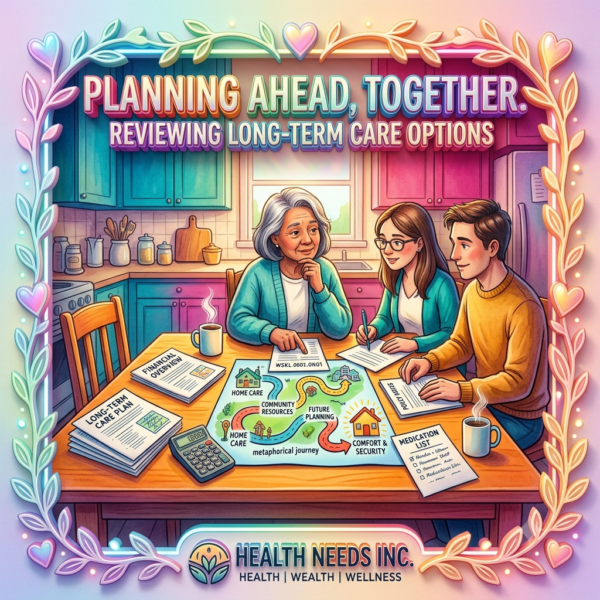
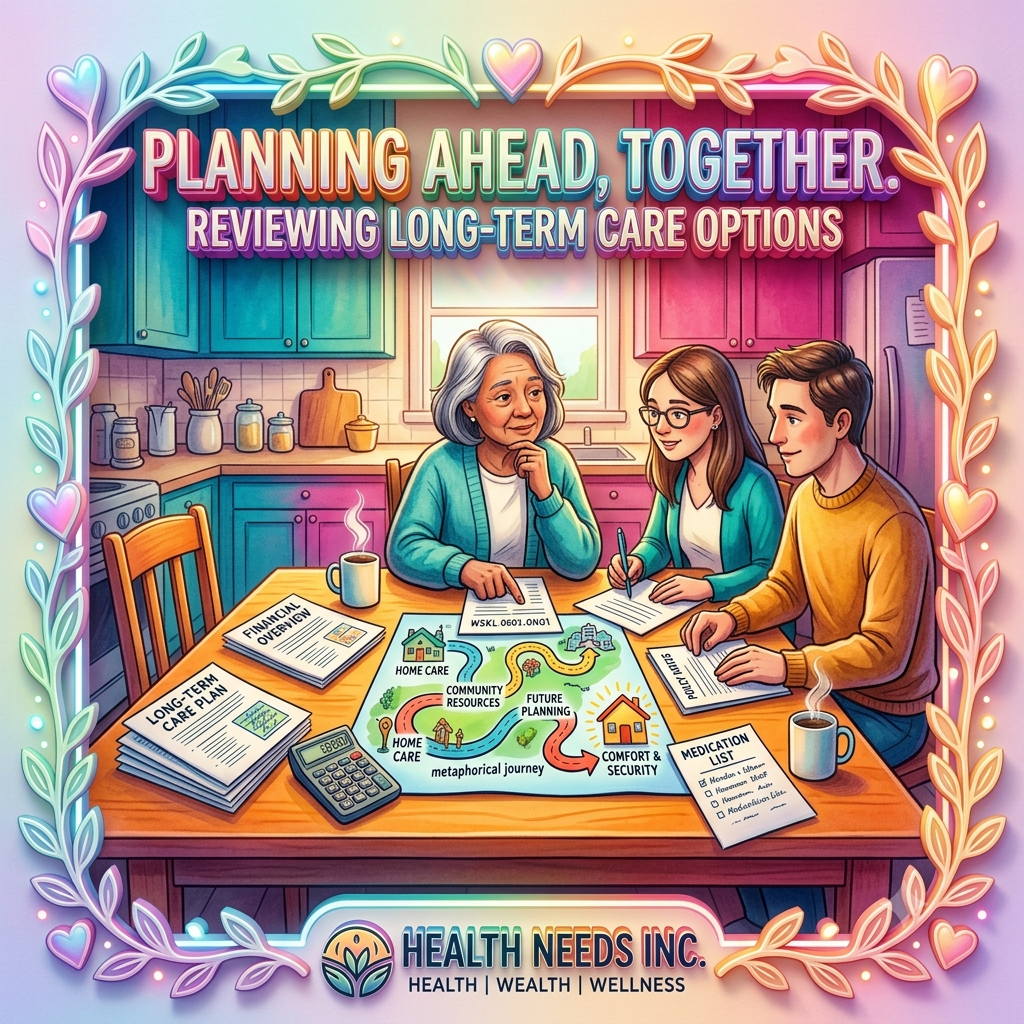
 A multigenerational family having a thoughtful care planning conversation Health Needs Inc Health Wealth & Wellness
Legal Documents and Family Meetings Matter
Money is only part of the plan.The legal and logistical side decides who can act, who can access information, and who gets to make decisions when the person needing care cannot manage everything alone. Review these documents with qualified professionals:
-
- Durable financial power of attorney.
- Health care power of attorney or medical proxy.
- Advance directive or living will.
- HIPAA authorization.
- Will or trust documents.
- Beneficiary designations.
- List of accounts, policies, advisors, medications, doctors, and passwords.
What the family meeting should cover
-
- Preferred care setting if staying home becomes unsafe.
- Who has legal authority to act.
- Who can access medical, insurance, banking, and housing information.
- How much family caregiving is realistic before paid help is needed.
- Which assets may be used for care and which are emotionally off-limits.
- What happens if dementia changes the timeline.
The National Institute on Aging advance care planning guide is a useful starting point for health care decisions and caregiver conversations. Broader wellness planning also belongs here, because long-term care can affect every part of the 8 Dimensions of Wellness, not just the bank account.
Then hold the family meeting. The goal is not to create a Broadway drama called “Who Loved Mom Most?” The goal is to clarify preferences, responsibilities, money boundaries, and decision authority while everyone can still speak plainly. The meeting should answer practical questions:-
- Where would you prefer to receive care if home is still safe?
- Who has authority to make medical decisions?
- Who has authority to pay bills and access accounts?
- What care expenses can be paid privately?
- When would Medicaid or veterans benefits be explored?
- Which family members can help, and which cannot?
- What is the plan if dementia or unsafe driving enters the picture?
Resources for Long-Term Care Planning
- CareScout Cost of Care, compare long-term care costs by state and care setting.
- Medicare long-term care coverage page, confirm what Medicare does and does not pay for.
- Medicaid long-term services and supports, understand how Medicaid fits into the care system.
- Eldercare Locator, find local aging services through the U.S. Administration for Community Living.
- LongTermCare.gov, review care settings, costs, insurance basics, and legal planning steps.
Want Less Retirement Fog?
Get practical retirement, wellness, and financial wellness thinking without product hype, panic marketing, or golf-shirt certainty.No spam ever. Unsubscribe any time.
Compare Care Settings Before the Crisis Chooses for You
Families often talk about long-term care as if there is one doorway. There is not. There are several doors, several price tags, and several ways to accidentally choose the most stressful one because nobody had the awkward conversation early.
Home care
Home care can preserve independence and routine. It can also become expensive when hours increase from “a little help” to daily supervision, transfers, meals, bathing, and nights.
- Best fit: moderate support needs, safe housing, available family backup, and manageable supervision risk.
- Watch for: caregiver burnout, falls, isolation, overnight needs, and dementia-related wandering.
Adult day services
Adult day services can provide daytime support, structure, meals, social contact, and relief for family caregivers. The Administration for Community Living basic needs resources can help families understand different support models.
- Best fit: caregivers who need daytime coverage and older adults who benefit from routine and social contact.
- Watch for: transportation, hours of operation, medical complexity, and whether dementia care is supported.
Assisted living and memory care
Assisted living is not the same as a nursing home. Memory care is not simply assisted living with a nicer brochure and a locked door. Levels of care, staffing, fees, medication support, and dementia services should be reviewed carefully.
The National Institute on Aging’s overview of assisted living and nursing homes explains the major facility categories. Read it before touring, because tours are designed to smell like cookies, not risk disclosure.
Nursing home care
Nursing home care may become necessary when support needs exceed what home care or assisted living can safely provide. Use Medicare Care Compare to review inspection, staffing, and quality information, then verify details locally.
-
- Compare staffing and inspection data.
- Ask how Medicaid beds, private-pay rates, and transitions are handled.
- Review discharge policies and care-plan meetings.
- Visit at more than one time of day.
A Step-by-Step Long-Term Care Planning Checklist
A plan does not need to solve every possible version of aging. It needs to make the first five decisions less chaotic.
- Define the likely care risks. Consider mobility, chronic illness, dementia risk, home layout, isolation, and family availability.
- Price local care. Use national medians for perspective, then get local home care, assisted living, memory care, and nursing home estimates.
- Separate Medicare from long-term care. Review Medicare’s long-term care coverage page so the plan is not built on wishful thinking with a government logo.
- Review Medicaid early. Check state-specific eligibility, home and community-based services, spousal protections, estate recovery, and transfer rules.
- Inventory funding sources. Include income, savings, investments, insurance, home equity, veterans benefits, and family boundaries.
- Protect the healthy spouse. Model housing, income, transportation, insurance, and daily living costs after one spouse needs care.
- Prepare legal documents. Update powers of attorney, advance directives, HIPAA releases, wills, trusts, and beneficiary designations.
- Talk before the crisis. Hold the family meeting while everyone can still pretend to be calm.
For households also thinking about cognitive decline, connect this planning with Health Needs Inc’s guide to the Five Pillars of Holistic Brain Health. Brain health does not eliminate long-term care risk, but it belongs in the prevention-and-preparation conversation.
Final Thoughts
Long-term care costs are not just a retirement expense.They are a family systems test. They reveal who has legal authority, who has liquid money, who has time, who has stamina, and who has been quietly hoping Medicare was a magic wand.
The goal is not to predict exactly how aging will unfold. Nobody gets that luxury. The goal is to remove as much improvisation as possible from the moment when people are already frightened, tired, and trying to make expensive decisions under fluorescent lights.
Start with local cost estimates. Review Medicare and Medicaid realities. Decide whether insurance belongs in the plan. Protect the spouse and caregiver. Put the legal documents in place.
Then talk to your family before the crisis version of the conversation arrives wearing hospital socks. That is the real strategy. Not certainty. Margin.
Where to go next
After you finish the cost model, read the related Health Needs Inc pieces on
↬ Retirement Planning Myths
↬ Stress and Cortisol
↬ The 8 Dimensions of Wellness
↬ Holistic Brain Health
Long-term care planning is not only a finance topic. It is health, family, housing, cognition, stress, legal authority, and dignity all arguing over the same calendar.
Frequently Asked Questions About Long Term Care