The Retirement Budget Shrinks, Until Life Sends an Invoice
⭐ TL;DR
Retirement spending often declines with age, but the more important story is that the budget changes shape.
-
Work, travel, restaurant, and transportation costs may fade.
-
Housing, insurance, health care, paid help, and family obligations can take their place.
-
A household average cannot predict your roof, mobility, marriage, rent, or adult children.
-
A safer plan separates fixed essentials, flexible pleasures, and irregular shocks.
Retirement does not necessarily become cheaper. It becomes different. The business lunches disappear, the furnace develops ambitions, and Medicare introduces you to the American tradition of needing several documents to understand one bill.
For educational purposes only. This is not individualized financial, tax, legal, insurance, or medical advice. Retirement costs vary widely; consult qualified professionals before making major decisions.
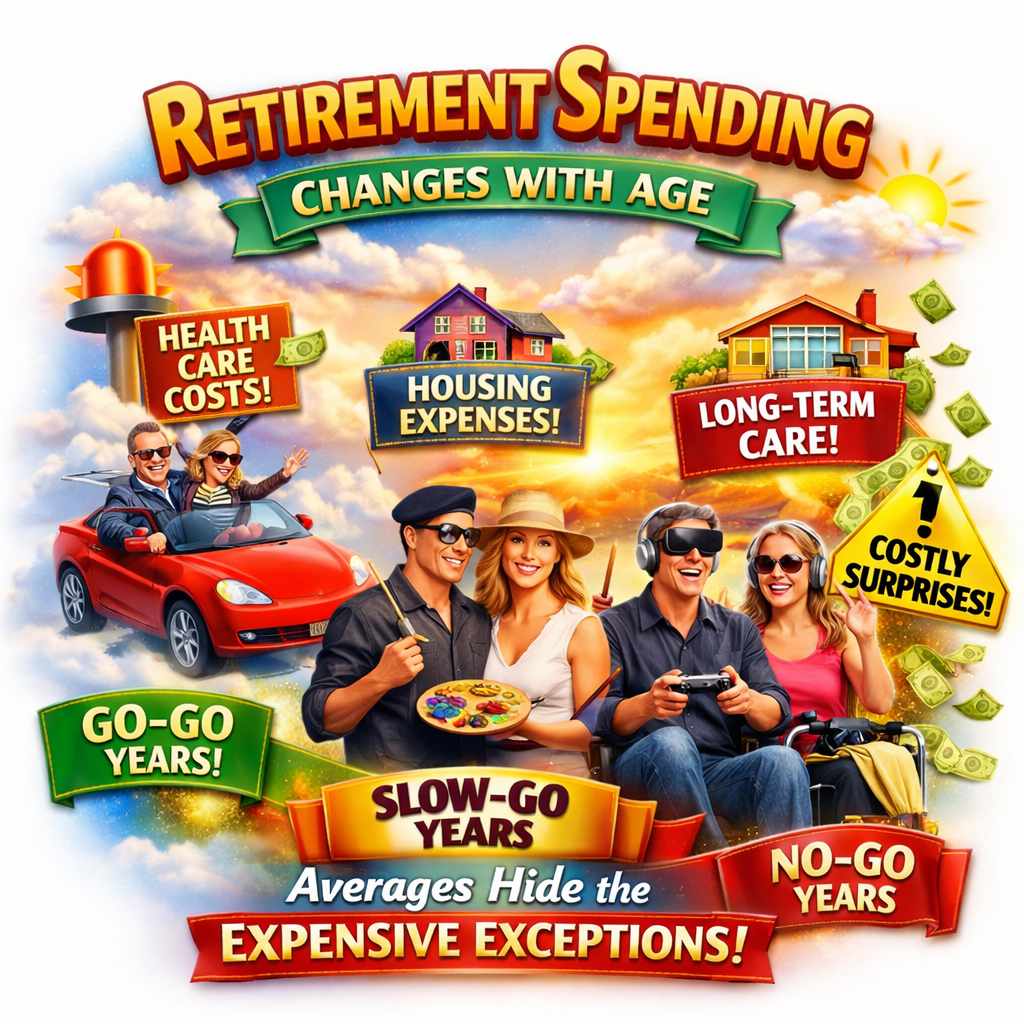 Retirement spending may decline with age, but the budget also changes shape.
The quick answer
Does retirement spending really decline as people get older?
Often, yes—especially after the early years of retirement and especially in flexible categories. Longitudinal research from the Employee Benefit Research Institute found median household spending dropped after retirement, while Bureau of Labor Statistics data show lower average spending among older age groups in several categories.
But “lower average spending” is not the same as “your bills will steadily fall.” Averages blend together healthy homeowners, frail renters, couples, widows, wealthy travelers, family caregivers, and people whose septic system has selected violence.
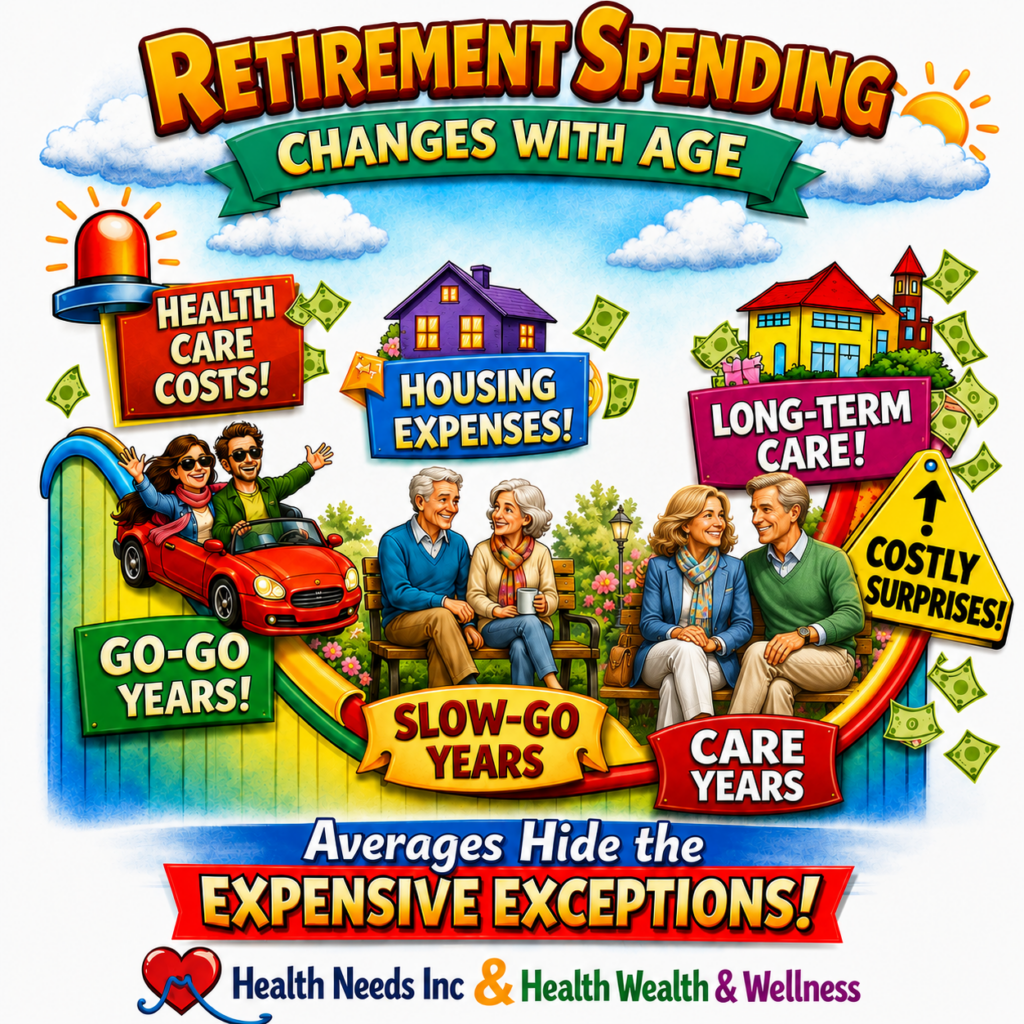
Retirement folklore likes a clean graph. Spending is high in the lively early years, lower in the quieter middle, and perhaps slightly higher near the end because health care arrives carrying a clipboard. The line resembles a smile. Financial planning has always enjoyed giving friendly names to things that may involve incontinence and five-figure invoices.
The “retirement spending smile” is useful. It corrects the assumption that every dollar of spending rises with inflation forever. But it can become another lazy rule if we forget what the line hides: different households, different categories, and very different reasons for spending less.
For the wider context, begin with our guide to Retirement Planning Myths That Cost People Money. The myth examined here is subtler than most. It is not false. It is incomplete—which is how the expensive myths usually dress.
Age does not cut every bill. It changes activities, needs, household size, and the mix of expenses.
Falling spending can reflect constraint. Some older adults spend less because they want less. Others spend less because health, mobility, income, or fear gives them fewer choices.
Fixed costs become heavier. A smaller total budget can make housing, insurance, food, and care consume a larger share.
Nominal dollars still rise. Real spending may decline even while the number leaving the checking account increases with inflation.
Plan by behavior, not one percentage. Separate costs that fade, persist, inflate, and arrive irregularly.
“Will I Spend Less?” Is the Wrong Retirement Question
There is solid evidence that household spending often falls after retirement. EBRI research following households over time found median spending dropped 5.5% during the first two years of retirement and 12.5% by the third or fourth year. The decline then slowed. That finding is more useful than a snapshot because it follows households through the transition instead of comparing strangers of different ages.
Yet even there, nearly half of retired households initially spent more than they had before retirement. Retirement did not issue everyone the same beige cardigan and coupon organizer. Some traveled. Some repaired homes. Some supported family. Some discovered that Tuesday afternoon is an astonishingly easy time to spend money.
The BLS Consumer Expenditure Survey tables also show that spending patterns differ by age. Older households tend to spend less on transportation, clothing, food away from home, and other categories connected to work and activity. Meanwhile, health care takes a larger share of the household budget.
That sounds like confirmation. It is, but with a warning label. Cross-sectional age groups are not a time machine. People who are 80 today grew up, worked, saved, married, and bought housing in a different economy from people who are 65 today. Comparing them can mix aging effects with generational history.
Household size also changes. A two-person household may become one. Spending falls, but it rarely falls by half because property taxes, rent, heating, internet, and home insurance are unmoved by bereavement. The total number shrinks while the surviving person may become less financially secure.
So the better question is: How will the composition, flexibility, and purpose of my spending change? That question is less cuddly. It is also far more useful.
Retirement Spending Is a Migration, Not a Melting Ice Cube
Imagine the retirement budget as a small town. In the first years, travel, hobbies, restaurants, home projects, and gifts occupy the lively storefronts. Later, some close. But the money does not simply evaporate. New tenants arrive: prescriptions, insurance, home maintenance, delivery fees, paid transportation, dental work, hearing aids, caregiving, and help with the tasks a spouse once handled.
Expenses that commonly fade
- Commuting, parking, tolls, and work clothing
- Payroll taxes and retirement contributions
- Convenience meals attached to the workday
- High-intensity travel and expensive recreation
- Multiple vehicles and the miles driven in them
- Furniture, equipment, and the late-middle-age campaign to own one of everything
Expenses that commonly persist or grow
- Property taxes, rent, insurance, utilities, and basic food
- Medicare premiums, supplemental coverage, prescriptions, and cost sharing
- Dental, vision, and hearing services
- Home repairs, accessibility improvements, and paid household help
- Transportation services after driving becomes difficult
- Support for a spouse, adult child, grandchild, or aging relative
This migration matters because the new tenants are often less flexible. You can postpone a cruise. You cannot negotiate with a broken molar by explaining that markets are temporarily down. The middle and later retirement budget may be smaller, yet more of it can be spoken for.

Is Spending Declining—or Is Life Contracting?
Financial models generally treat lower spending as good news. Less money going out means the portfolio lasts longer. Mathematics is innocent that way. It records the transaction but not the reason.
Some people spend less because they are satisfied. They have traveled enough. They prefer mornings at home, familiar restaurants, local friends, a good chair, and the profound luxury of not rushing anywhere. This is not deprivation. It may be the first time consumption and contentment stop pretending to be twins.
Others spend less because arthritis ends a hobby, vision limits driving, a spouse dies, friends disappear, or anxiety turns every withdrawal into a small moral failure. EBRI surveys have found that many retirees are reluctant to spend assets even when resources appear adequate. Fear of future medical or long-term care costs can turn a well-funded retirement into a decades-long emergency drill.
Disability adds another layer. EBRI research on disability and retirement spending reported that disability-affected retirees were more likely to spend under $2,000 monthly, while directing more toward housing and out-of-pocket medical costs and less toward entertainment. The total may be lower. The pressure may be higher.
This is where financial wellness meets the other 8 Dimensions of Wellness. Money records changes in physical ability, social connection, emotional security, environment, purpose, and family roles. A spending chart is a biography with the names removed.
When planning, distinguish between a voluntary decline and an imposed contraction. One represents preference. The other may signal isolation, fear, inadequate support, or health limitations. A financial plan should not congratulate itself for preserving assets while the owner becomes unable to use them for a decent life.
Video and Tools: Test the Story Before You Trust It
VIDEO PLACEHOLDER — place at approximately 30% of article
Recommended embed: a short HNI explainer titled “Why Retirement Spending Changes Shape With Age.”
Thumbnail alt text: A retirement spending line splitting into flexible expenses, fixed bills, and unpredictable shocks.
Use these tools with your actual numbers
- BLS Consumer Expenditure tables — compare broad spending patterns by age, but do not mistake averages for instructions.
- Medicare Plan Compare — examine premiums, drug coverage, and estimated yearly costs for available plans.
- Social Security retirement planning tools — estimate benefits and test claiming ages.
- Administration for Community Living long-term care guide — understand services, coverage gaps, and planning questions.
Create three versions of your own budget: today, a quieter later life, and a year with one major shock. Do not begin by cutting everything 1% annually. That produces a lovely line and a useless story.
For each expense, mark four traits: essential or optional; fixed or adjustable; recurring or irregular; likely to rise or fade. A streaming subscription and property tax are both monthly expenses, but only one can be killed by remembering a password.
The House Is Often the Budget’s Main Character
A paid-off house is routinely described as “free and clear.” Clear, perhaps. Free is doing considerable freelance work.
Housing includes property tax, insurance, utilities, maintenance, repairs, association fees, landscaping, snow removal, and eventual modifications for safety or accessibility. The mortgage may disappear while every object attached to the property continues aging in solidarity with you.
BLS research on older households found housing spending generally declined with age, partly because older homeowners were more likely to be mortgage-free. But an average annual decline cannot tell you when the roof, heating system, driveway, plumbing, or insurance premium will revolt.
Renters avoid the roof invoice, which is no small mercy. They face rent inflation, relocation risk, and less control over accessibility. A retirement plan that assumes rent rises with general inflation may be optimistic in a tight local market. Housing does not read retirement-planning textbooks.
Build a housing reserve, not a housing fantasy
Estimate routine annual maintenance separately from capital replacements. Then consider whether the house still fits the person you may become: stairs, bathrooms, transportation, distance from care, heating costs, and the availability of trusted help.
Downsizing is not automatically a financial triumph. Selling, moving, repairing, furnishing, and buying into an expensive market can consume the expected savings. Nor is staying automatically noble. A beloved house can become an unpaid part-time job with gutters.
Health Care Changes the Budget Even When Total Spending Falls
Older households can spend less overall while devoting a larger percentage to health care. That distinction matters. The BLS analysis of older Americans’ spending found the health-care share rose from 8.8% for households ages 55–64 to 15.6% for those 75 and older.
Medicare is substantial protection. It is not a force field. Beneficiaries can still face premiums, deductibles, coinsurance, drug costs, services outside coverage, and expenses for dental, vision, and hearing care. Current amounts and plan details should always be checked at Medicare.gov, because numbers age faster than the people reading them.
Long-term services and supports are the larger uncertainty. The Administration for Community Living says someone turning 65 has almost a 70% chance of needing some type of long-term care service or support during the remaining years of life. That does not mean 70% will enter a nursing home or pay the same amount. Much care is unpaid and provided at home.
But unpaid does not mean costless. A spouse or adult child may reduce work, travel, savings, sleep, and health to provide care. The invoice exists. It is simply sent to the family in hours instead of dollars.
A sensible plan considers a range: occasional paid help, home modifications, transportation, several months of intensive assistance, or a longer care need. No forecast will be precise. Precision here is often anxiety wearing a calculator.

Widowhood, Family, and the Arithmetic of One Less Person
When one spouse dies, household spending usually falls. Unfortunately, the household’s financial efficiency often falls too.
The surviving spouse still needs a home, utilities, transportation, insurance, internet, and property maintenance. One Social Security benefit generally ends, and a pension may be reduced depending on the survivor option chosen. Taxes may change when the surviving spouse eventually files as single. Grief acquires paperwork because apparently it was not already demanding enough.
The division of labor disappears too. One spouse may have handled investments, taxes, technology, cooking, driving, medical scheduling, or repairs. Replacing that labor can cost money. If it is not replaced, the surviving spouse may face risk, isolation, or declining quality of life.
Adult children complicate the tidy spending curve from the other direction. Parents may help with housing, unemployment, divorce, disability, grandchildren, or education. Family support can be meaningful and humane. It can also quietly consume money reserved for a retirement that has no restart button.
Set boundaries before the emergency
- Decide what kinds of help you are willing to provide.
- Choose whether help is a gift, loan, or shared expense.
- Set a maximum that does not endanger essential retirement needs.
- Avoid cosigning obligations you could not comfortably repay.
- Coordinate significant gifts with tax, estate, and benefits advice when appropriate.
Money is relational. It carries affection, guilt, authority, identity, and old family scripts. A retirement plan that ignores those forces may be mathematically polished and behaviorally fictional.

Build a Retirement Plan for Shape-Shifting Expenses
The goal is not to predict your grocery bill at 87. The goal is to build a system that remains useful when the forecast becomes comedy.
1. Establish the essential floor
List housing, food, utilities, insurance, taxes, basic transportation, and baseline health costs. These expenses deserve reliable income where possible, such as Social Security, pensions, annuity income appropriate to the situation, or a conservative withdrawal plan.
2. Create a flexible life layer
Travel, restaurants, hobbies, gifts, entertainment, and upgrades belong here. They are not frivolous; they are part of the reason for having money. But they can usually bend during poor markets or expensive years.
3. Fund irregular reality
Maintain reserves for home repairs, vehicle replacement, dental work, deductibles, family emergencies, and temporary care. Annualize predictable irregular expenses, then add a separate shock reserve. The emergency fund is boring right until the emergency arrives and becomes its publicist.
4. Model household transitions
Run the plan for both spouses together and for each possible survivor. Review Social Security, pension elections, insurance, housing, taxes, account access, and who could help with financial tasks. A survivor plan is an act of care, not pessimism.
5. Use guardrails instead of prophecy
Decide in advance what triggers a review or spending adjustment: a large market decline, unusually high inflation, a portfolio withdrawal above the target, a health event, or a major change in housing. Guardrails turn panic into procedure.
6. Review the meaning, not just the math
If spending falls sharply, ask why. Is life becoming simpler by choice? Or are fear, isolation, disability, or confusion preventing reasonable spending? Preserving principal is not the only measure of success. The person is not a support system for the portfolio.
If retirement planning itself has become a chronic stress ritual, see our guide to Understanding Cortisol. Money decisions occur in a nervous system. Excel has yet to acknowledge this, perhaps because it has never met a family.

Retirement without the fog.
Get practical retirement and wellness thinking without product hype, panic marketing, or golf-shirt certainty.
Useful Retirement Spending Sources
- EBRI: Change in Household Spending After Retirement
- EBRI: 2022 Spending in Retirement Survey
- BLS: Spending Patterns of Older Americans
- BLS: Consumer Expenditure Survey Tables
- Medicare.gov: Medicare Costs
- ACL: How Much Care Will You Need?
- Social Security Administration: Retirement Benefits
- IRS: Required Minimum Distributions
Final Thoughts: A Smaller Number Can Hide a Harder Life
Retirement spending often declines. That is real and useful. It means some plans that assume every expense rises forever may overstate later spending, especially for healthy households with flexible lifestyles.
But the decline should not be mistaken for a promise. Nor should it be celebrated without asking what caused it. Spending can fall because work costs vanish and contentment grows. It can also fall because a spouse is gone, driving stops, confidence weakens, or health narrows the map.
The safer plan assumes flexible spending may fade while stubborn costs persist and irregular costs occasionally kick down the door. It funds an essential floor, protects room for living, prepares for shocks, and revisits the plan when the household changes.
That approach is less elegant than a smooth downward curve. Life has never shown much respect for elegant curves. It prefers plot twists, plumbing failures, people we love, and invoices with due dates.
Continue with Retirement Planning Myths That Cost People Money, then connect financial choices to the broader 8 Dimensions of Wellness. A retirement budget is never only money. It is the architecture around independence, health, relationships, dignity, and time.
FAQs About How Retirement Spending Changes With Age
Research generally finds that real household spending often declines after retirement and at older ages. The pattern varies widely. Flexible expenses may fall while housing, health care, insurance, and support needs remain steady or rise.
It is a model in which real spending is higher early in retirement, declines during the middle years, and may level off or rise later as health and care costs become more important. It describes a broad tendency, not a guaranteed path for every household.
Work expenses disappear, households may become smaller, travel and driving often decline, and people may simply want fewer things. Spending can also fall because of health limitations, widowhood, fear of running out, or reduced social activity, so a decline is not always positive.
Property taxes, rent, insurance, utilities, basic food, health premiums, dental care, hearing care, home maintenance, and paid assistance can remain stubborn. Many are essential or difficult to reduce quickly.
A plan may model a gradual decline in flexible real spending, but applying one reduction to every category can conceal risk. Model essential, lifestyle, health, housing, and shock expenses separately, then stress-test the result.
Estimate the survivor’s income, taxes, housing costs, insurance, health expenses, account access, and need for paid help. Household expenses rarely fall by half when one spouse dies, while Social Security or pension income may decline.
Review it at least annually and after a health event, death, move, large repair, market decline, tax change, or new family obligation. A retirement budget is a working system, not a vow exchanged with a spreadsheet at age 65.