This article is for educational and informational purposes only and is not medical advice. If you are experiencing significant financial or emotional distress, consider speaking with a licensed mental health professional or a certified financial counselor.
Money Stress and Mental Health: Breaking the Cycle
★ TL;DR
Money stress and mental health can reinforce each other, turning financial uncertainty into disrupted sleep, strained relationships, avoidance, and harder decisions.
-
Financial pressure is not merely arithmetic. The body can process ongoing uncertainty as a persistent threat.
-
Shame and avoidance often make the cycle worse, while small concrete actions can restore a useful sense of control.
-
Financial wellness does not require wealth. It means making daily life less fragile and less dominated by fear.
How financial anxiety affects your body, your sleep, and your relationships, and what the research actually says about feeling better.

What Is the Connection Between Money Stress and Mental Health?
Does financial stress affect mental health?
-
- Money stress and mental health are deeply interconnected. Chronic financial pressure activates the body’s stress response, raising cortisol and disrupting sleep, concentration, and mood.
- The American Psychological Association consistently ranks money as one of the top sources of stress for American adults.
- The relationship runs both ways: financial problems worsen mental health, and declining mental health makes managing money significantly harder, creating a feedback loop that can be genuinely difficult to escape.
Key Takeaways
Money stress and mental health influence each other in both directions, each worsening the other when left unaddressed.
Financial anxiety crosses income lines. Teachers, doctors, high earners, and retirees all experience it. Stress doesn’t check your bank balance before moving in.
Chronic money worry activates the same cortisol-driven stress response as a physical threat, disrupting sleep, immunity, and cardiovascular health.
Debt attacks identity and self-worth, not just arithmetic. People describe it in emotional terms: trapped, ashamed, failed.
Small, boring financial actions work better than grand transformations when stress is high. Opening the mail counts.
Financial wellness is not wealth. It is reduced anxiety, manageable bills, and a life that is a little less fragile.
Shame thrives in silence. Talking about money difficulties, with a trusted person or a professional, meaningfully reduces psychological distress.
The Bill Collector Living Inside Your Head
Few subjects generate as much anxiety, shame, and quiet suffering as money. The connection between money stress and mental health is not a soft wellness topic. It is a documented, measurable, physiological reality that researchers are only beginning to study with the seriousness it deserves.
People argue about money. Marriages fracture under it. Sleep disappears because of it.
Entire wellness industries have sprung up promising abundance, manifestation, and the magical power of drinking green juice while visualizing passive income. Meanwhile, ordinary people are simply wondering whether they can pay the electric bill.
Financial challenges and mental health appear to influence each other in both directions. When money problems worsen, mental health often suffers. When mental health suffers, managing money becomes harder.
The result can resemble two people drowning while attempting to rescue one another.
This article does not promise a 30-day financial transformation. It does offer something rarer: an honest account of what research actually shows, what the stress response is actually doing to your body, and which modest, non-cinematic actions tend to move the needle when you are too exhausted for grand gestures.
Understanding the connection between financial anxiety and mental wellness is not weakness. It is, in a strange way, the first practical step toward doing something about it.
Why Money Activates Your Stress Response
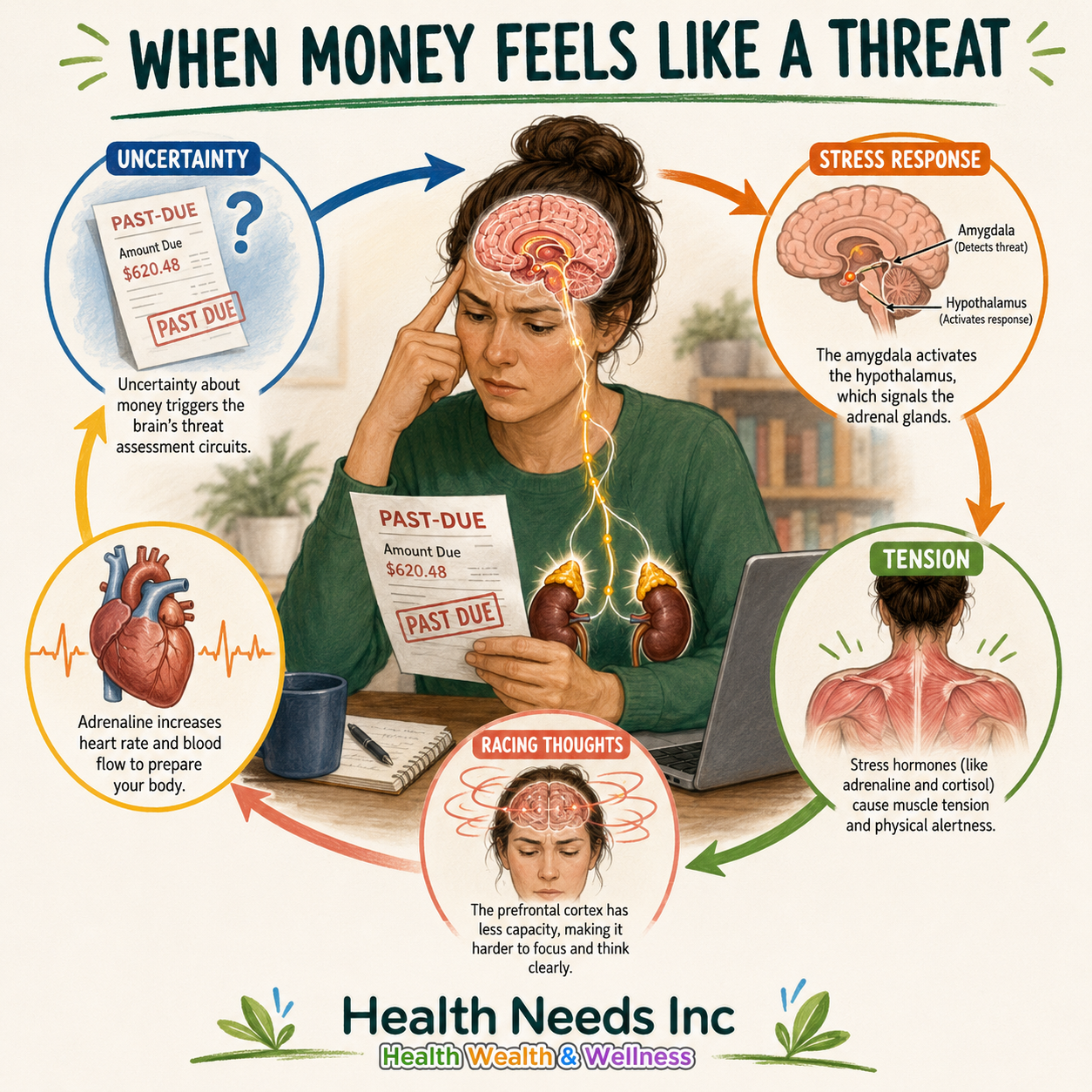
Human beings evolved to respond to threats. Thousands of years ago the threat might have been a hungry lion. Today the lion often arrives as a credit card statement.
The brain, inconveniently, does not distinguish especially well between a saber-toothed cat and an overdue rent payment.
Financial uncertainty activates the body’s stress systems in measurable ways. Cortisol rises. Heart rate increases.
Sleep becomes fragmented. Muscles tense. Thoughts spiral.
According to research reviewed by the National Institutes of Health, chronic activation of this stress response has been associated with anxiety, depression, cardiovascular disease, and a range of physical symptoms that would not typically appear on a bank statement but absolutely appear in the doctor’s office.
The mortgage doesn’t have teeth. But your nervous system doesn’t always know that. And a nervous system that cannot distinguish between a predator and a past-due notice is a nervous system running a very expensive background process, twenty-four hours a day, seven days a week, at a cost your body eventually has to pay.
How Common Is Financial Anxiety?
Many people assume they are uniquely bad with money. They imagine everyone else received a secret instruction manual at birth while they somehow missed orientation. Reality is considerably less glamorous.
Research consistently shows that money is among the leading causes of stress for American adults. The APA’s annual Stress in America survey has found money ranking near the top of stressors for over a decade, across age groups and income levels. More than half of Americans report significant financial anxiety, and that figure climbs substantially during periods of inflation, recession, or economic uncertainty.
The people experiencing money stress include teachers, doctors, parents, college graduates, retirees, high earners, and people living paycheck to paycheck. Financial anxiety does not check income before moving in. It simply unpacks its bags.
Understanding that financial stress is nearly universal, rather than a private character flaw, is itself a small but measurable reduction in the psychological burden of carrying it alone.
The Two-Way Loop: Money Stress and Mental Health
The old assumption was straightforward: money problems cause emotional problems. That is true. But researchers increasingly recognize that the relationship is bidirectional.
Mental health challenges can make financial management significantly harder.
Depression can reduce motivation to open bills or review accounts. Anxiety can impair decision-making under pressure. ADHD can complicate organization and follow-through.
Bipolar disorder can contribute to impulsive spending during elevated mood states. Exhaustion, which sits adjacent to depression on the mood spectrum, makes everything harder by default.
Eventually, unpaid bills and missed deadlines create even more financial stress, which worsens the underlying mental health condition, which makes money management harder still. It is a loop, not a line. People do not fail to escape it through lack of willpower.
They fail to escape it because willpower is a finite resource that chronic stress depletes faster than most people realize. Research published in journals including the American Journal of Psychiatry has documented this bidirectional relationship, describing it precisely as the vicious cycle it resembles.
Recognizing the loop is not an excuse. It is a map. You cannot navigate out of a system you refuse to acknowledge is a system.
Debt, Sleep, and the Body Keeping Score
Debt is not merely arithmetic. Debt has personality. It whispers.
It follows people into grocery stores and sits quietly during family dinners. Research consistently shows that financial hardship and debt are associated with higher levels of anxiety, depression, and psychological distress. Medical debt, in particular, has been linked with significantly poorer mental health outcomes in American adults.
People frequently describe debt using emotional rather than mathematical language: “I feel trapped.” “I feel ashamed.” “I feel like I failed.” Notice that none of those statements involve numbers. Because debt rarely attacks mathematics. It attacks identity.

Money stress is remarkably efficient at stealing sleep. You crawl into bed exhausted, and suddenly the mind decides this is an excellent opportunity to replay every financial mistake made since the eighth grade. Researchers studying the health effects of financial stress consistently document the same symptoms: insomnia, muscle tension, digestive issues, headaches, and chronic low-grade worry.
The body, as the popular phrase now goes, keeps score. And unfortunately the body is terrible at forgetting overdue invoices.
The cortisol that financial anxiety produces does not clock out at night. It disrupts sleep architecture, particularly the deep restorative sleep stages where emotional processing and memory consolidation occur. Which means that financial stress does not merely ruin tonight’s sleep.
It impairs the cognitive resources you need tomorrow to actually address the financial problem. It is efficient, in the worst possible direction.
Relationships, Shame, and the Cost of Secrecy
Money problems are rarely solitary. They spread to families, marriages, friendships, and children. Arguments about money often have very little to do with money itself.
Beneath the surface, people are arguing about security, control, fairness, fear, and expectations that were never made explicit. One partner sees spending. The other sees survival.
One sees investing. The other sees danger. Both people are speaking different emotional languages while using the same vocabulary.
No wonder so many conversations about household finances resemble hostage negotiations with a shared bank account.
Perhaps the most damaging element of money stress mental health research reveals is the role of shame. People hide. They avoid opening statements.
They ignore phone calls. They smile at parties, then panic alone. Shame thrives in silence, and financial difficulties carry a disproportionate moral weight in cultures that treat wealth as a proxy for virtue.
The implicit assumptions are corrosive: good people manage money perfectly; responsible adults never struggle; debt equals failure; success equals character.
Reality disagrees consistently. Illness happens. Layoffs happen.
Divorces happen. Recessions happen. Inflation happens.
Life occasionally behaves like a raccoon rummaging through the trash. Messes occur. Being human is not a character flaw, and the research on financial stress and mental health from the National Institute of Mental Health makes clear that circumstances, not moral failure, account for the vast majority of financial distress cases.
Social media compounds this efficiently. Platforms built on highlight reels have transformed wealth into performance art. Suddenly everyone appears to own luxury kitchens, perfect vacations, impossibly organized pantries, and side businesses generating six figures before noon.
Relative status comparisons are psychologically real, and researchers have documented for decades that you don’t have to be poor to feel financially inadequate. You merely need Wi-Fi.
Small Actions That Actually Help with Money Stress
The internet loves dramatic transformations. “Become financially free in thirty days.” “Manifest abundance.” “Wake up at 4 a.m. and conquer your financial life.” The body responds to these promises with something between laughter and indigestion.
Researchers studying financial wellness and mental health consistently find that small, incremental actions produce measurable psychological benefits, often independent of whether they move the actual numbers significantly. The act of taking any action, as opposed to continuing to avoid, reduces the feeling of helplessness that financial anxiety magnifies. Tiny improvements matter.
Sometimes wellness looks less like domination and more like stabilization.
1. Open the mail
Avoidance is the primary mechanism through which financial problems compound. Unopened statements accumulate late fees and psychological dread in equal measure. Opening the mail, even when the news inside is bad, ends the uncertainty that anxiety feeds on.
2. Review one account balance
Not a full budget audit. One number. The act of knowing, even when knowing is unpleasant, is consistently less distressing than not knowing.
Anxiety thrives in ambiguity. Mindfulness research supports this: deliberate, non-judgmental engagement with the present reality, however uncomfortable, reduces the suffering added by avoidance.
3. Make minimum payments on time
Late fees and credit score damage are entirely avoidable costs that compound financial stress. If minimum payments are the ceiling right now, the ceiling is acceptable. The goal is to stop the bleeding, not perform heroics.
4. Cancel forgotten subscriptions
Boring. Underrated. Most people have three to five recurring charges they have forgotten about.
Each one is both a cash drain and a tiny, renewable source of guilt. Eliminating them produces a measurable, if modest, financial improvement and removes a category of ambient anxiety entirely.
5. Talk to one person
Silence magnifies fear. Conversations shrink it. Researchers studying financial hardship consistently emphasize the role of social support in reducing psychological distress.
The person does not need to have answers. They need to exist in the same room as the problem so you stop carrying it entirely alone. Options include a trusted friend, a spouse, a therapist, a nonprofit credit counselor, or a certified financial planner who specializes in financial wellness.
6. Build a tiny emergency buffer
Research on financial resilience consistently shows that even a small emergency fund, $500 to $1,000, meaningfully reduces the psychological impact of unexpected expenses. Not because $500 solves large problems. Because it converts a certain disaster into a manageable inconvenience, and that cognitive shift is real and measurable.
As an element of holistic wellness, financial stability sits alongside sleep, nutrition, and stress management, not below them.
Wellness without the noise.
Get evidence-aware financial and emotional wellness thinking without product hype, panic marketing, or guru fog.
What Financial Wellness Actually Means
This may be the strangest misconception embedded in conversations about money stress and mental health: that financial wellness requires wealth. It does not. Financial wellness does not require yachts, or morning routines involving Himalayan salt lamps and eighteen supplements, or a portfolio generating passive income while you sleep in an aesthetically lit bedroom.
Financial wellness, as researchers and behavioral economists define it, means that bills are manageable, emergencies are survivable, anxiety is lower, sleep improves, and life becomes less fragile. That is all. Nothing cinematic.
Just stability, which, after enough chaos, begins to feel genuinely luxurious.
Therapy and financial counseling are not competing interventions. People often assume they must choose: fix emotions or fix money. In practice, both frequently need attention, and each supports the other.
Therapists address anxiety, depression, shame, and the cognitive distortions that make financial problems feel permanent and total. Financial counselors, particularly nonprofit credit counselors certified through organizations like the National Foundation for Credit Counseling, address budgets, debt management, and realistic planning. Researchers increasingly emphasize this dual approach precisely because mental health and financial health are so deeply entangled.
Trying to row with only one oar gets exhausting quickly.
Rest is not financial irresponsibility. Modern productivity culture occasionally behaves as though exhaustion is evidence of virtue. Sleep less.
Work more. Hustle harder. The message is relentless.
But chronic stress sends invoices of its own, in the form of diminished judgment, impaired decision-making, and reduced emotional regulation, all of which make financial management objectively harder. Protecting cognitive function through rest, exercise, and social connection is not indulgent. It is one of the most practical financial decisions a person can make.

Final Thoughts
Money stress is real. Not imagined. Not weakness.
Not personal failure. Research increasingly confirms that financial stress affects mental health, and mental health affects finances in return. It is a loop that can become exhausting, lonely, and overwhelming without acknowledgment.
Yet there is something strangely hopeful hidden inside that same loop. If money influences mental health, then improving financial habits, even small ones, can genuinely improve emotional well-being. And if emotional well-being improves, managing money becomes measurably easier.
The cycle can run in the other direction too.
Tiny changes accumulate. Conversations matter. Support matters.
Rest matters. People matter. The research supports all of it, with a consistency that wellness trends rarely achieve.
Perhaps that is the quiet truth beneath all the spreadsheets. Financial wellness is not about becoming rich. It is about becoming less afraid.
And in a world that constantly insists more is the answer, deciding that enough is sufficient may be the most radical ambition of all.
Start with the mail. Or the one account balance. Or the one phone call.
The grand transformation can wait. The small step cannot.
Frequently Asked Questions About Money Stress and Mental Health
Yes. Research consistently shows a significant association between chronic financial stress and depression. The mechanism runs through multiple pathways: elevated cortisol levels, disrupted sleep, social withdrawal, shame, and the sustained sense of helplessness that accompanies unresolved financial problems.
The relationship also runs in the other direction, as depression itself impairs the motivation and decision-making capacity needed to address financial challenges, which can deepen the problem. If financial stress is accompanied by persistent low mood, loss of interest, or significant changes in sleep or appetite lasting more than two weeks, speaking with a mental health professional is warranted.
The physical symptoms of financial stress include insomnia, headaches, muscle tension, digestive issues, elevated blood pressure, and reduced immune function. These symptoms arise because financial uncertainty activates the body’s cortisol-driven stress response, which is designed for short-term threats and not chronic ambiguity. When that system remains activated over weeks and months, the cumulative physiological cost is substantial.
Research has also documented increased risk for cardiovascular problems among individuals experiencing long-term financial hardship.
Debt is associated with higher rates of anxiety, depression, and psychological distress across multiple studies. Medical debt shows particularly strong associations with poor mental health outcomes. Beyond the financial arithmetic, debt carries significant emotional weight: people frequently describe it using language about identity rather than numbers, reporting feelings of shame, failure, and entrapment.
This emotional dimension is important clinically, because it means that addressing the psychological experience of debt often requires more than a repayment plan. Nonprofit credit counseling combined with mental health support produces better outcomes than either approach alone.
Nighttime worry about money is extremely common and has a physiological explanation. Cortisol levels, which are elevated by financial stress, follow a diurnal rhythm that can remain high in the evening when the mind is less occupied with external tasks. The quiet of bedtime removes the distractions that suppress anxious thought during the day, allowing unresolved concerns to surface.
Avoidance of financial problems during the day, such as not opening statements or checking accounts, also tends to increase nighttime rumination, as the unresolved uncertainty has nowhere else to go. Brief exposure to the actual numbers during the day often reduces nighttime anxiety more effectively than avoidance strategies.
Yes, and meaningfully so. Therapy does not balance a budget, but it addresses the anxiety, shame, and cognitive distortions that make financial stress harder to manage and financial decisions harder to execute well. Cognitive behavioral therapy (CBT) has the strongest evidence base for financial anxiety specifically, helping people identify and reframe the catastrophic thinking patterns that financial uncertainty tends to produce.
Some therapists specialize in money-related emotional patterns. Therapy works best in combination with practical financial guidance from a certified credit counselor or financial planner, since both dimensions of the problem typically need attention.
Financial wellness does not require wealth. Researchers and behavioral economists define it as a state in which bills are manageable, unexpected expenses are survivable without crisis, financial anxiety is reduced, and daily life is not dominated by money-related fear. This is distinct from financial success in the wealth-accumulation sense.
A person earning a modest income with minimal debt and a small emergency fund may have higher financial wellness than a high earner with significant debt and chronic anxiety. Financial wellness is one of the eight recognized dimensions of holistic wellness, alongside physical, emotional, social, and occupational health.