This article is for educational and informational purposes only and is not financial, investment, medical, or legal advice. Retirement, tax, Social Security, insurance, and investment decisions depend on your situation. Consider speaking with a qualified financial planner, tax professional, benefits specialist, or attorney before making major decisions.
The Hidden Threat of Being Forced to Retire: The Risk No One Wants to Face
★ TL;DR
Involuntary retirement risk is the possibility that health, layoffs, caregiving, age discrimination, or employer changes push you out of work before your planned retirement date.
-
Working longer can improve retirement security, but it is not entirely under your control.
-
An early exit can reduce savings years, lengthen retirement, interrupt health insurance, and force Social Security decisions sooner than expected.
-
A stronger plan stress-tests earlier retirement dates, builds accessible savings, protects insurance options, and creates a career backup plan before the emergency arrives.
Most retirement planning quietly assumes you will choose when to stop working. Many people do not get that choice. Here is how involuntary retirement risk can affect your money, health, identity, and backup plans.
Involuntary Retirement Risk and Why It Matters
What is involuntary retirement risk?
-
- Involuntary retirement risk is the possibility that you leave the workforce earlier than planned because of circumstances you did not fully choose, including job loss, health problems, caregiving demands, age discrimination, or employer changes.
- The Employee Benefit Research Institute’s 2025 Retirement Confidence Survey found that 40% of retirees retired earlier than planned.
- This risk matters because many common retirement strategies depend on working longer, and involuntary retirement can reduce earnings, force early Social Security claiming, create health insurance gaps, and shrink retirement savings.
Key Takeaways
Involuntary retirement risk is the chance you retire earlier than planned because of job loss, health, caregiving, or forces outside your control.
40% of retirees retired earlier than planned, according to EBRI’s 2025 Retirement Confidence Survey.
“I’ll just work longer” is a strategy that depends on health, employability, household stability, and your industry cooperating.
Early retirement attacks finances from both sides: fewer earning years and more spending years, often with reduced Social Security and no employer health insurance.
Stress-test your plan at earlier ages, build accessible savings, protect health insurance options, and create a career backup plan before you need one.
This is not pessimism. It is financial adulthood with the lights on.
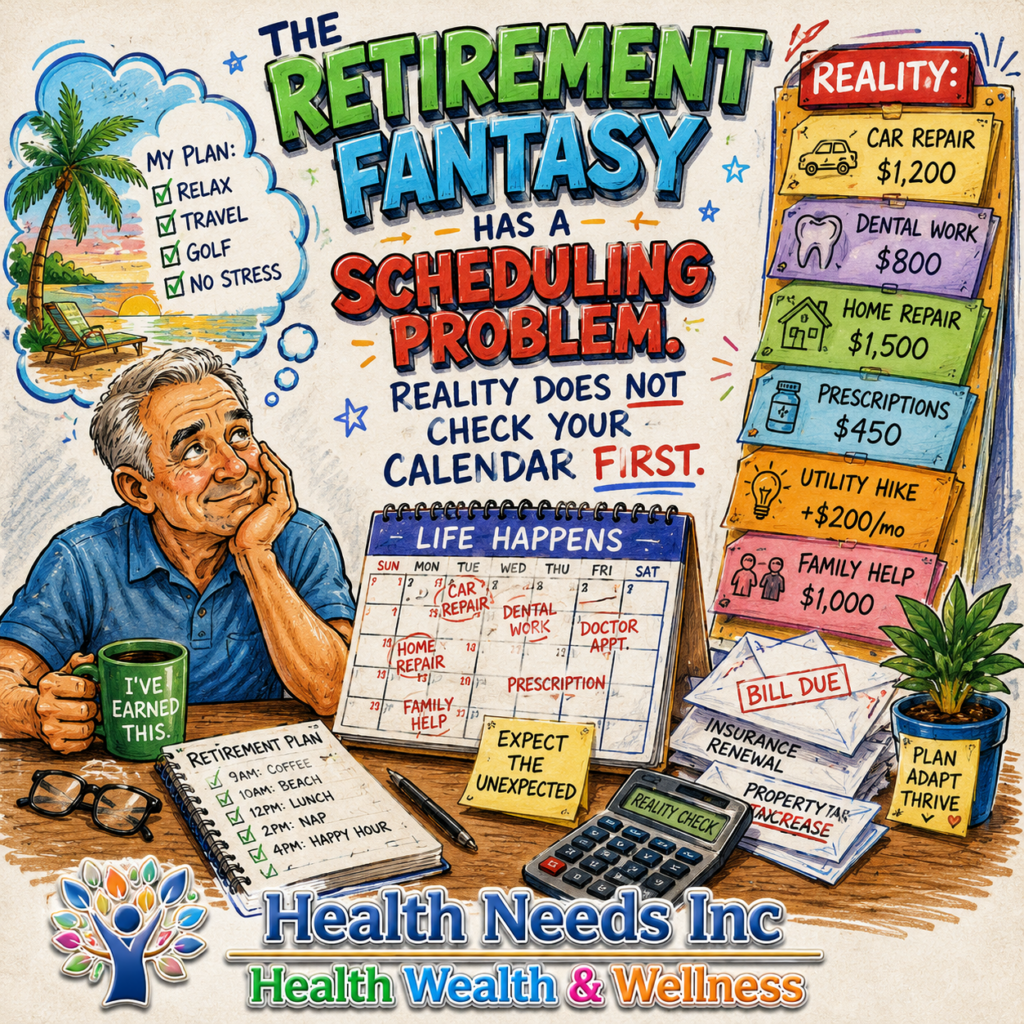
The Retirement Fantasy Has a Scheduling Problem
Most retirement planning has the emotional tone of a kitchen remodel. Pick a date. Pick a number. Pick a lifestyle. Maybe there is a lake. Maybe there is a dog. Maybe there is a golden hour where you finally become the sort of person who reads novels in linen.
Then reality wanders in wearing muddy boots.
A layoff. A back injury. A spouse’s diagnosis. A company reorganization with a name like “Project Horizon,” because corporations like to give missile-silo names to human disruption. A manager half your age explaining that your role has “evolved,” which is business poetry for “vanished.”
This is involuntary retirement risk: the risk that you may be forced, nudged, cornered, exhausted, or medically dragged into retirement before you planned. It is not a cheerful topic. But it may be one of the most important retirement risks most people underestimate.
The Employee Benefit Research Institute’s 2025 Retirement Confidence Survey found that 40% of retirees retired earlier than planned. Common reasons included health problems, disability, employer changes, downsizing, caregiving, or other circumstances outside the retiree’s control.
What Is Involuntary Retirement Risk?
Involuntary retirement risk is the possibility that you leave the workforce earlier than intended because of circumstances you did not fully choose. That can include:
- Job loss, downsizing, restructuring, or business closure
- Health problems or disability
- Caregiving demands for a spouse, parent, adult child, or other family member
- Age discrimination or difficulty finding comparable work
- Workplace burnout that becomes functionally non-optional
- Loss of required physical ability for a job
- Industry disruption, automation, or skills mismatch
- Employer benefit changes that make continued work less practical
Not every early retirement is involuntary. Some people genuinely retire early because they have enough money, better priorities, or an understandable allergy to quarterly meetings.
But there is a difference between “I am choosing freedom” and “the labor market has placed me gently in a drawer.” That distinction matters. Voluntary early retirement can be a victory lap. Involuntary early retirement can be a financial ambush.

Why “I’ll Just Work Longer” Does Not Reduce Involuntary Retirement Risk
Working longer can genuinely help retirement security. It can increase savings, shorten the number of years your portfolio must support you, preserve employer health insurance, and allow you to delay Social Security benefits.
But working longer is partly a financial strategy and partly a bet on your future employability, health, household stability, and industry. That second part is where the gremlins live.
The Center for Retirement Research has noted that retirement ages have risen over time and may continue to rise, especially as defined benefit pensions have declined and 401(k)-style plans have shifted more responsibility onto workers. But the same broad trend does not mean every individual can simply keep working as long as desired.
The OECD similarly reports that employment rates in many countries drop quickly after age 60, even as policy systems often push people toward later retirement. In other words, the official retirement age and the practical retirement age are not always on speaking terms.
This is the central weirdness of modern retirement planning: the system increasingly assumes longer working lives, while individual bodies, employers, and family emergencies remain aggressively unsentimental. If you are building your entire retirement plan on the assumption that you will work until a specific age, you are building on a single load-bearing fantasy.
Tool: The Ten-Minute Involuntary Retirement Backup Plan
Run this exercise using your current household numbers. The goal is not to predict the exact disaster. It is to discover whether the plan can survive retirement arriving before the invitation.
- Earlier date: rerun your retirement estimate at ages 60, 62, and 65, or three dates earlier than your current target.
- Income bridge: list cash savings, severance, unemployment benefits, a spouse’s income, part-time work, and other accessible income.
- Health coverage: identify the cost and eligibility rules for COBRA, a spouse’s plan, Marketplace insurance, Medicaid, and Medicare.
- Expense floor: calculate the minimum monthly amount needed for housing, food, insurance, transportation, debt, taxes, and care.
- Social Security decision: compare claiming early with using bridge resources to delay benefits.
- Career fallback: name one lower-stress role, consulting option, credential, or part-time path that could produce income if your current job disappears.
Output: one earlier-retirement number, one health-insurance bridge, one essential-expense floor, and one written career fallback. This is an educational stress test, not individualized financial advice.
Use the U.S. Department of Labor Retirement Toolkit, the Social Security early-retirement reduction guidance, and HealthCare.gov coverage guidance for retirees before Medicare for official context.
Watch: Why Working Longer Is Not Always a Retirement Plan
The Big Causes of Involuntary Retirement
1. Health Shocks and Involuntary Retirement Risk
Health is the tyrant variable. You can rebalance a portfolio. You can refinance a mortgage. You can update a resume. You cannot negotiate with a stroke using bullet points.
Research continues to show that poor health and acute health events increase the risk of early labor-force exit among older adults. A 2025 study using European SHARE data found that acute health shocks significantly increased the probability of leaving work before official retirement age, with poorer self-reported health and lower educational attainment also associated with higher early-exit risk.
This is not just about catastrophic illness. Chronic pain, fatigue, mobility limits, vision problems, mental health strain, and physically demanding jobs can all turn “I’ll work until 67” into “I made it to Tuesday.”
Physical wellness and financial wellness are often discussed as separate dimensions of wellness. They are not. Your back has a retirement opinion. So does your blood pressure. So does sleep.
This does not mean you can biohack your way out of uncertainty. But health maintenance is not merely a lifestyle hobby. It is a financial risk-management tool. Keeping your cortisol levels in check and your sleep habits functional is not vanity. It is part of staying employable.
2. Layoffs, Age Discrimination, and Employer Changes
Older workers can be highly skilled, experienced, and reliable. They can also be expensive, specialized, and vulnerable when companies decide to “flatten,” “streamline,” or “unlock efficiencies,” which are all euphemisms that should make nearby humans nervous.
The EBRI survey identifies employer changes, downsizing, and restructuring as major reasons people retire earlier than planned. The problem is not only losing a job. It is replacing the job.
A late-career layoff can mean a long search, lower pay, loss of employer benefits, relocation pressure, or a shift into part-time or contract work. For some workers, the layoff becomes retirement not because they wanted retirement, but because comparable employment never returns.
AARP has reported persistent concern among workers age 50-plus about age discrimination in job searches and workplaces. Prior AARP research found that nearly two-thirds of workers age 50-plus reported seeing or experiencing age discrimination at work.
Age discrimination is illegal in many contexts. It is also, like mold in an old basement, often subtle and hard to prove.
3. Caregiving and Involuntary Retirement
Many retirement plans quietly assume the worker is an isolated economic unit, like a Roomba with a 401(k). Humans are not like that.
A spouse gets sick. A parent falls. An adult child needs help. Grandchildren need care. Someone has to drive, manage medications, argue with insurance portals, decode hospital discharge paperwork, and become an unpaid logistics department with a pulse.
Caregiving can reduce hours, force job changes, or end paid work altogether. It is especially dangerous because it can arrive during peak earning years, when workers expected to save aggressively, pay down debt, or delay Social Security.
Caregiving is love. It is also labor. The spreadsheet often forgets this because spreadsheets were apparently raised by wolves.
4. Burnout and Workplace Mismatch
Some retirements look voluntary from the outside but are more complicated inside. A person may say, “I decided it was time.” Underneath that sentence may be years of exhaustion, grief, toxic management, chronic stress, long commutes, impossible metrics, or a workplace that has become spiritually similar to a printer jam.
Occupational wellness matters here. When your job eats your nervous system, retirement can become the emergency exit. That does not always make it financially safe, but it may feel psychologically necessary.
The danger is that burnout can shrink your planning window. People do not usually make their clearest long-term decisions when they are depleted, angry, sleep-deprived, and one email away from becoming a folk legend in HR.
Why Involuntary Retirement Risk Is So Financially Damaging
Early retirement is expensive because it attacks from both sides.
- You may have fewer earning years and more spending years
- You may contribute less to retirement accounts
- You may claim Social Security earlier than planned
- You may lose employer health insurance before Medicare eligibility
- You may draw down savings during a market downturn
- You may carry debt longer than expected
This is not one domino. It is a tiny domino convention.
Social Security May Be Reduced If You Claim Early
Social Security retirement benefits can start as early as age 62, but claiming before full retirement age permanently reduces monthly benefits. The Social Security Administration explains that benefits are reduced by a small percentage for each month you claim before full retirement age; delaying after full retirement age up to age 70 can increase your benefit.
SSA’s own material notes that claiming at age 62 can reduce benefits by as much as 30%, depending on your full retirement age. This does not mean claiming early is always wrong.
Sometimes health, family circumstances, job loss, or lack of savings make early claiming the least bad option. But involuntary retirement can turn Social Security from a strategy into a panic button.
Working While Claiming Early Can Create Surprises
Some people retire early, claim Social Security, then try to work part-time. That can be reasonable, but earnings rules matter.
For 2026, if you are under full retirement age for the entire year, Social Security says it deducts $1 from benefits for every $2 earned above $24,480. In the year you reach full retirement age, it deducts $1 for every $3 earned above $65,160, counting only earnings before the month you reach full retirement age.
These withheld benefits are not necessarily “lost” forever in the simplistic way people often fear, but the cash-flow effect can still be unpleasant. Retirement rules have a gift for becoming complicated exactly when your patience is least available.
Health Insurance Can Become the Bridge Troll
Medicare generally covers people age 65 or older, with some earlier eligibility for certain disabilities or conditions. That creates a problem for someone who expected to work until 65 or 67 but gets pushed out at 60, 61, or 62.
What fills the gap? COBRA? A spouse’s employer plan? Marketplace coverage? Medicaid eligibility? Part-time work with benefits? Health insurance is not a side issue. For involuntary retirement risk, it is often the hinge.
Retirement Savings Lose Time
A late-career interruption can damage retirement savings in several ways at once. You may stop contributing. You may lose an employer match. You may need to spend emergency savings. You may tap retirement accounts early. You may reduce your investment risk at the wrong moment because fear is now driving the bus.
The Federal Reserve’s 2024 household well-being report found that among adults not yet retired, measures of retirement preparedness remained below 2021 levels, even though some measures improved from 2023. That is a polite statistical way of saying: not everyone has enough cushion for a surprise ending.
The Psychological Side of Involuntary Retirement Risk
Retirement is usually discussed as a financial event. That is only partly true. Work is also identity, routine, status, friendship, irritation, competence, structure, and a reason to wear pants with a waistband that suggests civilization.
When retirement is involuntary, the psychological transition can be rougher. You may feel rejected, obsolete, embarrassed, angry, or strangely invisible. You may miss the role even if you hated the meetings. Humans are contradictory little weather systems.
There can also be shame. American culture has a bad habit of treating financial disruption as a character flaw. Get laid off at 58 and suddenly everyone wants to know whether you “networked enough,” as if networking can reverse a merger.
The healthier frame is this: involuntary retirement is a risk category, not a personal failure. Planning for it is not pessimism.
It is refusing to build your future on a single load-bearing fantasy. Mindful stress management is not a luxury here. It is part of navigating transition without making every permanent decision from a place of panic. Protecting your brain health during a major life disruption is not optional, because cognitive function and emotional regulation are the tools you need most when the plan falls apart.
How to Estimate Your Own Involuntary Retirement Risk
No one can predict this perfectly. But you can look for risk signals across several dimensions.
Job and Industry Risk
Ask:
- Is my industry shrinking, consolidating, automating, or outsourcing?
- Is my role physically demanding?
- Are older workers valued here, or quietly pushed aside?
- Would my skills transfer to another employer?
- If I lost this job, how long might it take to replace my income?
- Am I dependent on one employer for income, health insurance, and identity?
A job can be prestigious and fragile at the same time. So can a career.
Health Risk
Ask:
- Does my work depend on physical stamina?
- Do I have chronic conditions that could limit work?
- Am I delaying care because I am “too busy”?
- Is stress affecting sleep, blood pressure, mood, or relationships?
- Could I do this job part-time, remotely, or with accommodations?
This is not about blaming people for health problems. Bodies are not moral report cards. It is about recognizing that health and employability are financially connected.
Household Risk
Ask:
- Who might need my care in the next 5 to 10 years?
- Could my household survive on one income?
- Is my spouse or partner’s job stable?
- Are adult children or aging parents financially dependent on me?
- Do I have legal documents in place for family emergencies?
Caregiving risk is easy to ignore because it feels disloyal to quantify love. Quantify it anyway. Love deserves a budget.
Financial Flexibility
Ask:
- How many months of expenses could I cover without work?
- What expenses could I cut quickly?
- Do I know my minimum monthly spending number?
- How much debt would follow me into retirement?
- What happens if I retire 3, 5, or 10 years earlier than planned?
- Do I have a health insurance bridge plan?
The goal is not to predict disaster. The goal is to reduce the number of disasters that require immediate improvisation.
Practical Ways to Reduce Involuntary Retirement Risk
You cannot eliminate the risk. You can make it less catastrophic.
1. Build a “Retirement Shock Absorber”
Traditional advice says to keep an emergency fund. Fine. But late-career workers may need something more specific: a retirement shock absorber. That means cash or low-risk accessible savings designed to cover a job loss, health event, caregiving period, or insurance bridge without immediately raiding retirement investments.
This is not sexy. It will not make you feel like a financial wizard. It is more like owning a plunger. You do not brag about it, but when the moment comes, you are grateful.
2. Run an Early-Retirement Stress Test
Do not only model your ideal retirement age. Model ugly versions:
- What if I stop working at 62?
- What if I stop at 60?
- What if I lose my job and find part-time work at half the income?
- What if I must pay for private health insurance until Medicare?
- What if I claim Social Security earlier than planned?
- What if markets are down when this happens?
A retirement plan that only works under perfect conditions is not a plan. It is a decorative napkin.
3. Protect Your Health Like It Affects Your Balance Sheet
Because it does. Sleep, strength, mobility, preventive care, mental health care, ergonomic changes, chronic disease management, and stress reduction are not just wellness words floating in a beige Instagram post. They are part of your ability to earn, adapt, and choose.
No, stretching will not defeat capitalism. But ignoring your body because “I’ll deal with it later” is a risky form of borrowing from yourself.
4. Keep Skills Current Before You Need Them
Late-career skill maintenance is not about chasing every trend like a caffeinated squirrel. It means staying employable enough that one employer does not control your entire future.
- Update certifications
- Learn relevant software or AI tools
- Maintain a portfolio of work
- Keep a current resume
- Build relationships outside your company
- Document accomplishments while you still remember them
- Explore consulting, fractional, teaching, or part-time paths
The best time to repair the lifeboat is before the ship starts making symbolic noises.
5. Reduce Fixed Expenses Before Retirement Forces the Issue
The lower your required monthly spending, the more options you have. That may mean paying down high-interest debt, refinancing where appropriate, downsizing, reducing subscription creep, changing vehicles, or helping adult children in ways that do not quietly sabotage your own retirement.
This is not about becoming a joyless spreadsheet monk. It is about avoiding a future where every choice is made under pressure.
6. Understand Social Security Before the Crisis
Learn your estimated benefit at 62, full retirement age, and 70. Understand spousal and survivor implications if married. Know how work income may affect benefits before full retirement age. Review your earnings record at SSA.gov.
The Social Security Administration provides official tools and explanations, and those should be a starting point before relying on rumors from a guy at a cookout.
7. Know Your Health Insurance Options
Before retiring early, understand:
- COBRA costs and duration
- Marketplace plan options
- A spouse’s employer coverage
- Medicaid eligibility rules in your state
- Medicare timing at 65
- HSA implications if working past 65
- Retiree health benefits, if any
This is one area where a benefits specialist or financial planner can be worth the fee, because health insurance mistakes can be expensive and magnificently annoying.
8. Consider Disability Insurance
For workers still in their peak earning years, disability insurance can be a major protection. Employer coverage may not be enough, and individual policies become harder or more expensive to obtain with age or health conditions.
Many people insure phones better than incomes. The phone did not pay the mortgage, unless I missed a software update.
Useful Tools for Involuntary Retirement Risk Planning
- SSA Retirement Estimator, official Social Security benefits estimator based on your earnings record
- my Social Security Account, review your earnings record, estimated benefits, and Medicare enrollment status
- HealthCare.gov, federal health insurance marketplace for comparing coverage options and costs
- FIRECalc, free historical retirement calculator that tests withdrawal rates against actual market data
- Medicare.gov, official resource for understanding Medicare enrollment, timing, and coverage options
Wellness without the noise.
Evidence-based insights on financial wellness, retirement planning, and healthy aging. No hype. No spam. Just what works.
No spam ever. Unsubscribe any time.
What Not to Do When Involuntary Retirement Comes Early
If you are pushed into retirement unexpectedly, avoid making every permanent decision in the first week.
- Do not immediately assume you must claim Social Security
- Do not liquidate investments without understanding taxes and penalties
- Do not ignore health insurance deadlines
- Do not raid retirement accounts casually
- Do not sign severance agreements without reading them carefully
- Do not let shame isolate you
Start with triage:
- What income is coming in?
- What expenses must be paid?
- What health insurance options exist?
- What deadlines apply?
- What benefits or severance are available?
- What professional advice is needed?
- Is this retirement, a career pivot, a bridge job period, or something else?
Sometimes “retirement” is not a single door. It is a messy hallway.
Final Thoughts
Involuntary retirement risk offends us because it attacks the story we like best: that life is a clean exchange between effort and outcome. Work hard. Save diligently. Choose a date. Exit with dignity. Nice story. Useful, even. But incomplete.
A more honest story says: prepare diligently, yes, but also prepare for interruption. Bodies fail. Companies change. Families need us. Markets wobble. Employers make decisions with all the tenderness of a vending machine.
The point is not despair. The point is flexibility. A good retirement plan should have margins, backup options, insurance awareness, health realism, lower fixed costs, updated skills, a Social Security strategy, a health insurance bridge, and a willingness to revise the plan without treating revision as defeat.
Retirement planning is not just asking, “When do I want to stop working?” It is also asking, “What happens if work stops wanting me?” A rude question. A useful one.
This is not pessimism. It is financial adulthood with the lights on.