★ TL;DR
If money worries are keeping you awake, the job tonight is to stop conducting financial surgery in bed. The money problem still needs attention—during a time when you can act on it.
- Separate tonight’s rest from tomorrow’s financial tasks.
- Write down one concrete concern, one next action, and a time to do it.
- Persistent sleep problems deserve proper assessment; a calming routine is not a substitute for insomnia treatment.
At 3 a.m., your brain becomes an unpaid debt collector with access to every mistake you have ever made. Here is a more useful division of labor.
Educational information, not individualized medical, mental health, financial, tax, or legal advice. These suggestions do not diagnose or treat insomnia and cannot resolve an income shortfall. Seek qualified help for persistent sleep problems, financial hardship, or significant distress.
Money worries keeping you awake?
What can you do tonight—and what needs daylight?
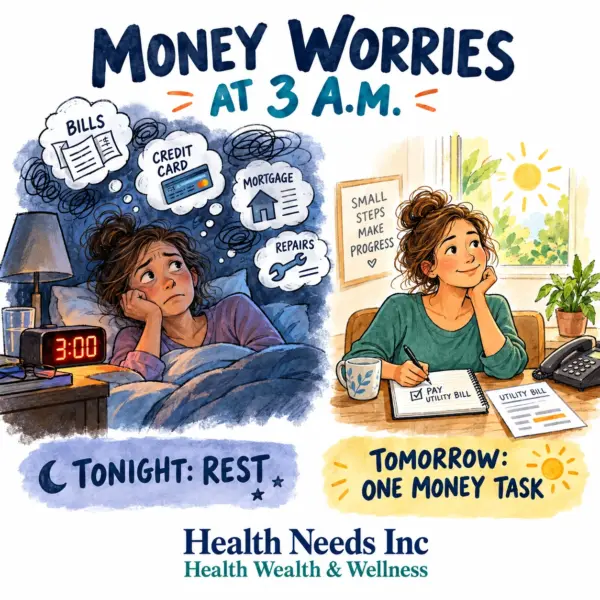
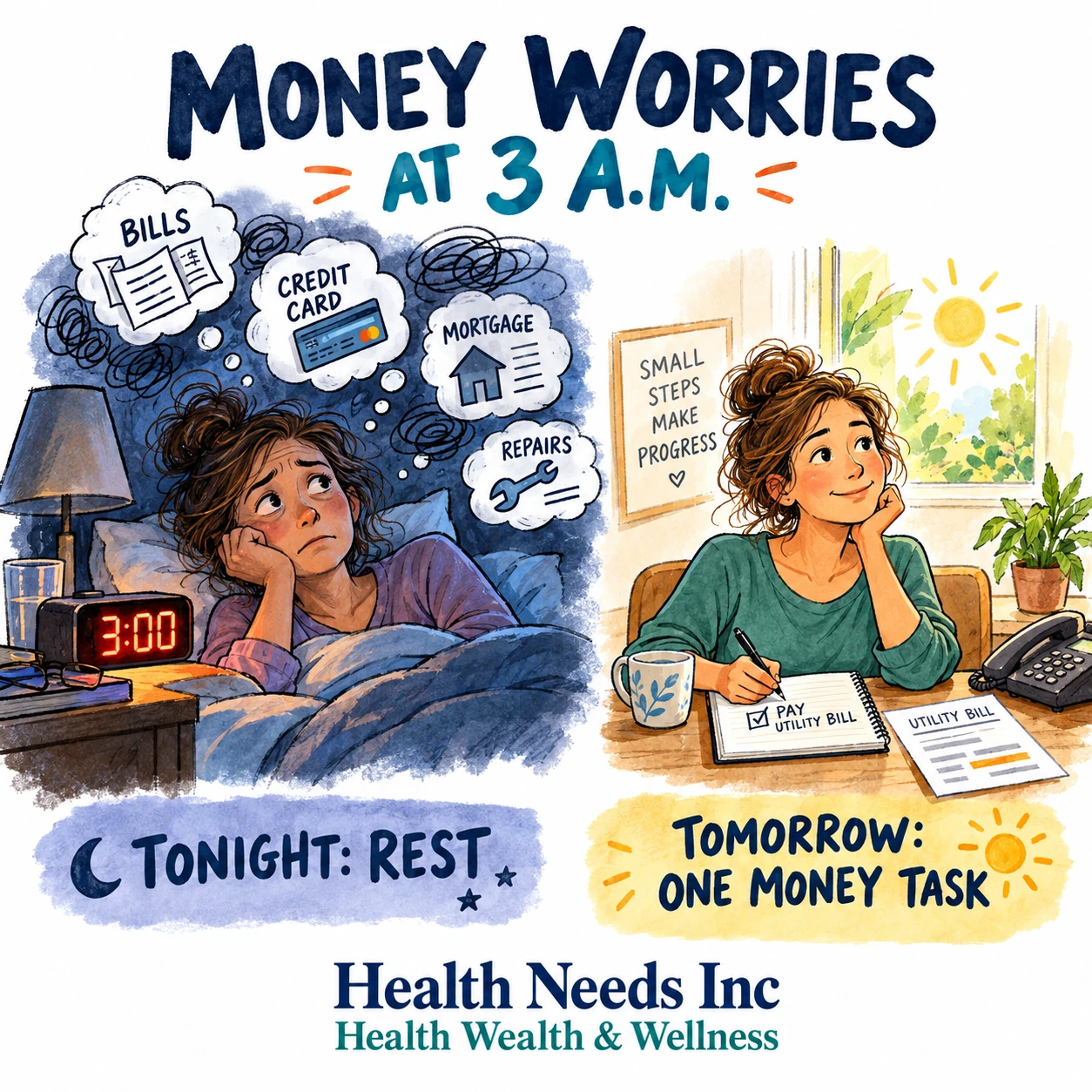
Give the concern somewhere to live outside your head, and give its next action an appointment. That is an organizing strategy, not a promise that writing on paper will make you sleep or make the bill smaller.
Key Takeaways
A genuine financial problem and a repetitive worry loop can coexist. They require different kinds of help.
A useful nighttime note ends with an action. Rumination ends with another lap.
Treat persistent insomnia as a health concern, not a failure to buy the correct pillow.
Why Your Mind Opens the Books at Night
The house becomes quiet. Your phone is finally still, the day’s distractions disappear, and your mind produces an invoice with a supporting slideshow. The mortgage, the dental bill, and that decision from 2008 would all like the floor.
The National Heart, Lung, and Blood Institute identifies money-related worry as a risk factor for insomnia. It also notes that clock-watching and worry about sleep can worsen the problem. The worry can acquire a second job: keeping you awake about being awake.
This does not establish that every nighttime awakening comes from money stress. Pain, medications, breathing problems, schedules, caregiving, and other health or environmental factors may also matter. A familiar explanation is not necessarily the whole explanation.
Our broader article on financial stress burnout looks at the wider pattern. This article has a narrower assignment: what to do when the ceiling has become your accounting department.
A Bill Is a Problem. Replaying It Is Not a Payment.
There are two questions worth separating: “What is happening financially?” and “What is my mind doing with it tonight?” Neither cancels the other. A person can have an urgent cash shortage and a thoroughly unhelpful mental rehearsal of that shortage.
If the rent exceeds the available money, the problem is material. Telling someone to breathe through that is like suggesting better posture during an eviction. Practical help, benefits advice, creditor conversations, or housing assistance may be needed.
If tonight’s thought is “What if everything falls apart twenty years from now?”, the next useful step may be to review actual figures with someone qualified. Recalculating an imaginary disaster without records, daylight, or a second opinion is not the same as planning.
What to Do When Money Worries Keep You Awake
First distinguish an actual immediate emergency from a problem that cannot be acted on until morning. Suspected active fraud or an immediate safety problem may require action now. A creditor’s office that opens at nine will not open earlier because you glare at the duvet.
- Name the concern precisely. “I need to check whether Friday’s payment clears” gives you a task. “I have ruined everything” gives you a courtroom.
- Put tomorrow’s first action on paper. Note the document, phone call, or person involved, along with a realistic time.
- Close the financial workspace. Unless something genuinely needs action now, stop opening statements, market feeds, loan offers, and retirement calculators in bed.
- Stop grading the night. Repeatedly checking how little sleep remains can become its own source of pressure. Notice the urge without turning the clock into a performance dashboard.
Those steps are HNI’s practical way to separate tasks from rumination. They are not a clinically validated money-anxiety treatment. If they do not help tonight, that is not another item for the self-blame spreadsheet.
NHLBI’s insomnia guidance describes stimulus control as part of treatment: reserve bed for sleep, go to bed when sleepy, and get up when unable to sleep. If you are awake and increasingly frustrated, a quiet activity elsewhere may be more useful than another prolonged argument with the mattress; move safely and adapt this with a clinician if mobility, falls, or other conditions make getting up difficult.
Do not improvise an aggressive sleep-restriction schedule from an article. That is a treatment component requiring appropriate guidance, not a competition to see how tired a person can become while claiming to optimize recovery.
Tool: The Tonight–Tomorrow Money Note
Purpose: turn one recurring concern into one scheduled action. Use paper, or the optional fields below. This is a planning aid, not a sleep treatment or a debt plan; do not enter account numbers, passwords, or other sensitive information.
How to use the result: when the same thought returns, refer back to the agreed task rather than opening a new investigation. If the deadline is sooner, or the action is not realistic, revise it honestly. The fields have no submit or saving function; reloads may clear them and browsers may restore form entries, so use paper if privacy matters.
Worked example: “I am financially hopeless” becomes “I have a payment due Friday, and I need to find out what options exist.” The money situation has not magically improved. The question has become answerable.

What to Do With the Problem in Daylight
A nighttime boundary is only credible if the daytime appointment actually happens. Otherwise “I will deal with it tomorrow” becomes avoidance with a calendar logo.
Start with the smallest complete picture: available money, the next incoming payment, essential costs, and approaching deadlines. You are not building a financial monument. You are finding the next decision.
- If you cannot pay everything: assess consequences, rather than paying whichever caller is loudest. The CFPB’s bill-prioritization worksheet helps consider housing, income, insurance, and other obligations.
- If a credit-card payment is unaffordable: the CFPB recommends contacting the issuer promptly. Explain the situation and ask about available arrangements; do not assume a concession is guaranteed.
- If the whole picture is overwhelming: consider a reputable credit counselor. The CFPB explains how counseling works and what to ask, including fees, qualifications, and proposed services.
Check written terms before agreeing to a plan. “Nonprofit” does not automatically mean every service is free, and debt counseling is not interchangeable with a debt-settlement pitch.
If shame is making you avoid even looking, our article on why smart people feel broken around money examines that emotional layer. Being competent in other areas does not make financial fear impossible. Unfortunately, anxiety does not check your résumé.
Which Kind of Help Fits the Problem?
| What is happening? | Useful next step | What that cannot promise |
|---|---|---|
| An immediate budget shortfall or overdue bill | Contact the provider, review assistance, or seek reputable debt or housing guidance. | A relaxation technique cannot create missing income. |
| Persistent sleep difficulty affecting daytime life | Discuss sleep with a healthcare professional; ask about assessment and CBT-I. | A darker bedroom alone is not a complete insomnia treatment. |
| Worry, shame, or low mood that is hard to manage | Seek appropriate mental health support alongside practical financial help. | Therapy cannot negotiate every bill or guarantee a financial outcome. |
| A specific future-planning question | Gather records and arrange a focused discussion with a qualified adviser. | No spreadsheet can remove all uncertainty. |
A retirement-specific worry can become particularly loud when there is less time to rebuild savings, income has become less flexible, or a partner depends on the same assets. Those circumstances justify a careful review—not an emergency purchase made after a sleepless night. Start with catch-up strategies after 50 if that is your situation.
When This Needs More Than a Bedtime Routine
If sleep difficulty is affecting daily functioning, talk with a healthcare professional. NHLBI describes chronic insomnia as difficulty occurring at least three nights weekly for three months or longer. That is not an instruction to wait three months before asking for help.
The American Academy of Sleep Medicine guideline strongly recommends multicomponent cognitive behavioral therapy for insomnia, or CBT-I, for chronic insomnia in adults. It advises against using sleep-hygiene advice alone as the treatment. A pleasant room and sensible routines can support care; they are not the whole treatment plan.
Ask about access, cost, and delivery options rather than assuming help requires a luxury sleep retreat. NHLBI describes CBT-I delivery in person, by telephone, or online; suitability and access still need checking.
Also mention breathing interruptions, substantial daytime sleepiness, pain, medications, mood changes, and the pattern of awakenings. Money worry may be present without being the only cause. Avoid driving or hazardous tasks when too sleepy to do them safely.
Wellness marketing often treats every sleepless person as one more potential buyer of magnesium, a wearable, or a nervous-system course. A product can be sold immediately. A careful assessment takes longer. That difference should make us more curious, not more impressed.
Quick Quiz: Planning or Another Lap of Worry?
This checks the article’s main distinctions. It does not measure anxiety, insomnia, financial competence, or your eligibility for help. Choose an answer before opening each explanation.
1. It is 3 a.m., and the same Friday bill keeps returning. Which step creates a plan?
A. Reopen the balance repeatedly. B. Write the amount to check, the call to make, and a realistic time. C. Decide you are bad with money.
B. A defined action and time create a next step. They do not guarantee sleep or solve the shortfall.
2. Your bedroom is dark, but persistent insomnia is affecting daytime life. What follows?
A. Buy more sleep accessories. B. Assume money is the only cause. C. Seek assessment and ask about evidence-based insomnia treatment.
C. Sleep hygiene alone is not the recommended treatment for chronic insomnia. Other contributors may also need evaluation.
3. Your income genuinely cannot cover essentials. What does a calming exercise change?
A. It erases the shortfall. B. It may support a calmer moment, but practical financial help is still needed. C. It proves the hardship is psychological.
B. Emotional support and material assistance serve different needs. Needing both is not a contradiction.
Interpretation: three correct answers means you recognized the distinctions, not that you are “cured.” Revisit any missed explanation and choose the kind of help that fits your actual problem.

Wellness without the noise.
Get evidence-aware financial and emotional wellness thinking without product hype, panic marketing, or guru fog.
The Night Does Not Need to Balance the Books
There is a moral story hiding inside a lot of money anxiety: if you cared enough, you would keep worrying. Rest begins to feel like negligence, as though the unpaid bill requires a witness at all hours.
But worry is not a transfer of funds. Staying awake does not prove seriousness. Sometimes the most responsible available act is to stop rehearsing and make room for the next useful action.
Give the concern a name, the action a time, and persistent sleep trouble the attention it deserves. You do not need to declare everything fine. You need a plan that can survive the difference between tonight and tomorrow.
Questions About Money Worries and Sleep
Money-related worry can contribute to insomnia, and a quiet bedtime can leave more attention for unresolved concerns. That does not prove money is the only cause of awakenings. Persistent symptoms deserve assessment rather than an assumption.
If there is a genuine urgent issue, act appropriately. Otherwise, record the specific question and a daytime action rather than repeatedly opening financial apps in bed. This is an organizing suggestion, not a treatment or a guarantee of sleep.
A calming practice may be useful to some people, but it cannot resolve a shortfall or replace evidence-based care for persistent insomnia. Address the practical money problem and the sleep problem according to their separate needs.
Ask when sleep difficulty is persistent, distressing, or affecting daytime functioning. Do not wait for a formal chronic-insomnia threshold before seeking advice. Mention other symptoms, medications, and your sleep schedule.
Prioritize consequences and essential needs, contact providers or creditors promptly, and consider reputable credit or housing counseling. Check fees and written terms. No worksheet can substitute for needed income, assistance, or professional advice.