Smart Toilets and Wellness: A Deep Dive into the Kohler Dekoda
★ TL;DR
Kohler Health’s Dekoda attaches to a toilet and uses optical sensors to track stool and urine patterns, hydration, and possible blood. It is interesting wellness technology, not a tiny gastroenterologist living under the seat.
-
The $599 device requires a paid membership and fingerprint-authenticated bathroom sessions.
-
It can identify patterns worth noticing, but it does not diagnose disease or replace evidence-based screening.
-
The most important questions concern accuracy, useful action, false reassurance, anxiety, subscriptions, and ownership of intimate health data.
For centuries, the toilet accepted our secrets and asked no follow-up questions. Now it has sensors, a subscription, and opinions about hydration.

For educational purposes only. This article discusses a consumer wellness device and is not medical advice, diagnosis, screening guidance, or a product endorsement. A toilet scanner cannot replace colorectal cancer screening, laboratory testing, or evaluation by a qualified healthcare professional. Seek prompt medical care for blood in urine or stool, black or tarry stool, severe pain, fainting, or other concerning symptoms.
Dekoda tracks waste patterns. It does not diagnose what caused them.
What does the new toilet scanning device actually do?
-
- It mounts to the toilet rim and uses downward-facing optical sensors to analyze stool and urine during an authenticated session.
- The companion app reports digestive patterns, hydration trends, and alerts related to possible blood.
- It is sold as a wellness tracker, so its insights should be treated as observations to discuss, not medical conclusions to obey.
The premise is scientifically reasonable. Stool and urine contain useful information, and automated monitoring could reveal changes people overlook.
The consumer claims are narrower than the futuristic headlines. Dekoda focuses on patterns, hydration, gut-health observations, and possible blood.
Detection is not diagnosis. Blood can have many causes, and an optical alert cannot determine its origin or replace a proper test.
Privacy deserves more than a reassuring adjective. Fingerprints and encryption matter, but buyers should still examine retention, sharing, deletion, and account policies.
More data can improve awareness or manufacture worry. The difference depends on accuracy, context, personality, and whether the result leads to a useful action.
The bathroom used to be the last analog room in the house.
The refrigerator knows when the milk is low. The watch knows when we slept badly. The phone knows we searched “why does my knee sound like bubble wrap?” at 2:13 in the morning. Still, the toilet remained admirably incurious.
That era has ended.
Kohler Health’s Dekoda is a consumer device that attaches to the rim of an ordinary toilet and analyzes what lands in the bowl. The company says it can track digestive patterns, estimate hydration trends, and alert users when its sensors detect possible blood.
Yes, the bathroom is listening. More precisely, it is looking downward, running proprietary algorithms, and sending the results to an app. Civilization has crossed another threshold, although nobody is certain whether to cut a ribbon or close the lid.
The device deserves neither reflexive ridicule nor the breathless worship normally granted to anything containing sensors and the phrase “personalized insights.” Human waste genuinely contains information. Clinicians have examined stool and urine for centuries because the body is an unreliable narrator but an enthusiastic producer of evidence.
The real question is not whether poop and urine can reveal something about health. They can. The real question is whether a $599 consumer camera can turn those signals into information accurate enough, useful enough, and private enough to earn a permanent seat in the bathroom.
This is where physical wellness without fitness-cult nonsense becomes relevant. Technology should make ordinary care clearer. It should not turn the body into a badly managed startup with quarterly bowel targets.
What Is the Dekoda Toilet Scanning Device?
Dekoda is an add-on health tracker made by Kohler Health. It is not a complete smart toilet and does not require replacing the porcelain throne, which is fortunate because home improvement already contains enough hostage negotiations.
According to Kohler’s product information, the device clamps onto the rim of most compatible toilet bowls without tools. A removable magnetic battery supplies power, while a small remote and the Kohler Health app control user sessions.
The listed purchase price at launch was $599. A membership is required for the app and device features, making this not merely a purchase but a relationship. Even the toilet has recurring revenue now.
Dekoda began shipping in October 2025. It joined a growing field that includes Throne, Withings U-Scan, research systems, and smart seats designed for senior-living settings.
The products do not all work the same way. Some use optical images, some use urine test cartridges, and some combine sensors with laboratory-style reagents. “Smart toilet” is therefore a category, not a standardized medical capability.
How a Fingerprint Starts the Bathroom Session
Before using Dekoda, a person authenticates with a fingerprint remote or logs in through the app. Kohler says the scanner operates only during an authenticated visit, which helps separate one household member’s data from another’s.
The sensors point into the bowl. They use optical imaging and spectroscopy, a technique that observes how light interacts with material, to analyze the contents without requiring the user to collect or handle a sample.
The results appear in the Kohler Health app. Users can also tag food, medication, activity, travel, and other factors to look for patterns between daily behavior and bathroom changes.
That passive design is the device’s strongest idea. Health tracking usually fails because human beings become bored, busy, or offended by the administrative burden of existing. A sensor attached to something people already use removes the need to remember a journal.
Passive collection also creates a new problem. When tracking becomes effortless, enormous quantities of low-context data accumulate. The machine never gets tired of observing. The user may get tired of interpreting.
What Dekoda Says It Can Measure
Kohler describes three main categories: gut-health patterns, hydration, and possible blood presence. Reports also discuss characteristics such as stool frequency, consistency, and shape.
Those measures are observations, not a comprehensive digestive workup. The device does not sequence a microbiome, inspect the colon, culture an infection, measure every urine biomarker, or explain why something changed.
Digestive Patterns
Frequency and stool consistency can be useful over time. Persistent constipation, diarrhea, or a major change in bowel habits may deserve attention, especially when accompanied by pain, bleeding, fever, weight loss, weakness, or other symptoms.
A trend may help a person remember what actually happened. Memory is wonderfully selective. Ask someone how often they had diarrhea last month and the brain frequently responds with the medical precision of “some weird days.”
Hydration Trends
Urine appearance and concentration can offer clues about hydration, although medications, foods, supplements, illness, kidney function, and other factors can affect what a sensor sees. The National Institute of Diabetes and Digestive and Kidney Diseases lists dark urine and urinating less than usual among possible signs of dehydration, alongside symptoms such as thirst, dry mouth, fatigue, dizziness, and lightheadedness.
No single color reading can summarize the entire person. Bodies remain annoyingly resistant to traffic-light simplicity.
Possible Blood
An automated alert might identify blood a person failed to notice. That could be useful, especially when people avoid looking into the bowl or when changes are intermittent.
But “possible blood” is the beginning of a question. It is not the answer.
The Science Is Plausible. The Consumer Evidence Is the Missing Chapter.
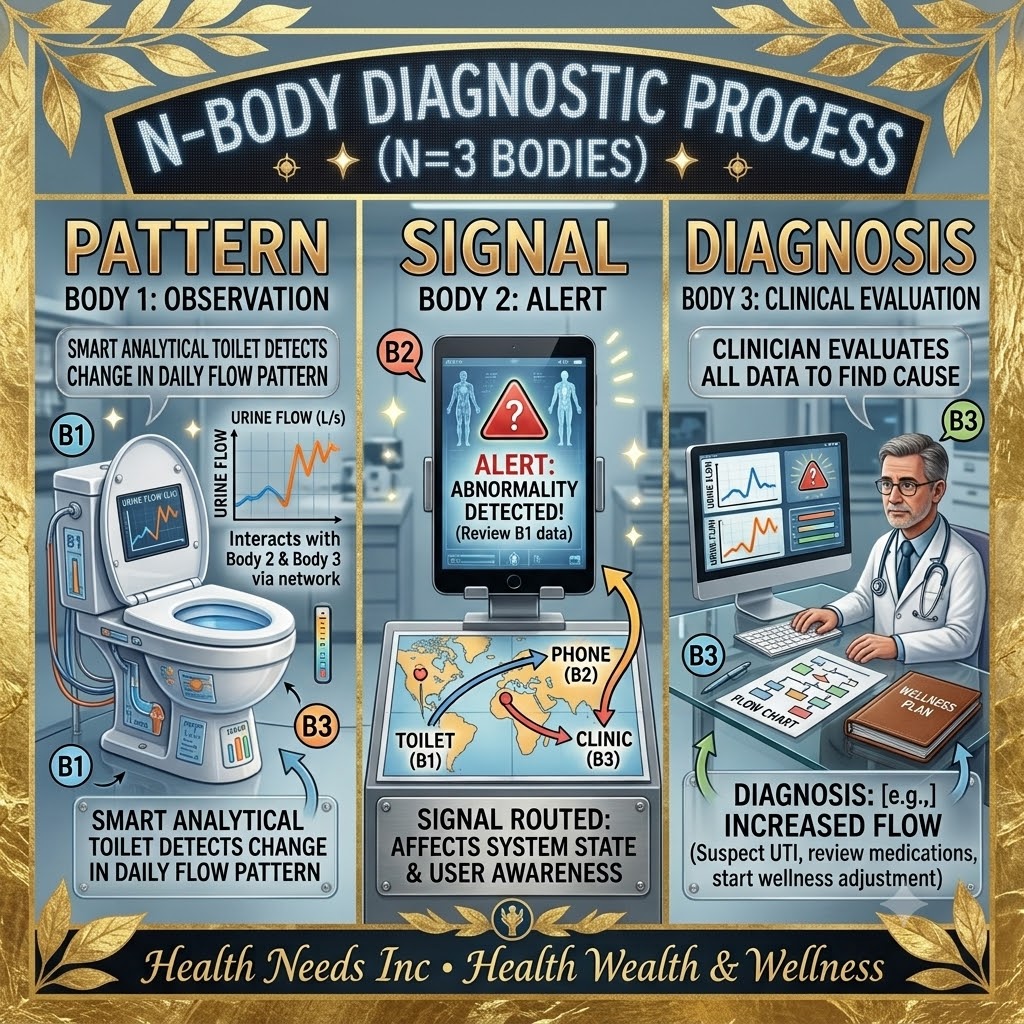
Smart-toilet research did not begin with this product. In 2020, Stanford researchers described a “precision health” toilet that used cameras, urine strips, sensors, and algorithms to evaluate stool and urine.
The Stanford prototype examined stool form, urine flow, and molecular markers. It demonstrated why bathrooms are attractive locations for continuous monitoring: almost everyone produces samples regularly, no needle is required, and the behavior already exists.
It also showed how early the field was. The initial study involved 21 participants, and researchers emphasized future potential. A promising research platform is not evidence that every commercial feature is clinically validated for every household and toilet configuration.
The distinction matters. Optical sensors can classify visible properties. Algorithms can detect patterns. Neither fact automatically establishes how often a specific consumer device produces false positives, false negatives, misleading trends, or useful changes in care.
Before granting a gadget medical authority, ask for boring information. How was the feature validated? Against what reference test? In how many people? Across which ages, skin tones, diets, medications, toilet designs, lighting conditions, and health conditions? How often was it wrong?
Boring questions are the immune system of consumer technology.
The Smart Toilet Reality Check
Score each statement from 0 to 2: 0 = no, 1 = partly, 2 = yes. This is a decision aid, not a medical assessment.
- Useful action: I know what I would do with a hydration, bowel-pattern, or blood alert.
- Emotional fit: More body data usually helps me act calmly rather than repeatedly checking and worrying.
- Clinical boundary: I understand that the device cannot diagnose disease or replace screening.
- Privacy comfort: I have read the current data collection, retention, sharing, and deletion policies.
- Financial fit: The device price and continuing membership are comfortable, not aspirational self-care debt.
- Household fit: Everyone using the bathroom understands the device and agrees to its presence.
9–12: The device may fit your goals if the policies and limitations remain acceptable. 5–8: Pause and investigate the weak categories. 0–4: The toilet may be collecting more value from you than you are collecting from it.
A Wellness Tracker Is Not a Diagnostic Test
The most important sentence in this article is also the least glamorous: Dekoda is a consumer wellness tracker. It should not be treated as a medical diagnosis, a negative test result, or permission to ignore symptoms.
A laboratory test has defined collection methods, analytical performance, intended uses, reference standards, quality controls, and clinical interpretation. A consumer observation may still be helpful, but the evidence burden is different.
This is not pedantry. It changes the meaning of every alert and every reassuring screen.
A false positive can produce unnecessary fear, appointments, costs, and testing. A false negative can be worse because it may persuade someone that a concerning symptom is harmless. A device can also be technically accurate about what it sees while the user makes an inaccurate conclusion about what it means.
The app says hydration looks low. The person assumes the problem is simple dehydration. The actual issue might involve medication, vomiting, diarrhea, fever, kidney function, or something else entirely.
The device says no blood was detected. The person assumes colorectal screening can wait. That conclusion would be unsupported.
The practical boundary is simple: use a trend as information to notice or discuss. Do not use it to overrule symptoms, screening recommendations, or professional evaluation.
Blood Alerts Are Important and Ambiguous
Blood in stool or urine can have many possible causes. Some are relatively common and treatable. Others require prompt evaluation.
The NIDDK guidance on gastrointestinal bleeding notes that acute bleeding may appear as black or tarry stool or as dark or bright red blood mixed with stool. Symptoms such as fainting, dizziness, weakness, shortness of breath, or abdominal pain can increase the urgency.
Blood alerts are therefore the feature most likely to sound medically consequential and the feature most in need of careful language. The sensor cannot reliably tell the user why blood may be present. Hemorrhoids, inflammation, infection, medication, menstrual contamination, urinary causes, polyps, cancer, and other conditions can enter the differential.
It also does not replace colorectal-cancer screening. Screening programs use validated tests such as fecal immunochemical tests, stool DNA tests, and colonoscopy according to age, risk, and clinical guidance.
A smart toilet alert may say, “Something deserves attention.” It cannot say, “This is harmless,” “This is cancer,” or “Your screening is complete.”
Bathroom Data May Be the Most Intimate Data You Generate
Kohler says Dekoda uses fingerprint authentication, downward-facing sensors, and encryption. Those are meaningful design choices.
They are not the entire privacy question.
The device may create a longitudinal record of bowel frequency, stool form, hydration patterns, possible blood, tagged medications, food, travel, and activity. Over time, the dataset could suggest illness, pregnancy-related changes, medication use, stress, alcohol patterns, travel, or when someone is home.
Consumers should not assume that every wellness app is protected in the same way as information held by a physician or health plan. HIPAA applies to specified covered entities and business associates. It is not a magic force field surrounding anything vaguely medical.
Questions to Read Before the Privacy Policy Reads You
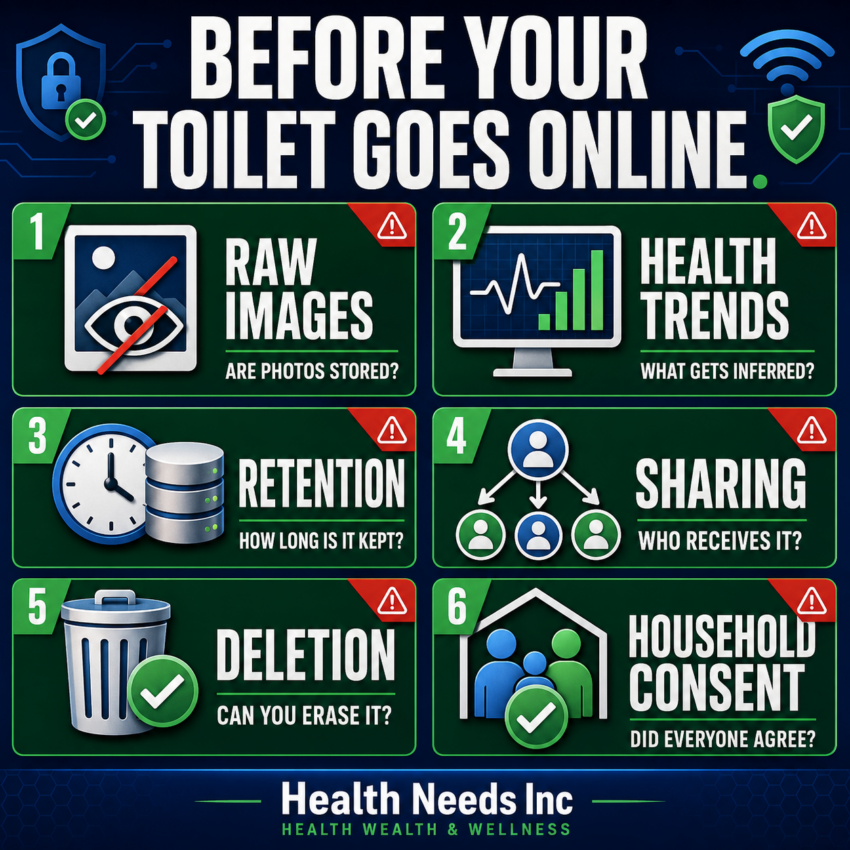
- What raw images, measurements, identifiers, and lifestyle tags are stored?
- Are images retained, transformed, or deleted after analysis?
- Where is the data processed and for how long is it retained?
- Is de-identified or aggregated information shared with partners or used to train models?
- Can users download and permanently delete their information?
- What happens to stored data if the company, product, or account is sold?
- Can every household member decline participation without losing ordinary bathroom access?
Consent also becomes peculiar in a shared bathroom. The purchaser may love quantified digestion. A partner, guest, teenager, caregiver, or child may not wish to conduct a biometric check-in before using the toilet.
Fingerprint authentication limits accidental attribution, but the presence of a sensor still deserves a household conversation. Privacy is not merely a technical property. It is a social agreement among the people standing near the plumbing.
When More Health Data Becomes More Health Anxiety
For some people, objective tracking reduces uncertainty. A record can reveal whether a suspected problem is persistent, occasional, improving, or connected to a specific change.
For others, tracking creates a new ritual of surveillance. Every variation becomes a clue. Every app notification becomes a referendum on whether the body is behaving correctly.
Stool naturally varies. Diet changes. Travel changes routines. Medication changes digestion. A stressful week can reorganize the gastrointestinal department without submitting paperwork.
Continuous monitoring can make normal biological variation feel like failure. This is already visible in sleep tracking, where a person can wake feeling rested, inspect a disappointing score, and retroactively decide the night was terrible.
The same phenomenon could migrate to the bathroom. One imperfect bowel movement becomes a trend. A trend becomes a fear. The fear buys a supplement subscription advertised by someone standing beside a houseplant.
A good health tool should reduce confusion and improve action. If it causes compulsive checking, repeated reassurance seeking, food restriction, or persistent fear, the data may be imposing a larger health cost than the device reports.
The Price Is $599, Plus the Cost of Remaining Curious
Dekoda launched at $599, and the system requires a paid membership. Reported launch pricing started at $6.99 per month or $70 per year for an individual, with a higher family plan.
Prices and plans can change, so buyers should confirm the current terms directly. More important, they should calculate the multi-year cost rather than staring only at the purchase price.
At $599 plus several years of membership, this is not an impulse purchase for most households. The value depends on whether the information changes a useful behavior, prompts appropriate care, supports a known monitoring need, or merely produces attractive graphs about activities that were previously free to observe.
Compare the expense with alternatives:
- Looking at stool and urine before flushing.
- Keeping a brief symptom or bowel diary during a specific concern.
- Using a simple Bristol stool chart for consistency descriptions.
- Completing recommended preventive screening.
- Discussing persistent changes with a qualified healthcare professional.
- Spending the same money on food, movement, medication access, or care that addresses an identified need.
The cheapest option is not automatically best. Neither is the option with the best app typography.
This is a recurring theme in wellness assessments: measurement earns its place only when the result is valid, interpretable, and connected to a reasonable next step.
Who Might Actually Benefit From a Smart Toilet?
The strongest use case is not universal optimization. It is low-friction observation for someone who has a clear reason to track a pattern and understands the limits.
Potentially interested users may include people who struggle to keep a symptom diary, households trying to notice changes over time, older adults who want passive tracking, or people working with a healthcare professional who finds a longitudinal record useful.
Even then, the clinician may prefer validated measurements or a conventional record. Ask before assuming the app’s dashboard will become medically useful evidence.
Smart toilet technology may ultimately prove especially valuable in assisted living and caregiving, where sudden changes in urine output, diarrhea, constipation, or bleeding can matter and may otherwise go unnoticed. That setting also raises serious questions about consent, dignity, staff response, and false alerts.
The weakest use case is healthy people purchasing surveillance because wellness marketing convinced them that unmeasured digestion is negligent. A body does not become healthier merely because its ordinary functions have analytics.
Eight Questions to Ask Before Buying
- What exact decision will this information improve? “I like data” is a preference, not a health outcome.
- What has been independently validated? Look for studies of the specific product and feature, not research showing that stool matters in general.
- What are the false-positive and false-negative rates? If those numbers are unavailable, uncertainty belongs in the buying decision.
- What does the app tell you to do after an alert? Advice should be proportionate and should never imply diagnosis.
- Does the device work with your toilet? Kohler notes compatibility limits, including problems with some dark-colored bowls.
- What happens without a membership? Understand which functions stop and whether historical data remains accessible.
- Can you delete the data and account? Read the current policy, not a screenshot from launch week.
- Will the device calm attention or recruit it? Know your relationship with health metrics before installing one beneath the seat.
These questions are not anti-technology. They are what respect for technology looks like after the launch video ends.
The Toilet May Become a Serious Health Platform
The long-term promise of smart toilets is considerable. Urine and stool offer repeated, noninvasive samples. Automated systems might one day track validated biomarkers, medication effects, infection, kidney function, metabolic changes, bleeding, or treatment response.
The bathroom also solves a problem that defeats many wearables: adherence. People forget to charge watches and abandon food logs. They rarely abandon toilets.
Still, a future clinical platform will require more than better cameras. It will require transparent validation, standardized performance, medical integration, accessible design, careful alert thresholds, strong privacy law, and a humane plan for what happens when the machine sees something.
Data without interpretation is trivia. Interpretation without evidence is marketing. Evidence without access to follow-up care can become a very expensive way to worry alone.
The field will likely divide into two paths. Wellness products will offer patterns, coaching, and habit nudges. Medical devices will pursue regulated claims, validated biomarkers, and clinical decision support.
Consumers need to know which path they are purchasing. The casing may look equally futuristic. The evidentiary plumbing underneath will not be the same.
Wellness without the surveillance theater.
Get skeptical, evidence-aware reporting on health technology, ordinary habits, and products that would like permanent residency in your bathroom.
Final Thoughts: The Bathroom Is Listening, but Should We?
Dekoda is neither ridiculous nor revolutionary. It is an early consumer product built around a sensible scientific premise and a very intimate stream of data.
It may help some people notice patterns they would otherwise miss. A possible blood alert could prompt appropriate attention. Passive tracking may be easier and more accurate than memory.
It can also create false reassurance, false alarms, subscription fatigue, health anxiety, and a durable record of bodily information that deserves unusually careful protection.
The right verdict is conditional. Buy it only if the information answers a defined question, the cost is comfortable, the household consents, the current privacy terms are acceptable, and you can hold the results lightly enough to seek proper care when needed.
Do not buy it because a dashboard makes ordinary biology look neglected.
For most people, the fundamentals remain scandalously low-tech: notice persistent changes, eat enough fiber, drink appropriately, move regularly, complete recommended screening, and talk with a qualified professional when symptoms are concerning. This broader view belongs inside physical wellness that makes life more livable, not a contest to see which room can collect the most data.
The toilet spent centuries as a silent witness. Now it can produce charts.
Whether that represents progress depends less on what the bathroom learns than on whether the information helps the person standing in it make a wiser decision.
FAQs About Toilet Scanning Devices
Dekoda is a consumer wellness tracker that attaches to the rim of a compatible toilet. It uses downward-facing optical sensors to observe stool and urine patterns, then reports hydration, digestive, and possible blood-related insights through the Kohler Health app. The device requires an authenticated session and a paid membership.
Kohler says the sensors are angled downward and can see only inside the toilet bowl. Sessions are started through fingerprint authentication or the app. Buyers should still read the current privacy documentation to understand what images or derived data are retained, processed, shared, and deleted.
No. A consumer smart toilet is not a colorectal-cancer diagnosis and does not replace recommended screening. Blood or persistent bowel changes can have many causes and should be evaluated appropriately. A negative app result should not be used to ignore symptoms or postpone validated screening.
Treat the alert as a reason to pay attention, not a diagnosis. Contact a qualified healthcare professional for guidance, particularly if bleeding recurs or appears with black or tarry stool, pain, weakness, dizziness, fainting, shortness of breath, or other concerning symptoms. Seek urgent care when symptoms are severe.
It can report hydration trends based on its sensor observations, but hydration cannot always be reduced to one image or color. Fluid intake, diet, supplements, medications, illness, and kidney function may affect urine. Symptoms and clinical context matter, especially when dehydration may be severe.
Dekoda launched at $599, plus a required app membership. Reported introductory membership pricing began at $6.99 monthly or $70 annually for one person, with a family option available. Confirm current prices, features, compatibility, cancellation terms, and data access directly before purchasing.
Do not assume that information in a consumer wellness app receives the same protections as records held by a HIPAA-covered healthcare provider or health plan. Privacy obligations depend on the company, service, data flow, and applicable law. Read the current policy for collection, sharing, retention, security, access, and deletion terms.